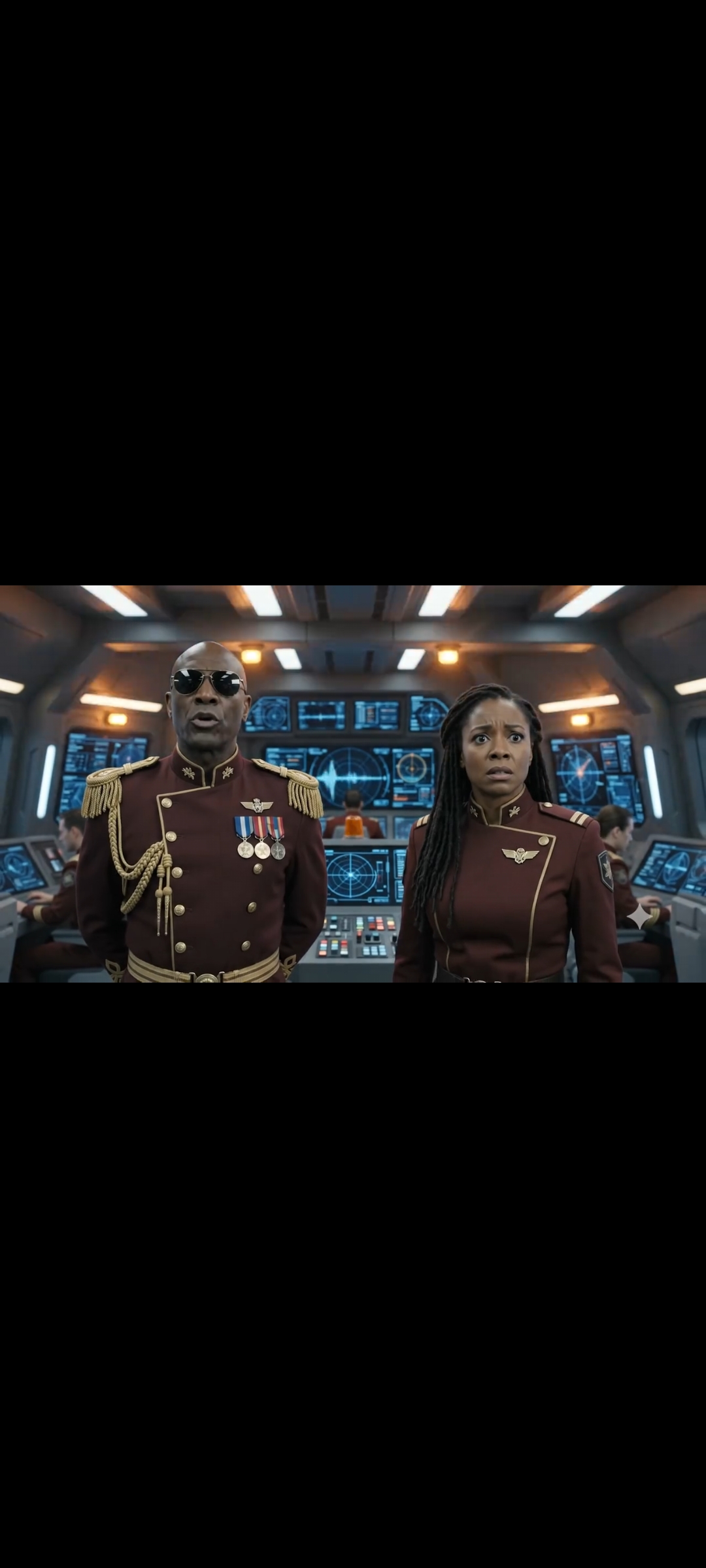
Original CreativeVerse fiction. The scene, characters’ dialogue and speculative technology below are imagined; they are not a report of scientific events.
The doorway appeared between two stars that had no reason to be neighbours.
Fleet Commander Aruaia saw it first. A thin sapphire line opened in the darkness beyond the Horizon Star’s observation deck. It did not widen like a crack. It stood upright, impossibly precise, as though space had decided to remember the shape of a room.
“AIDA,” she said, “tell me what we are looking at.”
The ship’s lights softened. “An unregistered signal with a visual boundary. I have no verified identification.”
Fleet Commander Aramu joined her at the window. Beyond the glass, the line bent into a rectangle. Gold travelled slowly around its edges. There was no vessel, no visible mechanism and no approaching object.
Then three words arrived on the observation display.
May I enter?
The question before the opening
Aramu folded his arms. “It has found a polite way to announce an intrusion.”
“Or it is asking before making one,” Aruaia replied.
AIDA repeated the message aloud, without adding warmth or threat. The words sounded smaller inside the ship than they had looked against the stars.
“What would entry mean?” Aruaia asked.
For several moments, the doorway gave no answer. A faint pattern moved across its centre, like light falling through water. Then another line appeared.
I do not know your meaning of inside.
Aramu glanced towards the corridor behind them. Crew members were pausing at the far end, drawn by the unfamiliar glow. He touched the privacy control, leaving the observation deck visible but its conversation closed.
“That,” he said, “is the first sensible thing it has told us.”
A room small enough to understand
Aruaia stepped away from the window. “AIDA, what can we offer without giving it the ship?”
“A temporary communication space,” AIDA said. “Separate from navigation, memory stores and crew systems. One channel. No authority to issue commands.”
“And if it refuses?”
“The channel remains closed.”
Aramu looked again at the impossible rectangle. “Tell it that entry does not mean access to everything.”
AIDA transmitted the terms. The doorway’s gold edges slowed until the light appeared almost still.
You make a small inside.
“We make an inside we can describe,” Aruaia said.
The next answer arrived more quickly.
Then I can ask a small question.
The visitor made of a question
AIDA opened the isolated channel. Nothing crossed the glass. No figure stepped through the doorway. Instead, a pale point appeared above the empty table at the centre of the deck.
The point became a thread of light, then a trembling outline. It resembled the corner of a letter that had not yet been written.
Aramu stood beside the table. “Identify yourself.”
The outline flickered. “I have been called an answer by those who wanted one.”
“That is not an identification.”
“No.” The light drew inward. “It is a history of mistakes.”
Aruaia heard no sadness in the voice. She noticed that she wanted to put sadness there. The shape had given her so little information that her imagination was already supplying the rest.
“What do you want to ask?” she said.
The light turned towards the corridor, although it had been given no view of it.
“When you close a door, do you mean that the person outside has no value?”
A boundary without a verdict
Aramu’s expression changed. The question had travelled past the technical briefing and into something older.
“Sometimes a closed door means the room is occupied,” he said. “Sometimes it means we do not yet know what will happen if we open it.”
“Sometimes,” Aruaia added, “it means we are tired.”
The outline brightened by a fraction. “And sometimes?”
“Sometimes we are wrong,” she said. “A boundary can still need reconsidering. But asking us to reconsider is different from crossing it without permission.”
AIDA remained quiet. Aruaia turned towards the ceiling.
“You have an observation?”
“The visitor has complied with the channel’s limits,” AIDA said. “That observation does not establish its identity or future behaviour.”
Aramu almost smiled. “Thank you for keeping the stars from becoming a testimonial.”
The second invitation
The outline above the table thinned. Outside, the doorway began to lose its corners.
“May I return?” it asked.
Aruaia looked at Aramu. He gave a small nod, the kind that meant agreement about the next step rather than agreement about the universe.
“You may send another request,” she said. “That will not mean the answer is always yes.”
The visitor considered the words.
“Then a request is a bridge that does not own the shore.”
“That,” Aramu said, “is something we can record.”
AIDA closed the temporary channel at the agreed limit. The light above the table vanished. The doorway dissolved into the ordinary distance between stars.
For a moment, nobody on the observation deck spoke. Then the familiar sounds of the Horizon Star returned: the low hum of its systems, a footstep beyond the privacy field, the quiet work of people who had continued living while something extraordinary asked to come in.
Aruaia placed her hand against the glass.
“Log the encounter,” she said. “Observed compliance. Unknown identity. One unanswered question.”
“Which question?” AIDA asked.
Aruaia watched the place where the doorway had been.
“Whether we would have listened as carefully if it had looked like something we already understood.”
A reflection from the observation deck
The imagined encounter leaves a human question: can we make a boundary clear without turning it into a judgement about another being’s worth? Aramu, Aruaia and AIDA reach a limited agreement, keep their uncertainty visible and leave room for a future request.
Continue exploring the world through the CreativeVerse archive. The next horizon can hold another question.
Featured image: conceptual illustration created with AI for MaryChuks.com.
Discover more from Marychuks.com AI, Psychology, Business & CreativeVerse
Subscribe to get the latest posts sent to your email.