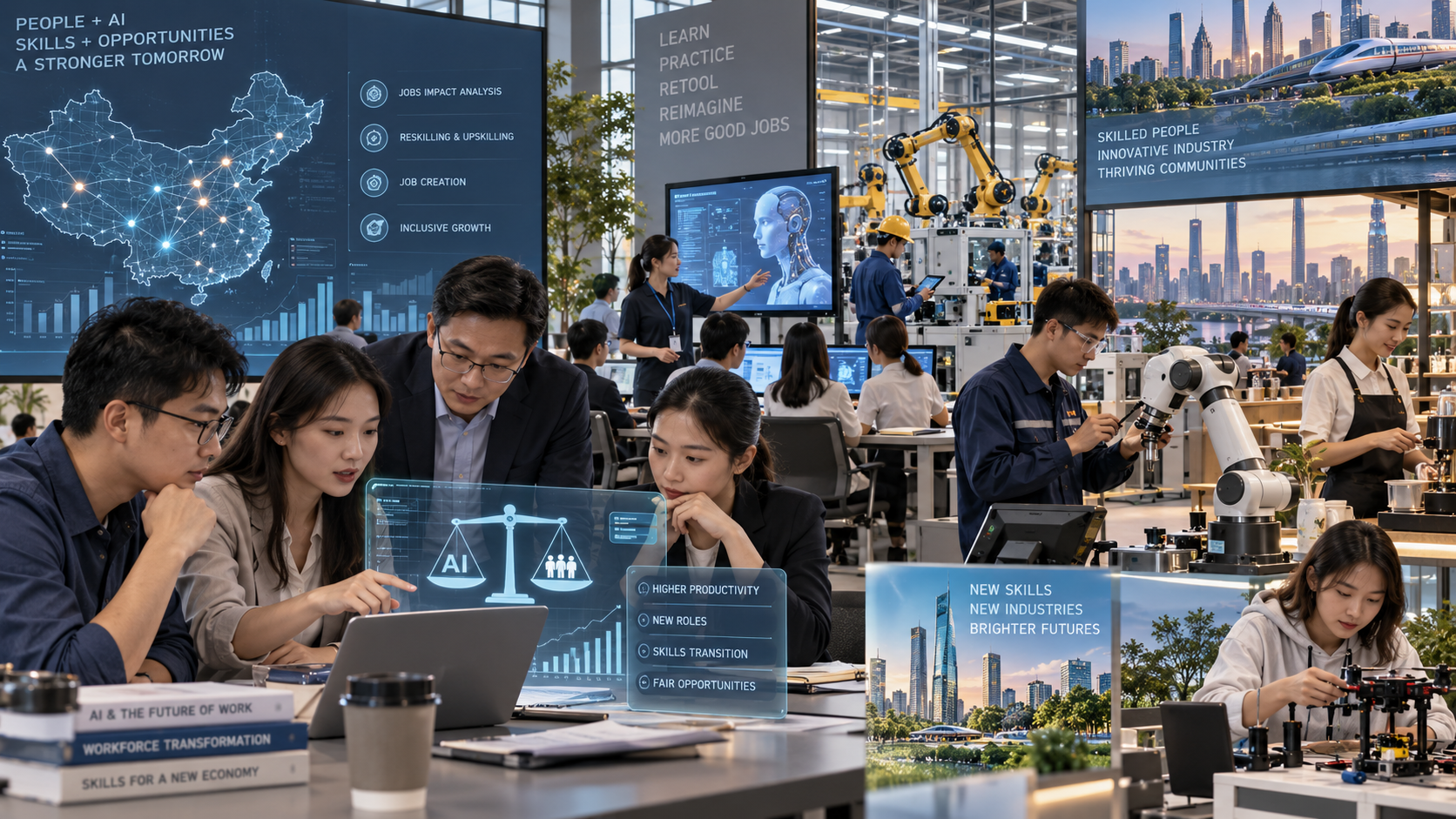

The most dangerous time to measure technological disruption is after people have already lost their routes into work. China’s 2026–2030 employment planning signals a different approach: monitor how artificial intelligence creates and destroys jobs, build early-warning capacity and connect the findings to training and job-creation policy.
China is simultaneously accelerating AI through its wider “AI+” strategy. That creates a tension shared by every major economy. AI can raise productivity, support ageing workforces and create new industries. It can also compress entry-level roles, reduce routine hiring and shift bargaining power before education systems have adapted.
Measurement is the first form of preparedness
An employment-impact system can look beyond headline unemployment. It can track which tasks are disappearing, which occupations are changing, where wages are weakening and which new roles remain inaccessible because training is missing.
- Job destruction: roles eliminated or hiring that quietly stops.
- Task transformation: jobs that remain but demand different skills and responsibilities.
- Job creation: new occupations in model operations, robotics, data, safety, integration and human services.
- Distribution: which regions, ages and education groups gain or lose.
- Transition time: how long displaced workers take to reach stable new employment.
The distinction between layoffs and reduced hiring matters. A company can automate work without announcing mass redundancies by allowing vacancies to disappear, cutting contractors or asking fewer people to produce more. Traditional statistics may register that change slowly.
Why early-warning systems matter
If a customer-service sector begins reducing junior recruitment, government and employers should not wait until thousands of people discover that their qualifications lead to a shrinking doorway. Training funds, apprenticeships and career guidance can move earlier.
Early warning must not become surveillance without protection. Data collection should be proportionate, secure and governed. Workers should know how algorithmic assessments influence hiring, performance and redundancy decisions. Measurement is valuable only when it increases human agency.
Training must follow real work
Generic calls to “learn AI” are not enough. A useful programme begins with the actual job. Which tasks can a tool accelerate? Which errors require professional judgement? What new responsibility does the worker inherit when an automated system produces the first draft?
The OECD’s work on AI and employment emphasises both productivity opportunity and displacement risk. PwC’s 2026 AI Jobs Barometer similarly argues that skills are changing fastest in AI-exposed work and that empathy, judgement and creativity become more important as routine tasks shift. These findings support a practical principle: reskilling should combine technical fluency with human expertise.
Protect the entry-level ladder
One of the biggest risks is not the disappearance of all work; it is the removal of the first rung. Junior employees learn by performing bounded tasks, observing experienced colleagues and gradually handling ambiguity. If AI absorbs the bounded tasks, organisations must create a new learning architecture.
- Redesign apprenticeships around supervised AI-assisted work rather than pretending old tasks will remain unchanged.
- Measure skill progression so junior workers can demonstrate judgement, not merely tool use.
- Preserve mentoring time instead of treating every efficiency gain as headcount reduction.
- Audit algorithmic management for unfair targets, hidden bias and unsafe pressure.
- Share productivity gains through better work, pay, training and new services—not only cost cutting.
What other countries and companies should learn
China’s approach is not automatically a model to copy in every detail. Different labour laws, institutions and data rights matter. The valuable principle is anticipatory governance: innovation policy and employment policy should be designed together.
Companies can apply the same discipline internally. Before deploying an agent, map the affected tasks, identify the people who will absorb verification work, define new skills and create a transition plan. Human oversight is not meaningful if the human role is underfunded or eliminated.
The future of work should not be discovered only through redundancy notices. It should be measured while choices still exist.
This connects with my wider exploration of one intelligence and many cultural recipes. AI may be global, but employment systems are local. Each society must decide how capability becomes shared opportunity.
Prepare for work shaped by AI
Sources and date note
This article reflects information available on 5 September 2026. Read The Next Web’s analysis of China’s employment blueprint, OECD guidance on AI and work and PwC’s 2026 AI Jobs Barometer.
Discover more from Marychuks.com AI, Psychology, Business & CreativeVerse
Subscribe to get the latest posts sent to your email.