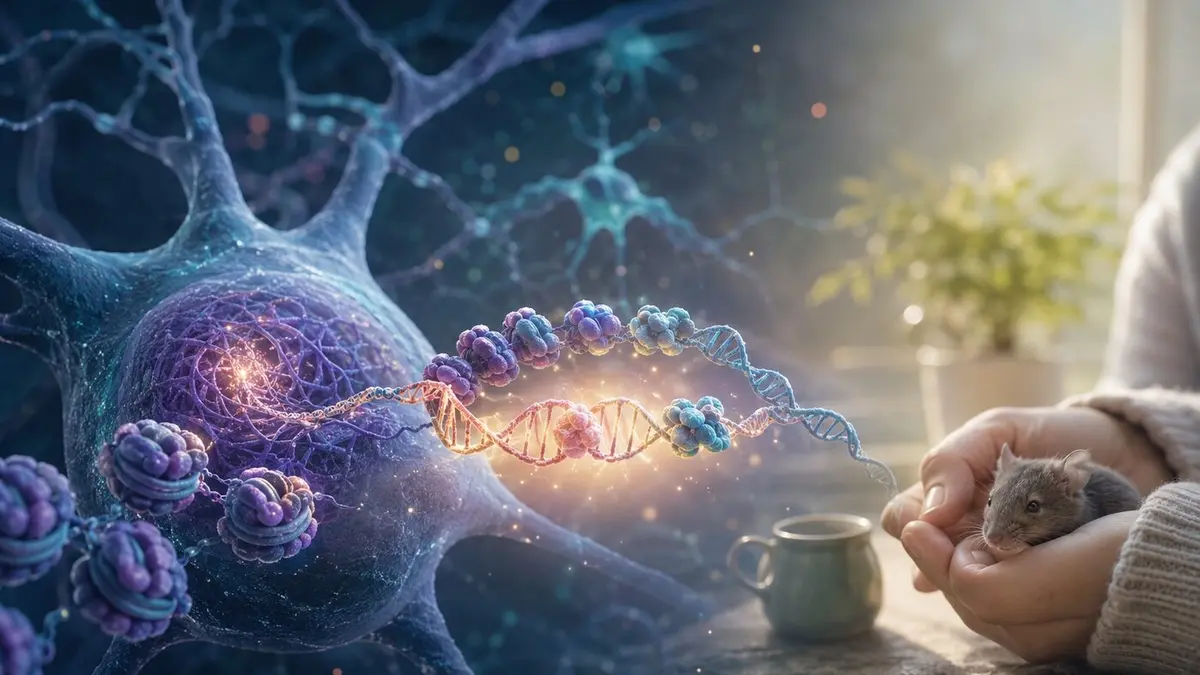
Severe stress early in life may leave a lasting biological mark by changing how DNA is packaged inside particular brain cells, according to research that helps explain why early adversity can increase sensitivity to stress later.
The phrase “molecular scar” is powerful, but it needs careful interpretation. The study was conducted in mice. It does not prove that every traumatised child develops a permanent brain change, and it does not provide a diagnostic test or established treatment for people.
Researchers from Washington University School of Medicine and Princeton University found that early-life stress altered an epigenetic marker in a reward- and stress-related brain region. The work was published in Neuron and explained for a wider audience by WashU Medicine.
What does DNA packaging mean?
DNA is not stored as a loose thread inside a cell. It is wrapped around proteins and organised into chromatin. When particular regions become more open, the genes in those regions may be easier for the cell to activate.
The researchers found that early stress changed this regulatory landscape in a way that primed a stronger molecular, neural and behavioural response when the animals encountered stress later.
This is an example of an epigenetic mechanism: experience affects how genes are regulated without rewriting the underlying DNA sequence.
Why the finding matters
Psychology has long recognised that early adversity can affect later mental health. The new work offers a possible biological pathway connecting an early environment with adult stress sensitivity.
- It helps move the conversation beyond the false choice between “psychological” and “biological.”
- It shows that experience can become embedded in brain regulation.
- It identifies a specific mechanism that future studies can test.
- It may eventually contribute to more targeted prevention or treatment research.
What the study does not prove
Mouse stress models cannot reproduce the full complexity of human childhood trauma, family relationships, language, culture or resilience. Human brains develop over a much longer period, and people differ in genetics, support, meaning-making and later experience.
The word “scar” should also not be confused with destiny. A biological trace can be modifiable. In the study, targeting the relevant epigenetic process prevented some later effects in mice. That is scientifically encouraging, but it is not permission to apply an experimental intervention to people.
The psychology of hope without hype
Trauma research must hold two truths together. Early adversity can have profound and lasting effects, and human outcomes are not mechanically predetermined. Supportive relationships, therapy, safety, community and later opportunities can all contribute to resilience.
The MaryChuks.com perspective
The most humane interpretation is not “trauma permanently damages the brain.” It is that experience can enter biology—and therefore early protection, responsive care and serious mental-health support matter.
This study gives researchers a promising mechanism to investigate. For families and practitioners, the responsible message remains grounded: take childhood adversity seriously, avoid biological fatalism and never turn an animal finding into a promise of human treatment before the evidence exists.
This article is educational and does not provide medical diagnosis or treatment advice.
Discover more from Marychuks.com AI, Psychology, Business & CreativeVerse
Subscribe to get the latest posts sent to your email.