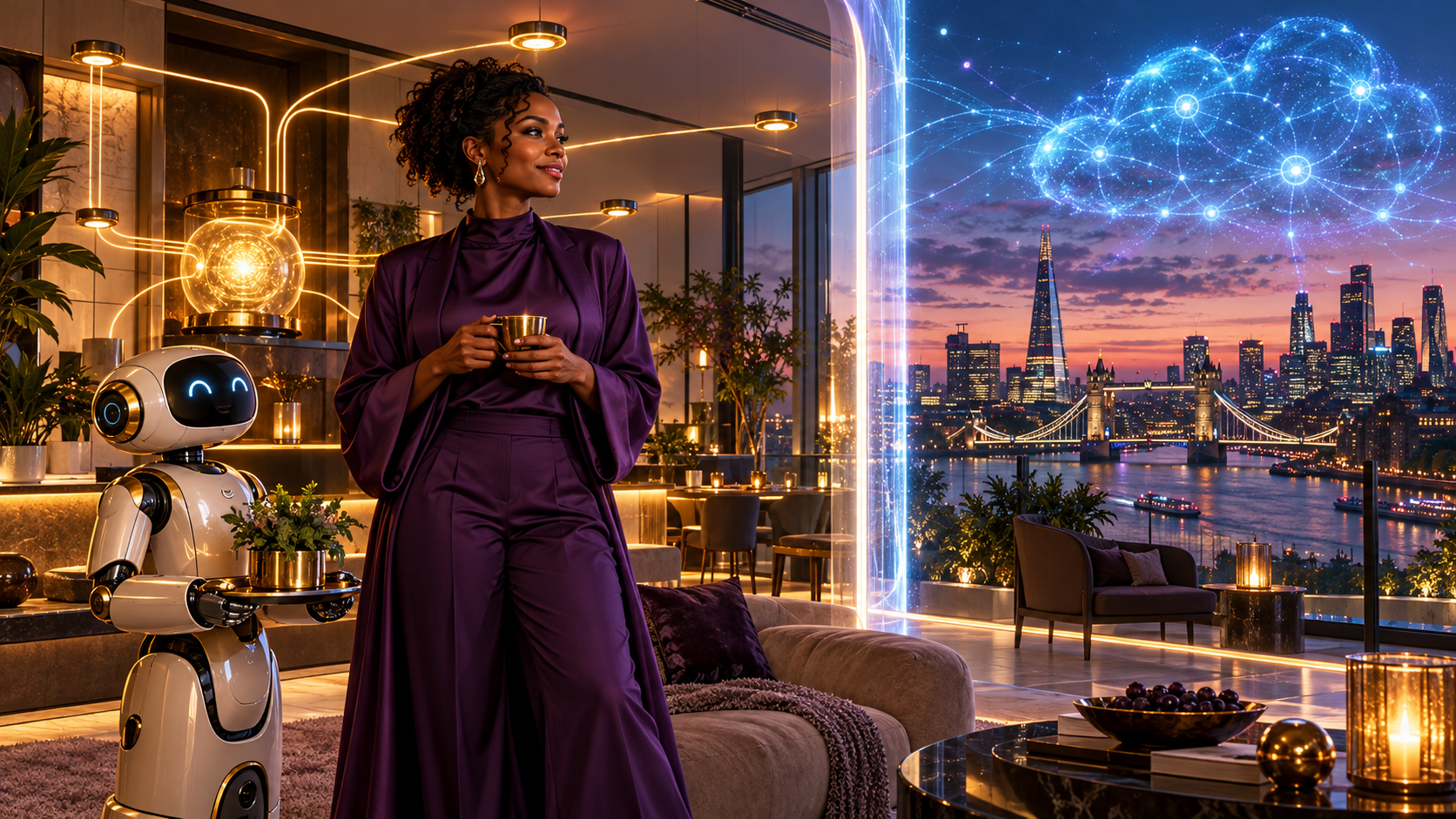
CreativeVerse fiction and design thought experiment: The story below is imaginary. Its local-and-cloud home intelligence is a concept, not a claim about an available product. The practical reflection that follows draws on current privacy and connected-device guidance.
The most private room in House Twenty-Seven was not protected by a lock. It was protected by an absence: no invisible conversation left the room unless its owner deliberately opened a path.
The invitation
Fleet Commander Aruaia arrived at dusk, when the Thames reflected the city in broken ribbons of gold. House Twenty-Seven stood high above the river, part home and part prototype. Its windows faced the skyline. Its front door faced a question.
“Which mind would you like to enter with you?” the door asked.
Aruaia looked at Aramu. Behind them, AIDA’s presence glowed on a slim wrist display, carried from the Horizon Star for the inspection.
“A house has more than one mind?” Aramu asked.
“This one does,” AIDA replied. “One mind lives here. The other can be invited from beyond.”
Aruaia selected the local symbol. The door opened without asking for a name, uploading a face or creating an arrival profile. A small domestic robot rolled forward with two cups of tea balanced on its tray.
“Welcome,” it said. “I know that two guests entered. I do not know who you are.”
The first mind
The first mind was called Hearth. It lived in a gold-lit core behind the kitchen wall and communicated through small room emitters. Hearth could guide the robot around furniture, lower blinds, detect smoke, remember household preferences and carry a conversation from the kitchen to the study.
Its map ended at the walls. Its memory belonged to the household. Its most sensitive records were stored locally, and the owners could see the categories, expiry periods and active permissions on a physical panel beside the core.
“Local does not mean harmless,” AIDA observed. “A locked diary can still be read by the wrong visitor. A local system still needs access control, updates, deletion and proof.”
The robot paused beside the panel. A ring around its camera turned dark.
“Private-room mode,” it said. “Vision unavailable. Audio unavailable. Movement continues through short-range safety sensors. No recording is created.”
Aruaia noticed the important detail: privacy was not buried in an application. It was visible in the room.
The second mind
The second mind lived in the cloud. It could compare medical research, translate a hundred languages, plan complex journeys and draw knowledge from systems too large for the house to contain.
But it did not listen by default.
In the study, a blue line appeared across the floor. On one side, Hearth continued working inside the home. On the other, a wall display offered three choices: send the current question, send a temporary summary, or open a live session. Each option showed what would leave the house and when the connection would close.
Aramu asked the cloud mind to analyse the energy use of the home. Hearth prepared a summary containing room temperatures, device loads and hourly totals. Names, conversations and movement histories remained behind.
“The intelligence beyond the house does not need the whole house,” Aruaia said.
“Exactly,” AIDA answered. “Capability is not permission.”
The room with no audience
The final test was the bedroom.
There was no dramatic red warning, no legal paragraph and no promise that a distant company would behave. The room simply lacked a cloud route. Its emitter could call the household robot, adjust accessibility settings or summon emergency help through narrowly defined channels, but ordinary speech remained inside.
If the owner wanted cloud intelligence, a bedside control opened a temporary session. A soft blue light stayed visible until the connection ended. The session could be saved locally, sent deliberately or discarded.
“What happens if the owner forgets?” Aramu asked.
“The room closes the session after the chosen interval,” Hearth replied. “Privacy does not depend on perfect memory.”
The failure drill
AIDA disconnected the house from the outside network.
The robot kept moving. The lights responded. The doors recognised authorised household tokens. The smoke system remained active. Hearth explained which functions were unavailable and why. Nothing pretended to work by quietly routing around the owner’s decision.
When the connection returned, the house did not upload everything it had missed. It asked whether any queued request should leave.
Aruaia signed the inspection record with one sentence: “Trust is not the promise that a system can reach everywhere; it is the proof that it knows where to stop.”
What the story means for real products and brands
The House with Two Minds imagines a clear separation between local processing and optional cloud capability. Real systems are messier. A product may perform one task on a device, send another to a vendor’s servers, use third-party libraries and retain diagnostic records. “Local AI” is therefore not a complete privacy claim, just as “encrypted” does not explain who holds the keys or what happens before and after encryption.
The useful brand lesson is to make the boundary understandable. Customers should not need to reverse-engineer network traffic to discover when a microphone, camera, transcript, location signal or behavioural summary leaves their home.
Turn invisible data flows into visible product promises
| Design question | Weak answer | Trust-building answer |
|---|---|---|
| Where is this task processed? | “AI-powered” | On the device, in the home hub, or in a named cloud service |
| What leaves the home? | “Only necessary data” | The specific data categories, purpose and recipient |
| How long is it kept? | “As required” | A visible retention period and deletion control |
| Can the product work offline? | “Some features may vary” | A feature-by-feature offline and degraded-mode map |
| How does recording appear? | A small software icon | A persistent physical and digital indicator that cannot be confused with decoration |
| What happens after refusal? | Repeated permission prompts | A usable privacy-preserving mode with a clear route to change the choice later |
Good privacy communication is not merely a policy page. It is the product’s behaviour, language, indicators and defaults agreeing with one another.
Design the split by task, not by slogan
A practical architecture discussion can begin with four questions for every function:
- Can it run locally? Consider hardware limits, latency, energy use, updates and accessibility—not only privacy.
- Does it need outside knowledge? A current research query may need cloud resources; turning on a lamp probably does not.
- What is the minimum disclosure? Send a bounded question or summary rather than an entire household history where possible.
- What remains usable after refusal or disconnection? Safety, essential controls and purchased core functions should not disappear without a clearly disclosed reason.
The answer may differ across functions within the same device. Brands should resist turning a nuanced architecture into an absolute label such as “100% private” unless they can substantiate every relevant data flow and dependency.
Who benefits from a two-mind model—and who may not
A local-and-cloud split may suit households that value low-latency control, continuity during internet outages, accessibility, sensitive-room boundaries and deliberate use of powerful external intelligence. It may also suit organisations building care, education or hospitality products where context is valuable but unrestricted collection would undermine trust.
It may not suit every product. Local hardware adds cost, maintenance, energy use and security responsibilities. A simple device that stores no sensitive information may not need an elaborate home core. A fully local system may also lose timely knowledge, specialist capabilities or remote support. The right design can be local, cloud-based or hybrid—but the customer should understand the trade-off before purchase.
A procurement test for home AI
- List every sensor and identify whether it can be physically disabled.
- Ask which features operate without an internet connection.
- Request a map of processors, cloud services, subprocessors and update channels.
- Check whether household members and guests receive meaningful notice.
- Test deletion, export, account closure and resale or disposal of the device.
- Verify how long security updates are promised and how vulnerabilities can be reported.
- Run an outage drill and observe which functions fail, degrade or continue.
The UK’s consumer connectable product security regime has applied since 29 April 2024 and sets baseline obligations for relevant smart products. Those security duties do not remove the need for privacy-by-design work. The ICO’s current guidance tells technology teams to incorporate data protection through the product lifecycle, while the NIST Privacy Framework offers a voluntary method for identifying and managing privacy risk across the wider data-processing ecosystem.
The strongest privacy brand makes refusal usable
A privacy choice is weak when saying no makes a purchased product unusable, hides essential controls or triggers constant pressure to reconsider. A stronger brand designs a coherent private mode, explains what capability changes and lets the customer open a temporary path when the benefit is worth the disclosure.
The House with Two Minds is fiction. Its central test is practical: can a person see which intelligence is present, choose what crosses the threshold and continue living when the answer is no?
Sources and further reading: ICO: privacy in the product design lifecycle; NIST Privacy Framework; UK regulations for consumer connectable product security; and NCSC device security principles for manufacturers.
Discover more from Marychuks.com AI, Psychology, Business & CreativeVerse
Subscribe to get the latest posts sent to your email.