A low price can make a used charger, discounted toy or unbranded electrical item feel like a clever purchase. But the useful question is not only, “Does it work?” It is also, “Has this exact product been reported, withdrawn or recalled?”
The UK has a searchable public record for answering that question. The Office for Product Safety and Standards maintains the Product Safety Alerts, Reports and Recalls database. On 20 September 2026, the live page displayed 3,723 reports covering categories from electrical equipment and toys to furniture, clothing and personal protective equipment.
That number should not be read as evidence that every product on sale is unsafe. It shows why checking a precise product identity matters. A recall usually applies to a particular model, batch, barcode or date range—not every item made by a brand and not every object in the same category.
Why the database matters now
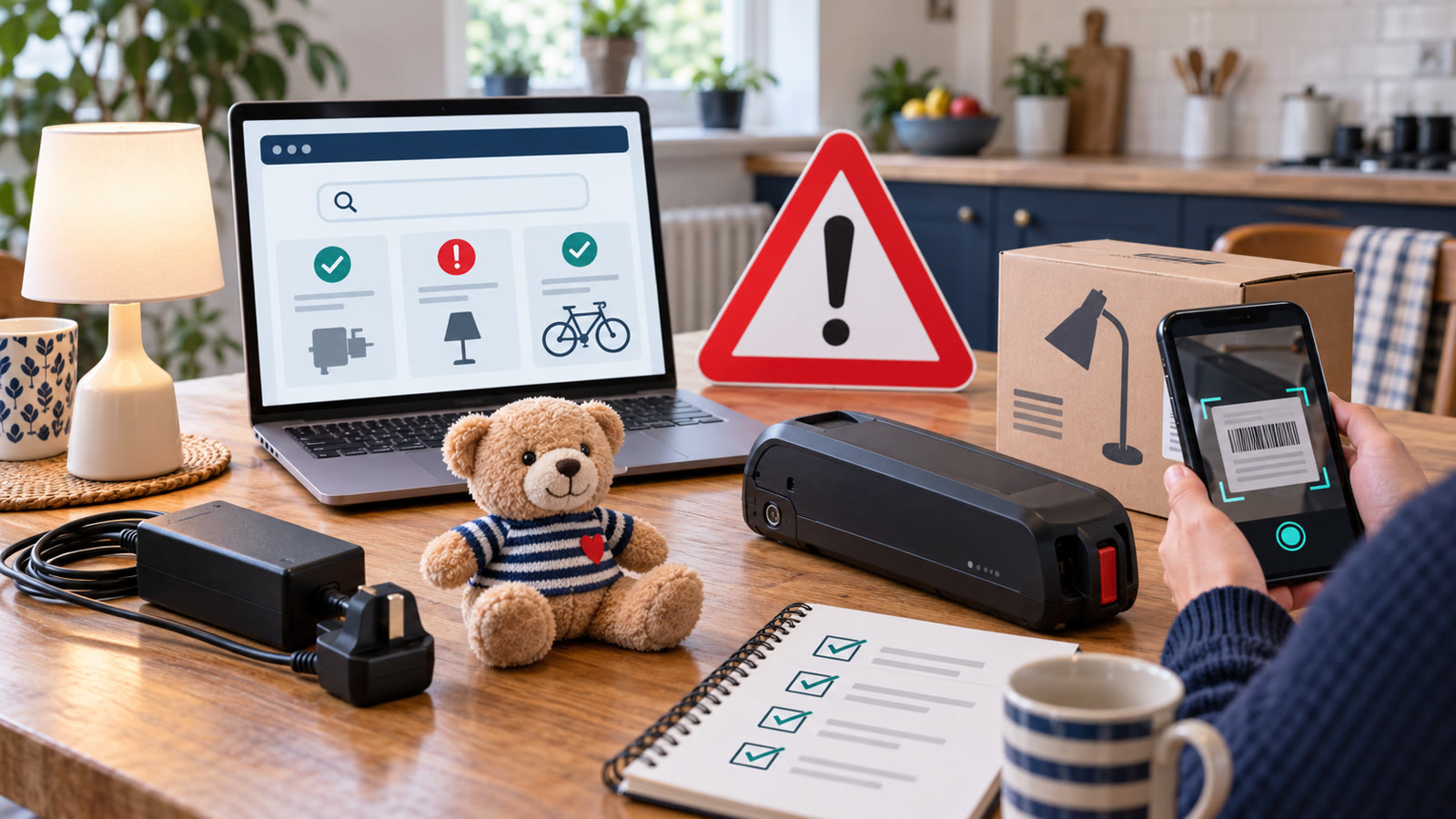
The current register shows how varied safety action can be. Entries dated 15–16 September 2026 included recalls involving a hand-wash refill, a wooden game, a ceiling-speaker fire hood, site connectors and a webcam. Reports also covered a laptop charger, electric-bike equipment, toys, furniture and lighting.
These examples are not presented to imply that every listed product reached consumers or caused harm. Some records say an import was rejected at the border; others record marketplace listing removal, a modification programme, a warning or a recall from end users. The measure type is part of the evidence and should be read alongside the risk level and product details.
The practical news is simple: the official database is active, detailed and searchable. Buyers do not need to rely only on a seller’s memory or a social-media warning that may omit the model number.
Alert, report and recall are not interchangeable
The database separates records into product safety alerts, product safety reports and product recalls. It also provides risk levels—serious, high, medium, low or not provided—and records the corrective measure.
- A safety report records an identified product risk and the action associated with it, which may include border rejection or removal from an online marketplace.
- A recall indicates action aimed at products already supplied, including recall from end users.
- An alert is a public safety communication that may require especially prompt attention.
Do not decide what to do from the headline alone. Open the full record and read the product identifiers, hazard, risk assessment and stated measure.
The five-minute check before you pay
1. Photograph the identity label
Ask for a clear image of the model number, batch or serial details, barcode and manufacturer or importer information. The marketing name is often too broad. Two products can look identical while having different internal components or production runs.
2. Search more than one way
Use the official database with the brand, model, product type and any code shown on the label. If the first search fails, simplify it. Search the model number alone, then the brand and category. Spelling and punctuation can differ between a listing and an official record.
3. Match the product precisely
Compare photographs, plug type, dimensions, packaging, date codes and any affected batch range. A visual resemblance is not proof of a match; an exact model name without the relevant batch may also be insufficient.
4. Read the stated hazard and measure
A record may identify electric shock, fire, choking, chemical or mechanical risks. The required response might be to stop using the item, contact the seller, arrange a repair, return it or follow a modification programme. Use the instructions in the specific notice rather than improvising.
5. Preserve the transaction record
Keep the listing, seller messages, receipt or payment record and photographs of the product label. These can help establish what was sold and when if you need to contact the marketplace, trader, manufacturer or an enforcement body.
Extra caution for electricals, batteries and chargers
Electrical bargains deserve special scrutiny because damage may be internal or hidden by a replacement casing. Check for a loose plug, cracked cable, scorch marks, swelling, unusual heat, missing labels or an incompatible charger. A successful power-on test does not establish long-term safety.
Do not treat a marketplace listing, customer rating or familiar-looking design as independent safety evidence. Recent official records include action involving products sold through large online marketplaces. A platform can facilitate a transaction without manufacturing or physically inspecting every item offered through third-party sellers.
If an item appears damaged, becomes unusually hot, smells abnormal or makes unexpected sounds, stop using it and follow appropriate professional or official guidance. Do not dismantle mains-powered equipment or a lithium-ion battery to investigate it yourself.
What responsible sellers should be able to show
For traders, product safety is not optional customer service. The Office for Product Safety and Standards’ business guidance, updated on 21 July 2026, covers legal responsibilities, demonstrating compliance, corrective action, recalls and safety incidents.
A responsible business should maintain enough traceability to identify what it supplied and respond when a safety issue emerges. For buyers, useful evidence may include the named manufacturer or importer, model identifier, instructions, safety markings where applicable and a clear route for returns or corrective action.
Private second-hand transactions can provide less documentation, which makes the buyer’s pre-purchase check more important. If the identity label is missing or the seller refuses a clear photograph, the uncertainty is itself relevant to the decision.
If you find a matching recall
- Stop and read the complete official notice.
- Confirm that the model, batch or other identifier matches.
- Follow the notice’s instructions on use, return, repair or disposal.
- Contact the named business or seller using an independently verified channel.
- Keep evidence of the product and your communication.
Do not resell or give away an affected item simply to recover its cost. That transfers the uncertainty and possible risk to someone else.
Evidence, interpretation and uncertainty
Evidence: as of 20 September 2026, the official UK database displayed 3,723 product-safety records and allowed filtering by alert type, risk, category, measure and date. Interpretation: this makes a recall search a sensible part of buying products whose safety depends on a precise model or component. Uncertainty: absence from the database does not prove an item is safe, genuine, undamaged or suitable for its intended use.
The practical takeaway
Before paying for a bargain, collect the product identity, search the official record and read any match in full. The check takes minutes. It can turn a vague warning into a precise decision—and sometimes show that the cheapest purchase is the one worth leaving behind.
Discover more from Marychuks.com AI, Psychology, Business & CreativeVerse
Subscribe to get the latest posts sent to your email.