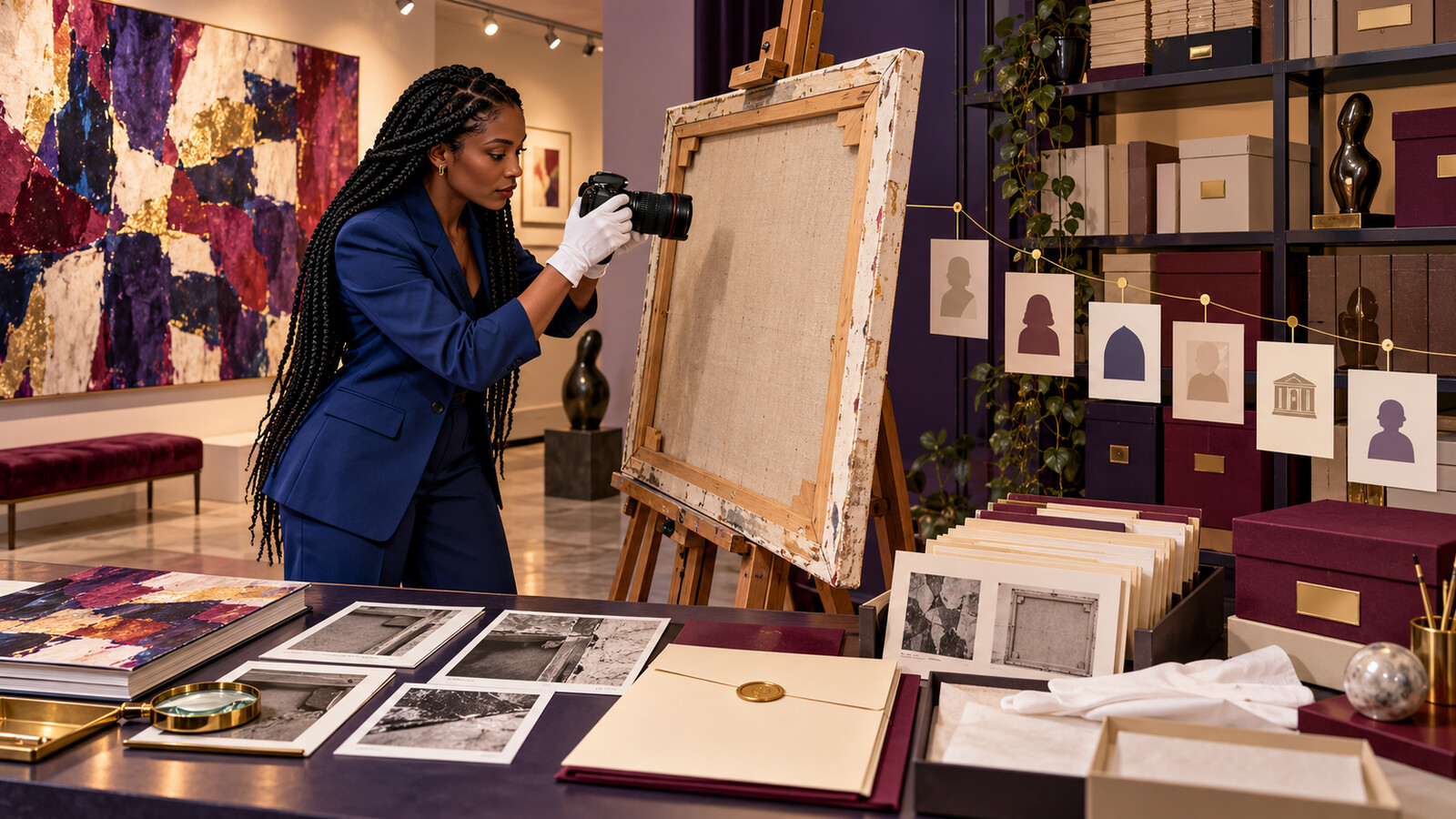
An artwork may leave the studio in perfect condition and lose half its story before it reaches its second owner.
The invoice sits in one inbox. The exhibition label is discarded. A photograph is renamed “IMG_4027”. A collector remembers buying the work in 2019, while the artist’s notebook says 2020. Years later, the object is real, visible and valuable—but the path that connects it to its maker has become difficult to prove.
That path is provenance: the documented history of an object’s ownership and whereabouts. The Getty’s cataloguing guidance defines it as the history of the people who owned a work and the places where it was located. Provenance can deepen interpretation, support responsible transactions and expose gaps that deserve further research. It is important, but it is not magical. A persuasive ownership history does not by itself prove authenticity, lawful title or authorship.
Four questions that must not be collapsed into one
Art records become misleading when several different questions are treated as synonyms:
- Provenance: where has this object been, and who possessed or owned it?
- Attribution: who is believed to have made it?
- Authenticity: is it what it claims to be?
- Title: does the seller have the legal right to transfer it?
These questions can support one another, but none automatically settles the others. A receipt proves that a transaction was recorded; it does not necessarily establish that the description on the receipt was correct. A signature may be relevant evidence, but signatures can be copied, added later or used inconsistently. Scientific analysis can clarify materials and age without reconstructing every owner.
For valuable, culturally sensitive or disputed objects, specialist legal, conservation and art-historical advice may be necessary. A home-made file is not a substitute. Its purpose is to preserve evidence before it disappears and make later expert work possible.
Start the file while the work is still in the studio
The artist has the first and best opportunity to establish the record. Give every work a stable identifier that does not depend on its title: for example, MOC-2026-017. Titles can change; identifiers should not.
Create a core object record containing:
- artist’s full professional name and relevant name variants;
- title, identifier, creation date or date range;
- medium, support, technique and edition information;
- unframed and framed dimensions, measured in a stated order;
- high-resolution images of the front, back, edges, frame and identifying marks;
- current location and owner or custodian, subject to privacy controls;
- condition notes, treatments and alterations;
- rights, licence and reproduction permissions;
- sales, gifts, loans, exhibitions and publications;
- the source and date for every entry.
Photograph the reverse even when it looks empty. Labels, stretcher marks, inscriptions, inventory numbers and frame details can later help distinguish one similar-looking work from another.
Record events, not just names
A list of owners is weaker than a timeline of documented events. For each transfer or movement, record the date or date range, parties, location, type of event, supporting evidence and confidence level.
“Private collection, London” may protect privacy, but it does not tell a future researcher whether the work was sold, inherited, gifted or loaned. Keep the confidential full record separately where appropriate, while publishing only what consent and security allow.
The Smithsonian’s guide to provenance research points researchers towards the business and personal records that reveal who owned an artwork, who placed it on the market, when and where. Useful evidence may include gallery stock books, invoices, correspondence, insurance schedules, shipping records, exhibition catalogues, auction listings, photographs and estate papers.
Build a document ladder
Not all documentation carries equal weight. Build a ladder rather than treating every scrap as proof.
- Primary transaction records: signed invoices, contracts, deeds of gift, consignment agreements and estate inventories.
- Contemporaneous supporting records: dated correspondence, shipping papers, insurance documents and installation photographs.
- Published records: catalogues raisonnés, exhibition catalogues, collection catalogues and auction records.
- Later recollection: interviews, annotations and family accounts created after the event.
- Unverified assertion: a claim repeated without an identifiable underlying source.
A later recollection can be valuable, especially when it identifies a lead, but it should not silently become a contemporary record. Preserve who said it, when and on what basis.
Write the gaps into the record
Honest provenance includes uncertainty. Use labels such as confirmed, probable, possible, disputed and unknown, and state why. “Probably acquired directly from the artist” is only useful if the record also identifies the letter, interview or circumstantial evidence supporting that probability.
Do not close a gap by copying the earliest date you find online. Titles change, names are misspelled, dimensions vary with framing and auction descriptions often repeat earlier descriptions. The Smithsonian American Art Museum’s research guidance recommends using exhibition guides, auction indexes, collection catalogues, catalogues raisonnés and archival files. Cross-checking matters because several later sources may descend from the same original error.
Due diligence is an ethical practice, not decorative paperwork
Provenance is not merely a marketing story that makes a work sound prestigious. It can reveal theft, coercive sale, colonial extraction, wartime displacement, illicit excavation or an export that may require investigation.
The International Council of Museums’ Code of Ethics treats provenance and due diligence as part of professional practice and the fight against illicit trafficking. Its accessioning standards say museums should exercise due diligence in verifying an object’s history when acquiring it.
For an artist or small collector, proportionate due diligence begins with questions: who is offering the work? How did they acquire it? Are there unexplained time periods, contradictory documents, export issues or pressure to avoid written records? If the answer creates doubt, pause the transaction and seek qualified advice. A neat folder should never be used to launder an unresolved history.
Preserve the digital file as carefully as the paper
Keep master photographs and scans unchanged. Store working copies separately. Use filenames that connect documents to the object identifier, date and event: MOC-2026-017_2026-09-12_invoice_sale-master.pdf. Maintain a simple index so another person can understand the folder without relying on your memory.
Back up the file in more than one place and test that it can be restored. Save email evidence outside a single mailbox, ideally with headers and attachments intact. If a database is used, export a non-proprietary copy periodically. Technology changes; a provenance file that cannot be opened is another gap.
What should travel with the work?
When ownership changes, supply a transfer pack containing the object record, invoice or deed, relevant certificate, condition report, current photographs, exhibition and publication history, rights statement, care instructions and an inventory of the supporting documents. Keep a record of what was transferred and when.
Do not place sensitive personal details, access credentials or an entire confidential archive inside a frame. Give the new owner a durable record and controlled access to protected material where necessary.
The file is part of the artwork’s future
A provenance file does not make an artwork better. It makes the history around it more inspectable. That protects the artist’s authorship, helps owners care for the object, gives researchers better evidence and allows uncertainty to remain visible instead of being polished into fiction.
Start with one identifier, one complete object record and one folder. Add every movement as it happens. The easiest provenance gap to resolve is the one you never allow to open.
Featured image: original conceptual AI-generated editorial illustration. It depicts no real artist, artwork, archive, gallery or ownership history and is not documentary evidence.
Discover more from Marychuks.com AI, Psychology, Business & CreativeVerse
Subscribe to get the latest posts sent to your email.