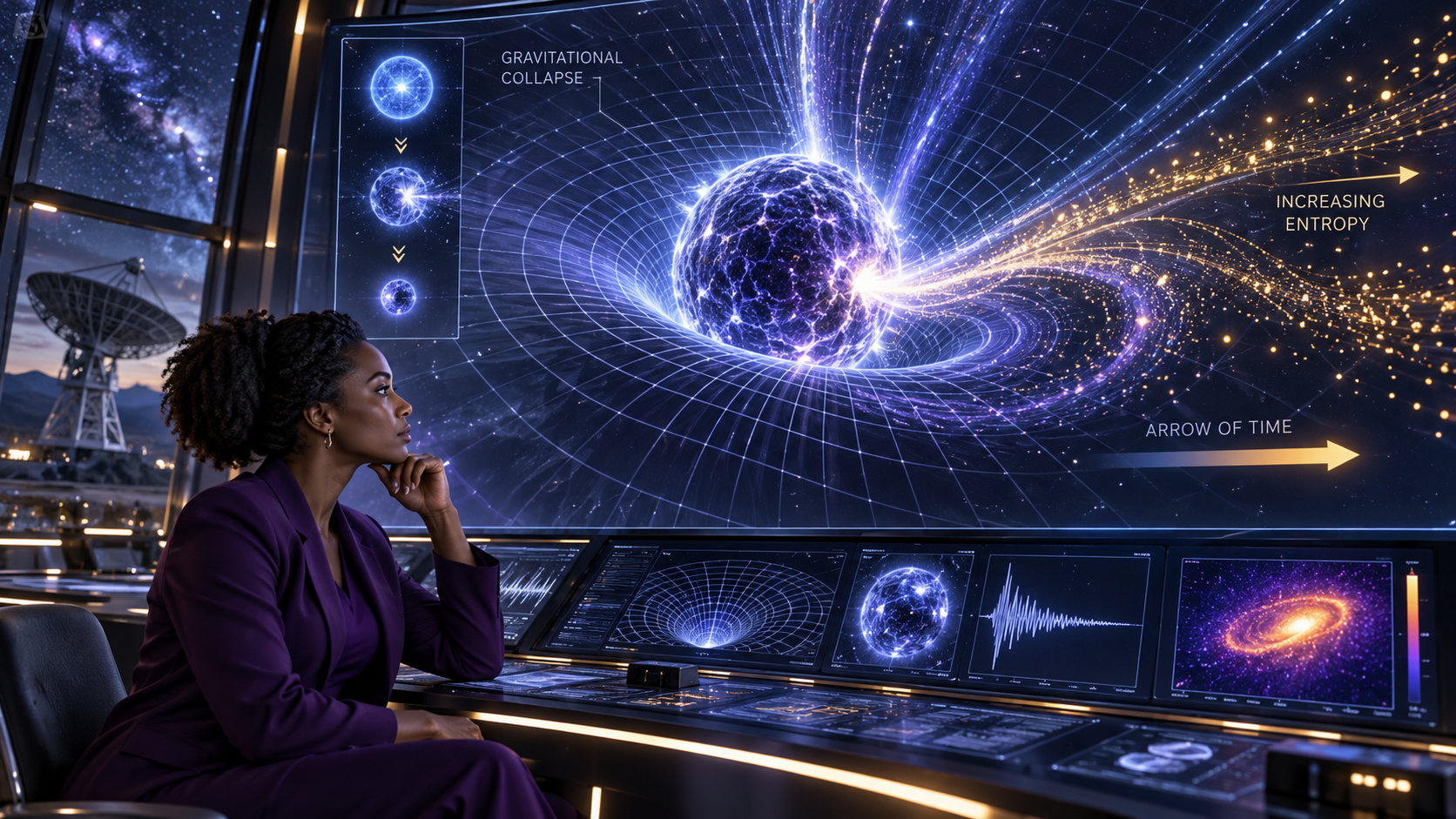

Could time run backwards inside a collapsing neutron star? It is an irresistible headline—and a misleading way to describe an interesting theoretical result. The research concerns different mathematical arrows associated with entropy during gravitational collapse. It does not show people, objects or history reversing.
Researchers studying radiating stars in higher-dimensional models have examined a measure of gravitational entropy during collapse. Their calculations indicate that the gravitational arrow defined by that measure can point opposite to the ordinary thermodynamic arrow. The result challenges how certain entropy ideas are applied in extreme gravity.
What physicists mean by an arrow of time
Many fundamental equations can describe processes in either temporal direction. Everyday experience is different. Heat flows from warmer objects to cooler surroundings. A broken glass does not spontaneously reassemble. We remember the past rather than the future.
Thermodynamics connects this direction with entropy: for an isolated system, entropy tends to increase. That statistical asymmetry gives ordinary physical processes a direction.
Why gravity complicates entropy
Gravity gathers matter into structure. A smooth cloud can collapse into stars, galaxies or black holes, creating clumps rather than the uniform spreading people associate with ordinary entropy examples. Physicists therefore need special ways to discuss gravitational entropy.
One influential approach connects gravitational entropy with properties of spacetime curvature, including the Weyl curvature. Different proposed measures can behave differently during collapse. The result depends on the definition and model—not on a universal clock visibly changing direction.
What the new analysis reports
- The setting is theoretical: a shear-free, spherically symmetric radiating star represented by mathematical spacetime models.
- The matter can be neutral or charged: the authors examine multiple cases and dimensions.
- The gravitational measure behaves oppositely: its associated arrow points against the thermodynamic arrow in the analysed models.
- The finding exposes a conceptual problem: a local application of the chosen gravitational-entropy hypothesis may give an arrow that appears physically wrong.
- The result is not an observation of time travel: no experiment shows events inside a neutron star literally reversing.
Why the phrase “time reversal” causes confusion
A quantity decreasing with the coordinate used to describe collapse does not mean every process reverses. Different arrows can represent different asymmetries: thermodynamic, cosmological, radiative, psychological or gravitational. A disagreement between two definitions can reveal that one measure is incomplete.
Imagine two indicators on a dashboard pointing in different directions. The disagreement may mean the system has reversed, but it may also mean the indicators measure different things or one is poorly calibrated for the environment. In extreme gravity, calibration is the scientific question.
Does this apply inside an observed neutron star?
The paper studies idealised collapse rather than placing an instrument inside a real neutron star. Neutron stars are extraordinarily dense remnants supported by nuclear physics; some collapsing stars may continue towards black-hole formation if pressure cannot halt the process.
To connect theory with observation, physicists look for signals such as gravitational waves, neutrinos and electromagnetic radiation. These can test aspects of collapse, but they do not allow an observer to watch an internal entropy measure directly.
What would count as stronger evidence?
- Agreement across definitions: several well-motivated gravitational-entropy measures should show consistent behaviour.
- Robustness across models: results should survive rotation, magnetic fields, realistic equations of state and departures from perfect symmetry.
- Observable consequences: the theory should predict a measurable signal that distinguishes it from alternatives.
- Independent replication: other researchers should reproduce the mathematics and test assumptions.
Why the result still matters
A paradox is useful when it reveals a weak concept. If a gravitational entropy measure gives the “wrong” arrow during realistic collapse, physicists learn where a hypothesis needs refinement. Science advances not only when a model confirms expectation, but when careful mathematics shows that our definitions are incomplete.
This is a good lesson for AI and public science communication too. An extraordinary interpretation should never be allowed to outrun the evidence. The responsible headline preserves wonder and boundary at the same time.
The mathematics may reverse an entropy arrow. It does not reverse your history.
Continue exploring evidence-led Future Thinking
Sources and date note
This article reflects information available on 6 September 2026. Read the paper “Arrow of time problem in gravitational collapse” and its published journal version. The models concern gravitational collapse; popular neutron-star descriptions are a public-facing interpretation, not evidence of literal reversed time.
Discover more from Marychuks.com AI, Psychology, Business & CreativeVerse
Subscribe to get the latest posts sent to your email.