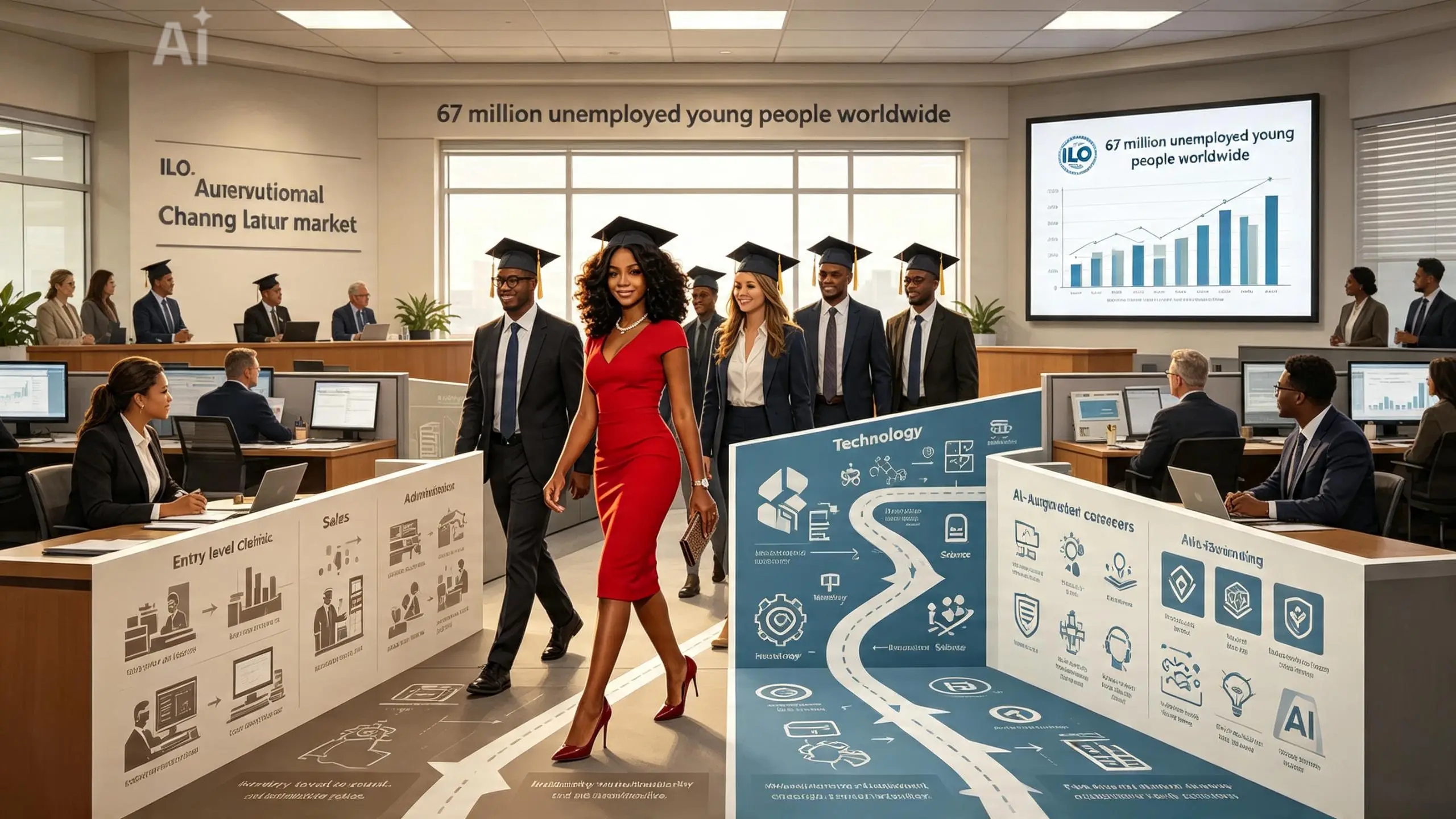
Artificial intelligence is arriving at an awkward moment for the youngest workers.
Global youth unemployment increased to 12.4% in 2025, equivalent to approximately 67 million people aged 15 to 24, according to a new International Labour Organization report. More than 257 million young people are now classified as not in employment, education, or training. �
Reuters
The ILO warns that AI could add further pressure.
It estimates 6.1% of jobs held by people aged 15–29 sit within occupations most exposed to AI-related transformation. If only 10% of those roles disappeared completely, roughly 5.6 million young workers could face unemployment, career changes, or labour-market exit. �
Reuters
Importantly, that 5.6 million figure is a scenario—not a forecast that those jobs definitely will disappear.
Why Young Workers Are Particularly Vulnerable
Entry-level jobs traditionally teach people how an industry works.
Those jobs often include:
administrative tasks,
basic research,
data entry,
simple drafting,
routine customer service.
Unfortunately, these are precisely the tasks AI can increasingly perform.
Companies may still need senior professionals while hiring fewer juniors.
That can create a dangerous pipeline problem:
Where do tomorrow’s experts come from if nobody hires today’s beginners?
The Problem Is Not Universal
High-skilled employment in science, engineering, health, and IT continues expanding in many regions. �
Reuters
Meanwhile, nearly nine in ten young workers in low- and lower-middle-income economies remain in informal employment, where AI displacement may operate differently. �
Reuters
The AI jobs story, therefore, differs enormously by country and occupation.
Mary Chuks’ Perspective
We should stop telling young people only:
“AI may take your job.”
Teach them:
“AI is changing the entry point—here’s how you move with it.”
Education should combine domain expertise with AI literacy, communication, judgement, and practical experience.
And companies should not automate their junior pipeline out of existence.
A business that never trains beginners eventually discovers there are no experienced people left to hire.
Conclusion
AI does not automatically create a generation of unemployed young people.
But combined with weak job creation and disappearing middle-skilled entry roles, it can intensify an already serious transition.
The answer is preparation—not panic.
Primary source: Reuters reporting on the ILO’s latest youth employment report, 11–12 August 2026. �
Reuters
Discover more from Marychuks.com AI, Psychology, Business & CreativeVerse
Subscribe to get the latest posts sent to your email.