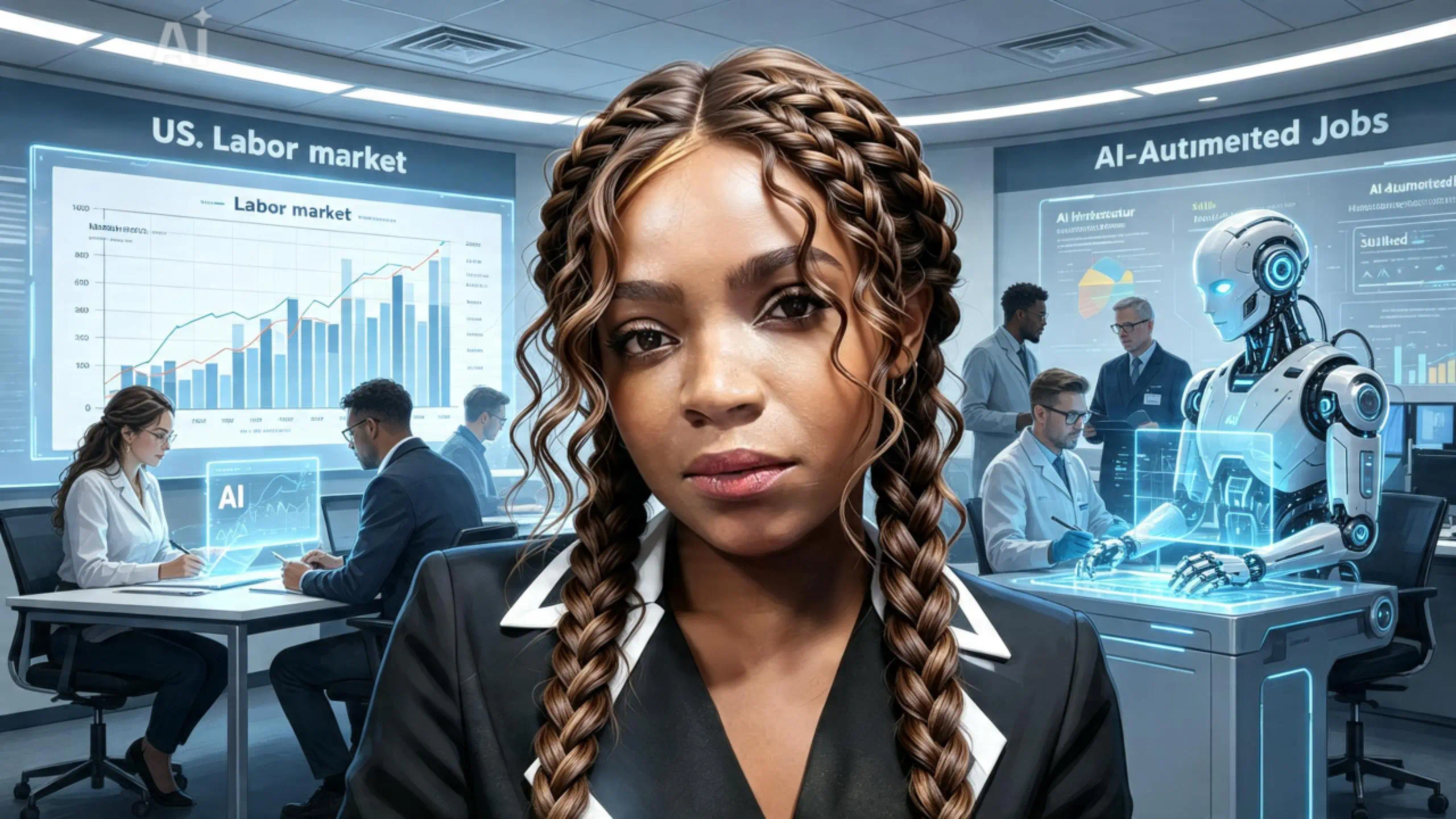
Artificial intelligence is affecting employment.
But despite some spectacular headlines, the United States has not yet entered an AI-driven jobs apocalypse.
Reuters commentary citing Morgan Stanley analysis estimated that occupations highly exposed to AI account for around 30% of employment, but current AI-related labour-market disruption could be contributing at most roughly 0.15 percentage points to the aggregate unemployment rate as of June 2026. �
Reuters
That is real.
It is also nowhere near a complete collapse of human employment.
Where Pressure Is Appearing
AI exposure is strongest in work involving digital information and repeatable cognitive tasks.
Examples include portions of:
software development,
administration,
customer support,
writing,
data processing.
Entry-level workers can face particular pressure because many junior responsibilities are precisely the tasks AI assistants perform increasingly well.
Meanwhile, other sectors—including AI data-centre construction and maintenance—are experiencing increased hiring demand. �
Reuters +1
Why Headlines Can Mislead
A company may say:
“We are restructuring because of AI.”
That does not necessarily mean AI directly replaced every affected worker.
Companies also restructure because of:
weak demand,
overhiring,
cost cutting,
economic uncertainty,
organisational changes.
AI may become the justification, accelerator or tool rather than the sole cause.
Good labour-market analysis needs to distinguish those effects.
The Bigger Risk Is Transition
The most serious near-term challenge may not be universal unemployment.
It may be skills mismatch.
A displaced administrator cannot instantly become a data-centre electrical engineer.
New jobs may exist while individual workers remain unable to access them.
That is where retraining policy becomes critical.
Mary Chuks’ Perspective
The future-of-work conversation needs less panic and more preparation.
AI is changing tasks faster than it is eliminating entire categories of human usefulness.
People should ask:
“Which part of my job is becoming automatable?”
Then build strength around the parts requiring judgement, relationships, domain expertise and accountability.
Do not compete with AI at what AI does cheaply.
Learn how to direct it.
Conclusion
The AI labour disruption is real.
The apocalypse is not.
At least not yet.
The intelligent response is neither denial nor panic.
It is adaptation while the transition is still manageable. �
Discover more from Marychuks.com AI, Psychology, Business & CreativeVerse
Subscribe to get the latest posts sent to your email.