Environmental stories for young readers have a difficult job. They must tell the truth about damage and responsibility without leaving a child with the impression that catastrophe is inevitable and adults have already failed. The strongest stories create a bridge from concern to agency.
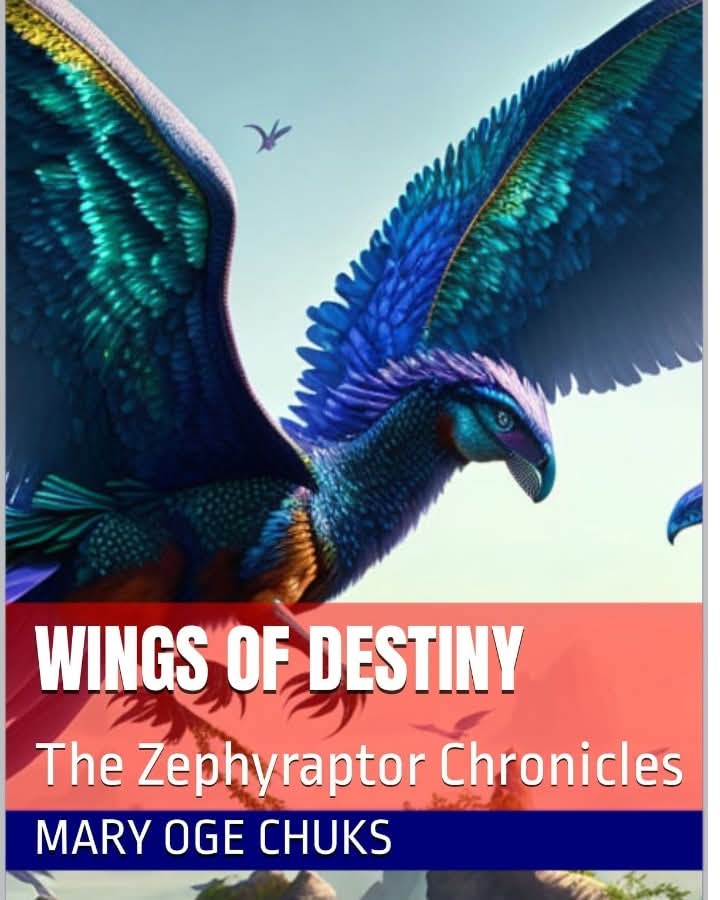
Wings of Destiny: The Zephyraptor Chronicles by Mary Oge Chuks offers a useful starting point for that conversation. Its published synopsis describes a young human and an extraordinary Zephyraptor undertaking a quest to protect a living planet from ecological catastrophe. This companion guide does not reveal or invent additional plot details. Instead, it uses the book’s stated themes—adventure, friendship, courage, nature and responsibility—to help families, reading groups and educators turn a fantasy journey into thoughtful discussion.
Why ecological fantasy can open a serious conversation
Facts tell readers what is happening. Stories help them rehearse what it might feel like to care, choose, cooperate and persist. Fantasy creates enough imaginative distance for difficult questions to feel approachable while keeping the moral problem recognisable.
That combination fits UNESCO’s definition of Education for Sustainable Development. UNESCO says sustainability education should build knowledge and skills alongside values, attitudes and behaviours. In other words, knowing that an ecosystem is threatened is not the final learning outcome. Readers also need opportunities to consider judgement, responsibility and action.
UNESCO’s current figures show why this action dimension matters: it reports that 47% of national curriculum frameworks in a 100-country review made no reference to climate change, while only 20% of teachers could explain well how to take action. A novel cannot close that gap alone, but a guided conversation can help move reading beyond awareness.
Before reading: establish the emotional contract
Before opening the book, tell younger readers that ecological danger can produce many reactions: worry, anger, sadness, curiosity or determination. None is the “correct” emotion. The purpose of the discussion is not to test whether they care enough. It is to give them language for what they notice and choices about how they respond.
- Look at the title. What could “destiny” mean if the future is shaped by choices rather than fixed in advance?
- Explore the companion idea. What can a human learn from a creature with different senses, abilities or needs?
- Name the scale. What environmental changes can one person influence, and which require a community or institution?
Seven questions to use during or after the story
1. When does fear become useful information?
Ask readers to identify moments when danger warns a character to pay attention and moments when fear could stop useful action. The goal is not to praise fearlessness. Courage usually means acting with fear present, using evidence, preparation and support.
2. What makes the friendship more than a side story?
If two companions bring different strengths, their relationship may function as part of the solution. Invite readers to notice listening, trust, disagreement, repair and shared risk. A friendship becomes ethically interesting when it changes what each character is able—or willing—to do.
3. Who can speak for nature?
A forest, river or species cannot vote in a human meeting. Discuss who notices its condition, whose knowledge is trusted and who carries the consequences of a bad decision. This opens a wider conversation about stewardship without reducing nature to scenery.
4. Is a dramatic rescue enough?
Adventure stories often build towards a decisive act. Real environmental care also depends on maintenance: protecting habitats, changing routines, monitoring results and cooperating over time. Ask what would need to happen one week, one year and one generation after the heroes’ immediate task.
5. How should responsibility be shared?
A young protagonist can model agency, but children should not be told that planetary repair rests on their shoulders. Separate personal choices from collective responsibilities. Individuals can learn, reduce waste and join projects; businesses and governments control systems, infrastructure and policy at a different scale.
6. What evidence would the characters need?
Turn fantasy into an exercise in critical thinking. Before changing a habitat or attempting a rescue, what would the characters need to observe? Which claim is a fact, which is an interpretation and which remains speculation? Caring deeply does not remove the need for evidence.
7. What does a hopeful ending owe the reader?
Hope is not the same as a guarantee. A credible hopeful ending shows why improvement became possible: someone learned, cooperated, changed a system or accepted a cost. Ask readers to distinguish earned hope from a convenient last-minute solution.
A 20-minute post-reading activity: the three-circle action map
Draw three circles labelled Me, Us and Systems. Choose one environmental concern raised by the reading and place possible responses in the appropriate circle.
- Me: something one reader can learn, change or observe.
- Us: something a family, class, neighbourhood or reading group can do together.
- Systems: something that requires a council, school, company, regulator or government.
Then add two checks to every proposed action: “What evidence says this will help?” and “Could it create a new problem?” Those questions keep the exercise practical. A well-intentioned action can still waste resources, shift harm elsewhere or ignore the people most affected.
For educators: assess thinking, not moral performance
Avoid grading children on how passionate or frightened they sound. Instead, assess whether they can identify a problem, consider more than one perspective, connect actions to consequences and revise an idea when evidence changes.
Creative responses can make this visible. A learner might write a letter from the Zephyraptor’s point of view, design a recovery plan with trade-offs, map alliances needed to protect a habitat or rewrite a decision after discovering new information. Each task tests reasoning while preserving the imaginative energy of the story.
The reading goal: informed hope
The most valuable environmental adventure is not one that frightens readers into agreement. It helps them recognise that care must be joined to knowledge, courage to cooperation and hope to a credible plan.
That is the productive conversation around Wings of Destiny: not “Can one fictional hero save everything?” but “What becomes possible when people notice, learn, form relationships and act at the right scale?”
Sources: MaryChuks.com book synopsis for Wings of Destiny; UNESCO, Education for Sustainable Development. Accessed 20 September 2026. Interpretive teaching suggestions in this article are original editorial guidance, not claims about scenes beyond the published synopsis. The featured image is a conceptual AI-generated illustration, not an official book cover.
Discover more from Marychuks.com AI, Psychology, Business & CreativeVerse
Subscribe to get the latest posts sent to your email.