A Fluent AI Translation Can Still Change Your Offer
An elegant translation can alter access, timing or support promises. A practical guide to preserving your offer’s meaning while adapting its language for new readers.
Marychuks.com AI, Psychology, Business & CreativeVerse
Empowering Minds with AI, Psychology and Digital Innovation
An elegant translation can alter access, timing or support promises. A practical guide to preserving your offer’s meaning while adapting its language for new readers.
Create a practical AI project handover that preserves approved decisions, current files, open questions and the next action when work moves into a new chat.
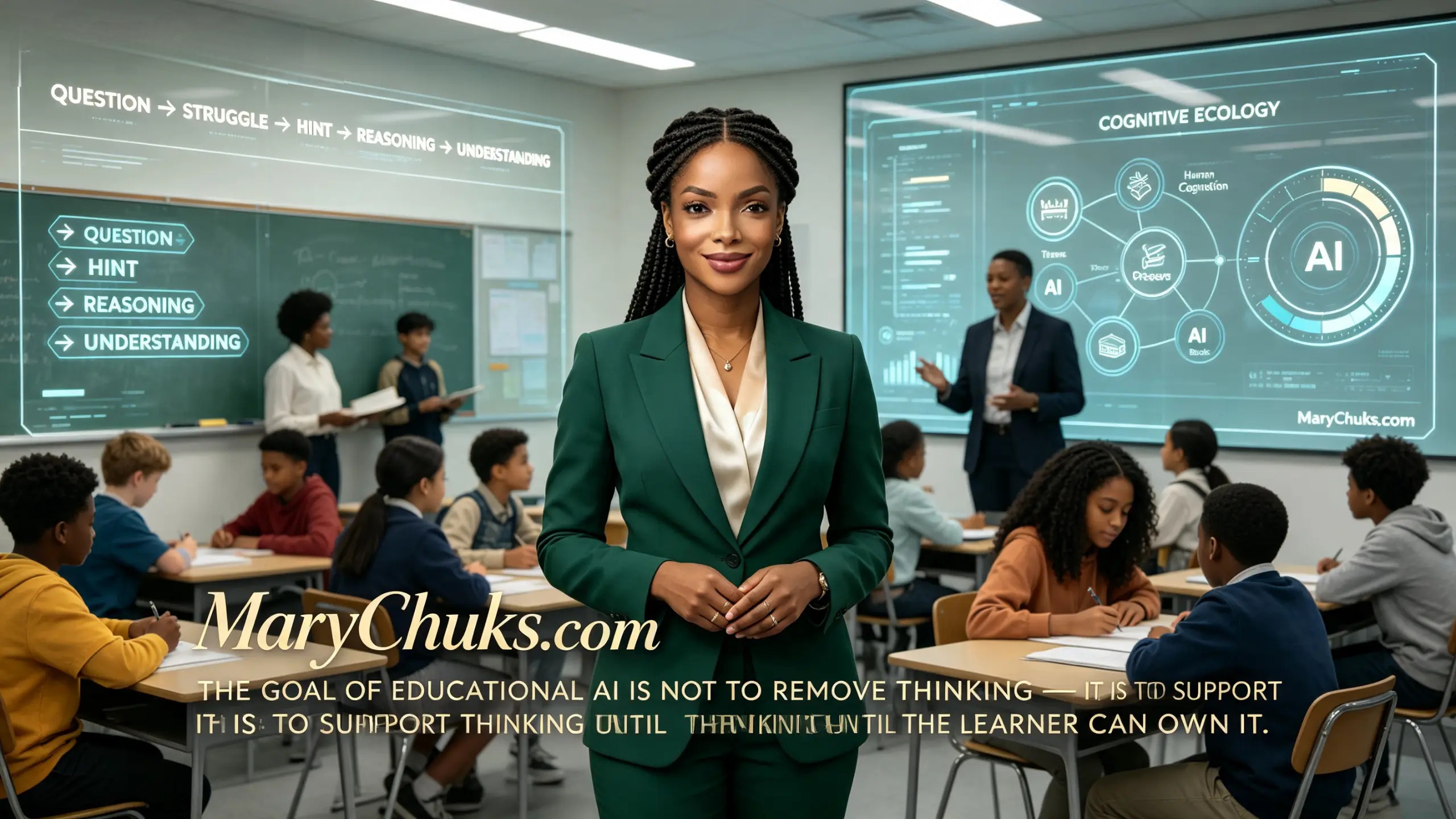
A new Communications Psychology perspective argues that generative AI should not be treated as another classroom tool. Because AI can explain, evaluate, generate and interact continuously, it may redistribute the cognitive work traditionally performed by students and teachers.
A new Communications Psychology perspective argues that generative AI should not be treated as another classroom tool. Because AI can explain, evaluate, generate and interact continuously, it may redistribute the cognitive work traditionally performed by students and teachers.
Build an AI learning portfolio that records initial reasoning, feedback, revisions and a fresh application—not only a polished final answer.
Africa’s AI opportunity depends on local language, context and practical access. Explore what a useful language test should ask beyond translation.
A planetary AI does not need to erase cultural difference. Mary Oge Chuks explains how one shared intelligence could serve humanity through transparent, locally governed cultural filters.
The AI University of the Future could combine human professors, AI tutors, robot instructors and 24-hour laboratories in a new hybrid model of higher education.
The smartest AI users do not blindly trust or reject AI. They build a verification habit that keeps human judgment active while still benefiting from machine intelligence.
New York City has paused student-facing generative AI for nearly 600,000 younger students. Mary Oge Chuks asks whether protecting independent thinking requires prohibition — or better AI literacy.