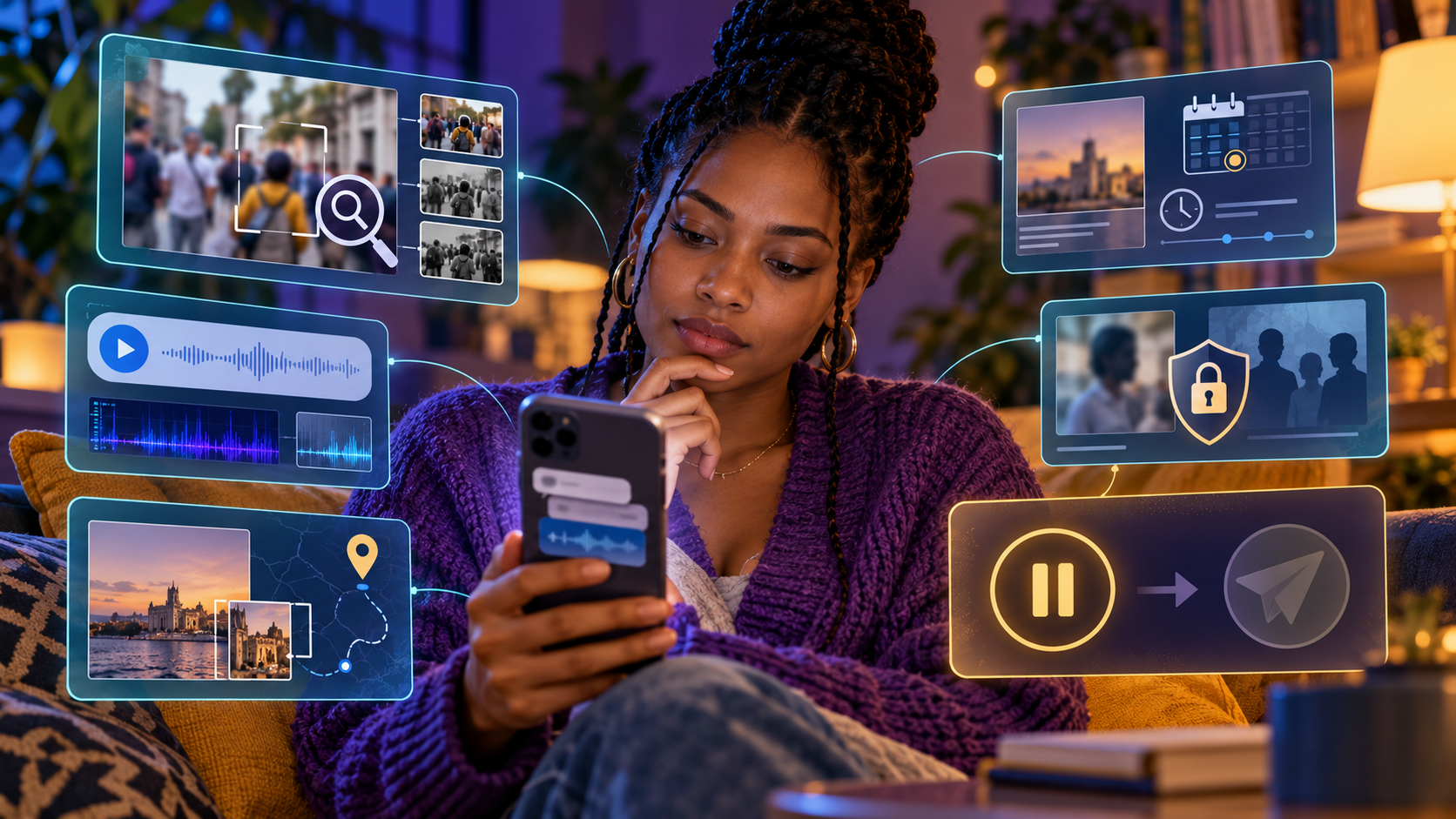
The most persuasive line in a viral message is often not the claim itself. It is the instruction beneath it: “Forwarded as received.” Those three words make uncertainty travel while responsibility appears to stay behind.
A screenshot can preserve the appearance of a conversation while losing the account, date, preceding messages and reason it was created. A voice note can sound intimate while providing no reliable identity, location or time. A cropped video can show a real event and still attach it to the wrong story. The answer is not to distrust everything. It is to slow the journey from surprise to sharing.
Why gossip feels like evidence
Gossip is socially efficient. It packages a person, an event and an emotional verdict into a story that can be repeated in seconds. Specific details—an amount of money, a supposed insider, a familiar neighbourhood—can make the story feel verified even when nobody has traced them.
Emotion adds speed. Anger asks us to warn others; amusement asks us to entertain them; fear asks us to act before checking. Full Fact’s updated 2026 misinformation toolkit recommends three useful questions: Where is it from? What is missing? How do you feel? That final question matters because emotional intensity is not evidence, but it can determine whether we look for evidence at all. See Full Fact’s introductory verification guide.
A screenshot is an artefact, not a chain of custody
A screenshot may accurately show what appeared on one screen at one moment. It does not automatically establish who created the account, whether the text was edited before capture, what was omitted, or whether the image belongs to the claimed date. Treat it as a lead that needs a source.
- Look for the original: Can you reach the account, article, court record, company notice or full video?
- Check the date: Old material is regularly recirculated as new.
- Expand the frame: Cropping may remove a correction, satire label, username or earlier message.
- Search the wording: A distinctive sentence in quotation marks may reveal earlier versions and changed details.
- Compare independent sources: Ten accounts repeating one anonymous post are not ten confirmations.
If the original has disappeared, do not promote that absence into proof of a cover-up. The honest status is simpler: the claim cannot presently be verified.
Voice notes create intimacy without provenance
A confident voice can create the impression of access: “My cousin works there”, “I know the family” or “This came from someone inside”. Yet the listener usually cannot inspect the speaker’s identity, expertise or route to the information.
Transcribe the central claim in one sentence. Remove the speaker’s tone and ask what evidence remains. Does the note name a checkable institution, document, date or public statement? Can that organisation be contacted through a number or website you found independently? If the message asks you to contact a number contained inside the same unverified message, do not use it as your verification route.
AI-generated audio adds another reason for care, but ordinary misidentification, imitation, editing and false attribution existed long before generative AI. A strange pause or robotic sound may raise a question; it does not prove that audio is synthetic. Verify the source and claim rather than declaring a deepfake from sound alone.
Images and videos need context checks
Start by capturing a clear frame and running a reverse-image search. Full Fact’s guidance notes that finding the image’s earlier appearances can reveal whether it has been recycled, altered or attached to a new event. But visual search is not infallible: matching pages may repeat the same false caption, so inspect the earliest credible appearance and compare it with reliable reporting. See Full Fact’s guides to checking an image’s history and verifying misleading video.
Then inspect internal clues: weather, language, road markings, architecture, uniforms, shadows, vehicle plates and visible signs. These clues can support or challenge a caption, but avoid turning a guess into certainty. A building that “looks like” one city is not a confirmed location.
Separate fact, interpretation and speculation
A disciplined check uses three boxes:
- Verified fact: a claim supported by an identifiable primary record or multiple independent, credible sources.
- Interpretation: a reasoned explanation of what the known facts may mean.
- Speculation: a possibility for which the available evidence is insufficient.
Suppose a public figure cancels an appearance. The cancellation may be verified. Saying it indicates a contract dispute is an interpretation only if relevant evidence exists. Naming an alleged private cause without evidence is speculation. The boxes prevent a small fact from carrying a large accusation.
Use professional standards as a benchmark
Most individuals are not regulated publishers, but professional standards provide a useful discipline. The IPSO Editors’ Code says the press must take care not to publish inaccurate, misleading or distorted information or images, must distinguish comment, conjecture and fact, and must correct significant inaccuracies promptly and prominently.
That code does not turn every group-chat participant into a newspaper. It offers a practical question: if this claim could affect someone’s safety, work, family or reputation, have you applied at least as much care as the seriousness of the harm requires?
Privacy does not disappear when a story is interesting
Even a true item may not be yours to distribute. Phone numbers, addresses, medical details, children’s identities, intimate images and private conversations can create risks far beyond embarrassment. The Information Commissioner’s Office advises people to limit personal information made widely available online because it can be misused, including for identity theft and fraud. Its social-networking safety guidance is a useful starting point.
Before sharing, ask whether the public-interest value outweighs the privacy intrusion. “People will want to know” is not the same as public interest. If there is a genuine safety or crime concern, preserve the original material and report it through an appropriate official route rather than inviting a digital crowd to investigate a named individual.
The six-step PAUSE check
- P — Pin down the claim. Write one checkable sentence, not a cloud of insinuation.
- A — Ask for the origin. Find the first available post, document, recording or named witness.
- U — Uncrop the context. Check the full image, conversation, video, date and location.
- S — Seek independent confirmation. Look for sources that did not merely copy one another.
- E — Evaluate harm. Consider privacy, safety, reputation and whether sharing serves any legitimate purpose.
- Pause again. If the story remains unverified, do not upgrade it with your own credibility.
This routine is deliberately small. Verification fails when the ideal process is so elaborate that nobody uses it. A two-minute pause will not solve every claim, but it can expose missing dates, circular sourcing, recycled images and emotional manipulation.
What to do when the claim is urgent
Urgency changes the route, not the standard. For an alleged danger, contact the relevant emergency service, school, employer, bank, health body or local authority through independently verified details. For suspected fraud, use the official reporting channel. Do not publish a person’s private information while waiting for confirmation.
If you shared something false, correct it in the same places and with comparable visibility. Do not quietly delete the message and leave recipients believing it. State what was wrong, provide the better source and ask people not to forward the earlier version.
A better social reward
Online status often goes to the first person with the story. Healthy information cultures reward a different role: the person who asks for the source, finds the earlier image, protects the child’s identity or stops an unsupported allegation from travelling further.
Gossip will not disappear, and conversation does not need to become a courtroom. But the moment a story names a person, predicts harm, requests money or demands urgent forwarding, entertainment has acquired consequences. A screenshot may start the question. It should not finish the investigation.
Featured image disclosure: conceptual AI illustration created for this article. It is not documentary evidence and does not depict a real event or person.
Discover more from Marychuks.com AI, Psychology, Business & CreativeVerse
Subscribe to get the latest posts sent to your email.