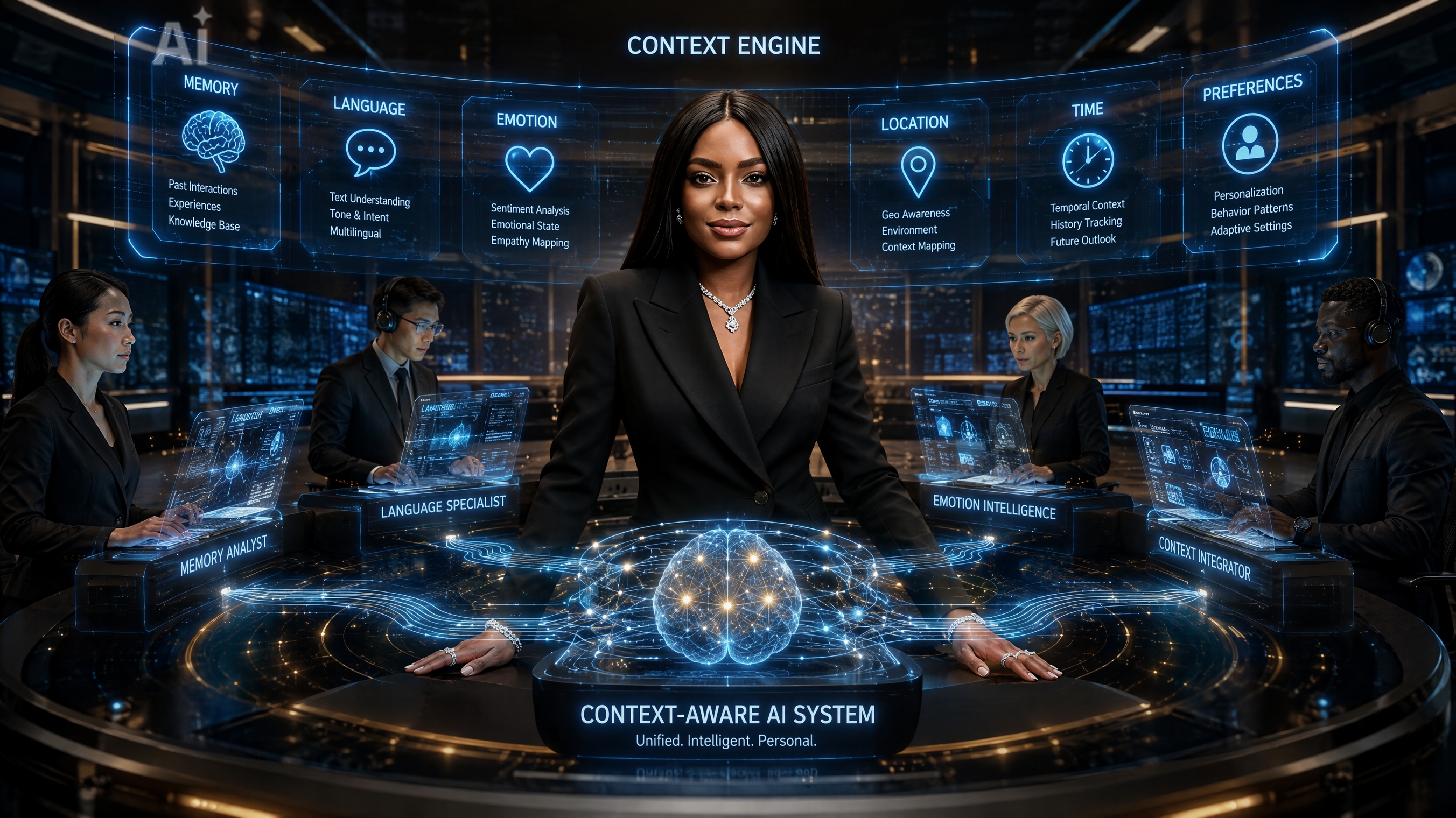
For much of the public conversation about artificial intelligence, progress has been measured by what an AI can produce after receiving a prompt.
Can it write an article?
Can it create an image?
Can it analyse a document?
Can it generate code?
Can it summarise a meeting?
These abilities remain important, but they represent only the beginning of intelligent assistance. The next significant phase of AI will not simply involve systems that produce better answers. It will involve systems that understand more of the situation surrounding the question.
In other words, the future of AI is increasingly about context.
A truly useful intelligent system must understand not only what a person is asking, but also why they are asking, what they are working on, what they have already completed, what constraints they face and what outcome they are trying to achieve.
The difference between an ordinary tool and an intelligent assistant is not merely output quality. It is situational understanding.
A Prompt Is Only One Small Part of Human Intention
Human communication rarely exists in isolation.
When someone says, “Make this better,” another person may understand what “this” refers to because they can see the document, remember the previous conversation and recognise the desired standard.
An AI without context may need several additional instructions:
What should be improved?
Who is the intended audience?
What tone should be used?
What has already been approved?
What information must remain unchanged?
What does “better” mean in this situation?
A context-aware system would already have access to much of that information.
It might know that the user is preparing a business proposal, that the audience is a potential investor, that the preferred tone is confident but not exaggerated, and that the financial figures must remain exactly as written.
The prompt remains important, but it becomes part of a much larger information environment.
What Context-Aware AI Actually Means
Context-aware AI refers to systems that can use relevant surrounding information when generating a response or taking an action.
That context may include:
Conversation history
The system understands what was discussed earlier and does not force the user to repeat every detail.
User preferences
It remembers preferred formats, writing styles, accessibility needs, recurring tasks or professional standards.
Project information
It recognises that a request belongs to a particular website, application, research project, campaign or client.
Time and location
It may adapt recommendations according to deadlines, time zones, opening hours, weather conditions or local requirements.
Available tools and resources
It understands which documents, calendars, databases, applications or workflows are relevant to the request.
Current goals
It recognises whether the user is exploring an idea, making a decision, preparing to publish or completing a final review.
The strongest AI systems will not use all available information indiscriminately. They will identify which context is relevant and ignore what is not.
That distinction is essential.
More information does not automatically create more intelligence. Intelligence also requires selecting the right information at the right moment.
Context Changes the Quality of the Answer
Imagine asking an AI:
“What should I work on today?”
Without context, the system can only provide general productivity advice.
With context, it may know that:
A client proposal is due tomorrow.
Three blog posts are already drafted.
A product launch campaign has just been approved.
An unanswered email requires a decision.
The user normally does creative work in the morning.
A meeting is scheduled for the afternoon.
The answer can then become specific:
“Finish the client proposal first because it has the nearest deadline. Review the approved campaign landing page next. Schedule the completed blog posts before your afternoon meeting.”
This is no longer generic advice. It is operational intelligence.
The value does not come from eloquent language. It comes from correctly understanding the user’s present situation.
From Chatbots to Continuous Digital Partners
Traditional chatbots treat each interaction as a separate exchange.
A question arrives. An answer is generated. The interaction ends.
Context-aware AI introduces a more continuous relationship between the system, the person and the project.
The AI may understand that a task is part of a larger sequence:
Research the topic.
Develop the strategy.
Draft the material.
Review the factual claims.
Create the visual assets.
Publish the final content.
Analyse the performance.
Instead of waiting passively for isolated instructions, the system can help maintain continuity across the process.
This does not necessarily mean the AI should act independently. In many cases, the best model remains human-in-the-loop.
The AI organises, suggests, drafts and identifies risks. The human provides judgment, values, accountability and final approval.
Why Memory Matters—but Must Be Carefully Designed
Memory is one of the most visible components of context-aware AI.
When a system remembers useful preferences, the user saves time. They do not need to restate the same instructions repeatedly.
However, memory also creates serious design questions.
What should an AI remember?
How long should it remember it?
Can the user inspect or delete the information?
Should different projects have separate memories?
How does the system prevent outdated information from influencing a new decision?
A helpful memory system must be transparent and controllable.
For example, remembering that a business prefers British English may be useful across many writing tasks. Remembering a temporary campaign deadline after the campaign has ended may create confusion.
Context must therefore be treated as a living structure rather than a permanent pile of information.
Good AI memory should be:
Relevant.
Editable.
Secure.
Time-sensitive.
Easy to inspect.
Easy to remove.
Context Is Also Psychological
Human beings do not communicate through facts alone. We communicate through intention, emotion, uncertainty and social meaning.
Consider the sentence:
“I’m fine.”
Its literal meaning may suggest that everything is satisfactory. Its psychological meaning may be entirely different depending on tone, timing and circumstance.
AI systems are becoming increasingly capable of recognising emotional and conversational cues. However, they must be careful not to claim certainty about a person’s internal state.
A responsible system might say:
“Your message sounds more discouraged than your words suggest. Would it help to talk through what happened?”
An irresponsible system might declare:
“You are depressed.”
Context can improve empathy, but it should not become overconfidence.
Psychological interpretation requires humility.
Context-Aware AI in Business
For businesses, contextual intelligence may become more valuable than raw content generation.
A business AI system could understand:
The company’s products.
Current inventory.
Customer history.
Pricing rules.
Brand language.
Support policies.
Active campaigns.
Delivery conditions.
Regulatory restrictions.
A customer may ask, “Can I change my order?”
A generic chatbot might provide a policy page.
A context-aware assistant could identify the specific order, check whether it has shipped, confirm which changes remain possible and guide the customer through the correct next step.
This reduces friction because the system understands the real situation rather than merely retrieving general information.
Context-Aware AI in Education
In education, context-aware AI could adapt explanations according to the learner’s existing knowledge.
Two people may ask the same question but require very different answers.
A beginner asking about machine learning may need a simple analogy.
A software engineer may need mathematical detail, implementation considerations and limitations.
A context-aware tutor could also remember which concepts the learner struggled with, which examples were effective and what learning objective comes next.
The goal is not to make education easier by removing effort. It is to make effort more productive by meeting the learner at the correct level.
Context-Aware AI in Healthcare and Psychology
In sensitive areas such as healthcare and psychology, context can improve support but must be handled with particular caution.
A system may help users:
Track recurring symptoms.
Prepare questions for a professional.
Record behavioural patterns.
Organise care information.
Understand general educational material.
However, context-aware systems should not present uncertain interpretations as medical facts.
The more personal the context, the greater the responsibility to protect privacy, communicate uncertainty and keep appropriate human professionals involved.
An AI may recognise patterns. A qualified professional must still evaluate their meaning.
The Risk of Context Collapse
Context-aware AI also introduces a danger: the wrong context can contaminate the answer.
A system may apply information from one project to another.
It may treat an old preference as a current instruction.
It may misinterpret humour as a serious command.
It may use personal information that is technically available but irrelevant.
This is why future AI systems need contextual boundaries.
People should be able to separate:
Personal life.
Business projects.
Academic research.
Creative work.
Client accounts.
Temporary experiments.
A well-designed AI should understand not only what it knows, but also where that knowledge belongs.
The Future Interface May Be Less About Prompting
The current AI era has created an entire culture around prompt engineering. Knowing how to describe a task clearly remains valuable.
However, as systems become more context-aware, users may need fewer elaborate prompts.
Instead of explaining the entire project every time, a person may simply say:
“Prepare tomorrow’s version.”
The AI would understand which project, which format, which audience, which deadline and which previous version is being referenced.
This does not eliminate human thinking. It changes where human thinking is concentrated.
The user spends less time repeating context and more time making meaningful decisions.
Intelligence Is Not Merely Knowing More
The next generation of AI will not be defined only by larger models or longer responses.
It will be defined by whether systems can understand:
What matters now.
What belongs to this project.
What has changed.
What the user is trying to achieve.
When clarification is necessary.
When not to act.
Which information should be forgotten.
The future of AI may therefore depend less on the ability to answer every question and more on the ability to understand each question within the correct human context.
A prompt tells an AI what has just been said.
Context helps it understand the world in which those words matter.
Conclusion
Artificial intelligence is moving from isolated content generation toward deeper situational assistance.
Context-aware AI can make systems more useful, efficient and personalised. It can reduce repetition, strengthen continuity and help people manage complex workflows.
But context also creates responsibility.
The AI systems that earn lasting trust will not simply remember everything. They will use relevant information carefully, respect boundaries, communicate uncertainty and keep humans in control.
The future of intelligent assistance will not be won by the system that speaks the most.
It may be won by the system that best understands what the moment requires.
Discover more from Marychuks.com AI, Psychology, Business & CreativeVerse
Subscribe to get the latest posts sent to your email.