Slug: great-subtitles-screen-storytelling
Tags: Entertainment, Movies, TV show
Meta description: Good subtitles preserve dialogue, timing, speaker identity and meaningful sound without competing with the story. Learn how to recognise captions crafted with care.
A subtitle appears for only a few seconds, yet it must carry language, rhythm, identity and emotion without pulling the viewer out of the story. When it succeeds, it feels almost invisible. When it fails, the audience notices every late line, missing joke and unexplained sound.
Subtitling is sometimes treated as the final administrative task before release. It is better understood as a form of screenwriting under severe constraints. The subtitler decides what must be preserved, what can be condensed, when a line should arrive and how the audience will know who is speaking. Those choices affect access, comprehension and dramatic tension.
Subtitles and captions overlap, but the distinction matters
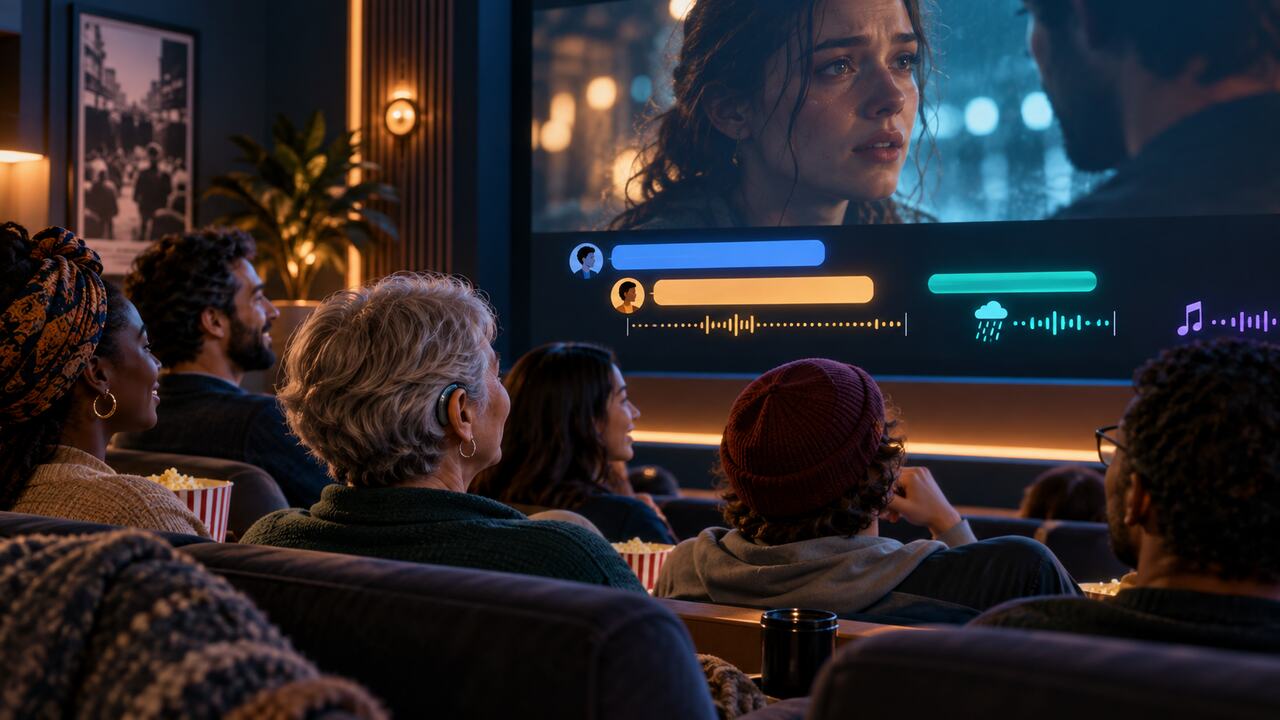
In everyday conversation, “subtitles” can describe any words placed over moving images. More precisely, translation subtitles commonly assume that the viewer can hear the soundtrack but does not understand the spoken language. Captions for deaf and hard-of-hearing audiences also communicate relevant non-speech information, such as music, alarms, laughter and speaker identity.
The World Wide Web Consortium’s accessibility guidance explains that captions provide speech and non-speech audio information needed to understand media. UK broadcasting obligations are addressed through Ofcom’s television access-services framework, alongside audio description and signing. The underlying principle is simple: if the soundtrack carries meaning, an accessible text track must decide how that meaning reaches someone who cannot rely on the sound.
Timing is part of the performance
A line that arrives before the actor speaks can spoil a reveal. One that remains after the scene has moved on can attach dialogue to the wrong face. Captions need to appear closely enough to the relevant speech or sound to preserve cause and effect, while remaining on screen long enough to be read.
This creates a genuine trade-off. Fast conversation may contain more words than viewers can comfortably read at full speed. The solution is not simply to shrink the text or flash it more quickly. A careful subtitler may remove repetition or verbal filler while protecting the sentence’s meaning, tone and plot function. The objective is not a perfect transcript at any cost; it is an accurate viewing experience.
Line breaks can change meaning
Good line breaks follow the structure of a thought. Breaking “I never said she stole the money” after different words can momentarily shift emphasis or create confusion. Articles should generally stay with nouns, prepositions with their phrases and names with their titles. A caption is easier to process when its visual shape respects the language.
Position also matters. Text should not cover a face, a clue, an on-screen message or an important action when an alternative placement is possible. That is why subtitle quality cannot be judged from a spreadsheet alone. The words must be reviewed against the finished picture.
The audience needs to know who is speaking
In a close-up conversation, the picture may make the speaker obvious. In darkness, crowd scenes, phone calls or off-screen dialogue, it may not. Identification can be conveyed through positioning, names, labels or other conventions, depending on the platform and house style.
The label should reveal only what the drama has already revealed. Naming a disguised character too early can turn an accessibility feature into a spoiler. “Woman” or “distorted voice” may be more faithful than a character name the hearing audience has not yet learned.
Meaningful sound is part of the plot
Not every noise deserves a caption. The useful question is whether the sound changes what the viewer understands. A door closing in the background may be irrelevant; a lock clicking behind the protagonist may be the scene’s threat. Music can establish a location, signal an approaching character or contradict the mood of the image.
Descriptions should be specific enough to serve the story without becoming miniature reviews. “[Tense music]” may be adequate in one scene and too vague in another. “[Floorboard creaks upstairs]” communicates direction and danger. “[Song continues]” may matter when the music bridges a cut. The caption describes evidence in the soundtrack; it should avoid inventing an emotion that the scene does not establish.
Translation requires loyalty to effect, not word order
Literal translation can preserve vocabulary while losing the scene. Idioms, jokes, forms of address and cultural references may not have one-to-one equivalents. The translator must decide which function matters most: information, humour, status, insult, tenderness or pace.
This is interpretation, and it should be recognised as such. Two competent translators may make different choices without either fabricating the story. What matters is whether the translated line remains consistent with character, context and the audience’s available reading time. A forced explanation that doubles the length can destroy the timing of a joke just as surely as a mistranslation.
Why automatic captions still need review
Speech recognition can produce a useful first pass, especially for clear studio dialogue. It can also confuse names, accents, overlapping speech and specialised vocabulary. More importantly, a transcript generator does not automatically make editorial decisions about relevant sound, concealed identities, line breaks or dramatic timing.
The evidence is the generated text and its timing. The interpretation is whether those words reproduce the intended scene. Human review remains important because a plausible sentence can still be the wrong sentence—and the most damaging errors often look grammatically tidy.
A five-minute subtitle quality check
- Mute the programme briefly. Can you still identify speakers and understand the sounds that drive the scene?
- Watch a rapid exchange. Are the words readable without racing, and is essential meaning preserved?
- Find an off-screen voice. Does the text identify it without revealing information too early?
- Inspect the frame. Do captions obscure faces, graphics, clues or foreign-language text?
- Check names and unusual terms. Are recurring spellings consistent?
- Test more than one device. Text that works on a television may become uncomfortable on a phone.
Accessibility can improve the craft
High-quality subtitles primarily remove a barrier for people who are deaf or hard of hearing and for audiences watching in another language. They can also help viewers in noisy or quiet environments, people learning a language and anyone trying to follow unfamiliar names. Those additional uses do not replace the core accessibility purpose; they demonstrate how thoughtful inclusive design often serves more people than expected.
The best time to plan subtitles is during production. Accurate scripts, character lists, song information, final audio and notes about invented terminology reduce guesswork later. Accessibility becomes stronger when the caption team is treated as part of the storytelling pipeline rather than an external repair service.
A great subtitle does not merely repeat what was said. It preserves what the moment meant, at the speed the story intended, for an audience that deserves the whole experience.
Sources and production guidance
- W3C Web Accessibility Initiative: Captions
- Ofcom: Provision of television access services
- BBC accessibility guidance: Subtitles
- Netflix Partner Help Centre: English timed-text style guide
Discover more from Marychuks.com AI, Psychology, Business & CreativeVerse
Subscribe to get the latest posts sent to your email.