A defibrillator on the clubhouse wall may look like preparedness. It is not proof of preparedness. If the cabinet is locked, the postcode is uncertain, the pads have expired or nobody knows who will fetch the device, the club owns equipment but lacks a working response.
Sudden cardiac arrest is an electrical failure in which the heart stops pumping blood effectively. It is not the same as a heart attack, although a heart attack can trigger it. The person is typically unresponsive and not breathing normally. On a sports field, early cardiac arrest can be harder to recognise because an athlete may briefly show seizure-like activity or appear to be panting. The Resuscitation Council UK’s 2025 adult basic life support guidance specifically warns that athletes may display a near-normal or panting breathing pattern soon after cardiac arrest begins.
This is why a match-day plan must be designed for action under pressure, not for inspection when everything is calm.
The evidence: recognition, 999, CPR and early defibrillation
The evidence-based sequence is deliberately simple. If somebody is unresponsive, call 999 without delay. Assess breathing while the call is being answered. If the person is unresponsive and not breathing normally, assume cardiac arrest, begin CPR and attach an automated external defibrillator (AED) as soon as it arrives. Put the phone on speaker so the call handler can guide the response.
Resuscitation Council UK says bystander CPR and AED use increase the chances of survival by two to four times. Its community CPR and AED quality standards, last updated in January 2026, report that adult defibrillation within three to five minutes of collapse may produce survival rates as high as 50–70 per cent. Those figures describe populations and circumstances, not a promise for an individual. They do, however, explain why retrieval time matters.
Practical rule: do not wait for a medically qualified spectator before calling 999, starting CPR or bringing the AED. Anyone can use an AED; it analyses the rhythm and will only advise or deliver a shock when appropriate.
A six-part readiness audit for every sports venue
1. Start the clock at the furthest point
Stand at the furthest place where a player, official or spectator could collapse. Start a timer. Send someone to retrieve the AED at a brisk but safe pace and bring it back. Do this under the conditions in which the ground is actually used: gates positioned for a match, evening lighting, changing rooms occupied and the usual route available.
A wall-mounted unit that takes four minutes to reach requires an eight-minute return journey before unpacking and pad placement. That observation is an operational finding, not a clinical outcome prediction. It may justify moving the device, adding another unit or changing access arrangements.
2. Test access, not merely location
Can a visiting coach find it without asking? Is the route open when the clubhouse is closed? Is the cabinet visible after dark? Does a code, key or alarm create hesitation? The 2025 UK guidance says AEDs should be in clear sight, prominently signposted, housed in unlocked cabinets and accessible around the clock. NHS England likewise advises unlocked cabinets because extra access steps can delay use.
If vandalism risk shapes the club’s arrangement, record the trade-off rather than pretending it does not exist. Seek advice from the local ambulance service or responsible AED provider. A device protected so effectively that rescuers cannot reach it is not ready.
3. Make the address ambulance-ready
Display the venue name, full address, postcode, gate name and a precise description of the access point beside the first-aid kit and in the match-day briefing. Rural grounds and multi-pitch complexes may need a landmark or grid reference. Confirm that the emergency gate opens and that a vehicle route is not blocked by parked cars, bins or removable barriers.
Register the device and keep its status current on The Circuit, the UK national defibrillator network. The ambulance service uses that information to direct callers to nearby devices. Registration is not a substitute for local knowledge, but it connects the club’s equipment to the wider emergency system.
4. Inspect what expires
Nominate a named role—not a vague committee—to check the AED at the manufacturer’s recommended interval. The check should cover the readiness indicator, battery status, pad packaging and expiry date, cabinet condition, signage and any accessories specified for that model. After use, restore the device promptly and report its status through the relevant system.
A short dated log creates accountability. It also reveals recurring failures, such as a cabinet light that repeatedly stops working or replacement pads ordered too late. Follow the manufacturer’s instructions: AED models differ, and a generic checklist cannot override the device documentation.
5. Assign roles before the whistle
In an emergency, several necessary jobs compete for attention. A simple briefing can allocate them in advance:
- First responder: checks responsiveness and starts the 999 call.
- CPR responder: begins compressions when the person is unresponsive and not breathing normally.
- AED runner: retrieves and switches on the device.
- Access marshal: opens the gate and meets the ambulance.
- Space marshal: moves players and spectators back while preserving privacy.
- Welfare contact: supports family members, teammates and responders after the event.
These are functions, not permanent job titles. At a small fixture one person may begin two tasks before help arrives. The point is to remove the dangerous assumption that “someone else” has called, fetched or opened.
6. Rehearse the handover
A tabletop discussion is useful; a timed walk-through is better. Use a training manikin and training AED rather than attaching live pads to a volunteer. Practise calling out the exact location, putting a phone on speaker, swapping the person doing compressions, clearing everybody during rhythm analysis and guiding an imagined ambulance from the entrance.
The AED will give spoken and visual instructions. When more than one rescuer is present, UK guidance says CPR should continue while pads are attached. Nobody should touch the person while the device analyses the rhythm or a shock is delivered, and compressions should resume immediately when instructed. Training builds fluency, but lack of training must not become a reason to avoid using the device in a real cardiac arrest.
The gender and privacy problem clubs should anticipate
Defibrillator pads need contact with bare skin and correct placement. Clothing may have to be cut or removed. Resuscitation Council UK says rescuers should prioritise correct pad placement; a bra may remain only if it does not interfere, and it should be removed if it does. The lifesaving intervention takes priority.
That clinical requirement can collide with embarrassment, cultural concerns and fear of being accused of impropriety. The club should make its policy explicit: preserve dignity where possible by moving spectators back and using a screen or spare jacket around—not over—the working area, but never delay CPR or pad placement. NHS England’s cardiac-arrest resources link to specific guidance on CPR and AED use for a person with breasts, reflecting a known disparity in bystander response.
What an AED does not solve
Buying a device does not replace a 999 call, CPR, first-aid planning or professional medical care. Not every cardiac arrest has a rhythm that can be shocked. If the AED says no shock is advised, rescuers should restart CPR immediately and continue following its prompts and the call handler’s instructions.
Nor should clubs turn screening claims into false reassurance. A player who has passed a medical assessment can still collapse; a spectator, referee, volunteer or parent can also experience cardiac arrest. Readiness should cover the whole ground and everyone in it.
A ten-minute pre-match check
- Point out the AED and verify that it is accessible.
- Confirm its readiness indicator and the current check log.
- Read aloud the venue address, postcode and correct gate.
- Make sure a charged phone has a signal at pitch level.
- Keep the emergency access route clear.
- Name the person who will call, the AED runner and the gate marshal.
- Tell visiting staff where the device and first-aid kit are.
- Identify who will manage the crowd and protect privacy.
- Check that youth fixtures follow the club’s age-appropriate first-aid and safeguarding arrangements.
- After the session, record any access problem and give one person a deadline to fix it.
The critical distinction: equipment versus capability
Evidence: early recognition, an immediate emergency call, prompt CPR and early AED use form the core response to adult cardiac arrest. Clear signage, ready access, maintenance and registration support that response.
Interpretation: a sports club should measure the entire chain—from collapse on its most distant pitch to AED arrival and ambulance access—because ownership alone does not reveal the delays inside that chain.
Uncertainty: no checklist can predict whether a particular person will survive. Venue layout, the cause of arrest, responder action and ambulance time all vary. The defensible aim is to remove avoidable delay and make the recommended actions easier to perform.
A prepared club is not one that can point to a red box. It is one whose people can recognise the emergency, call for help, start CPR, bring a working AED and guide professionals to the scene without wasting the minutes that matter.
Medical note: This article is general UK safety information, not a substitute for certified first-aid training, a venue-specific risk assessment or advice from emergency services. In an emergency, call 999 and follow the call handler’s instructions.
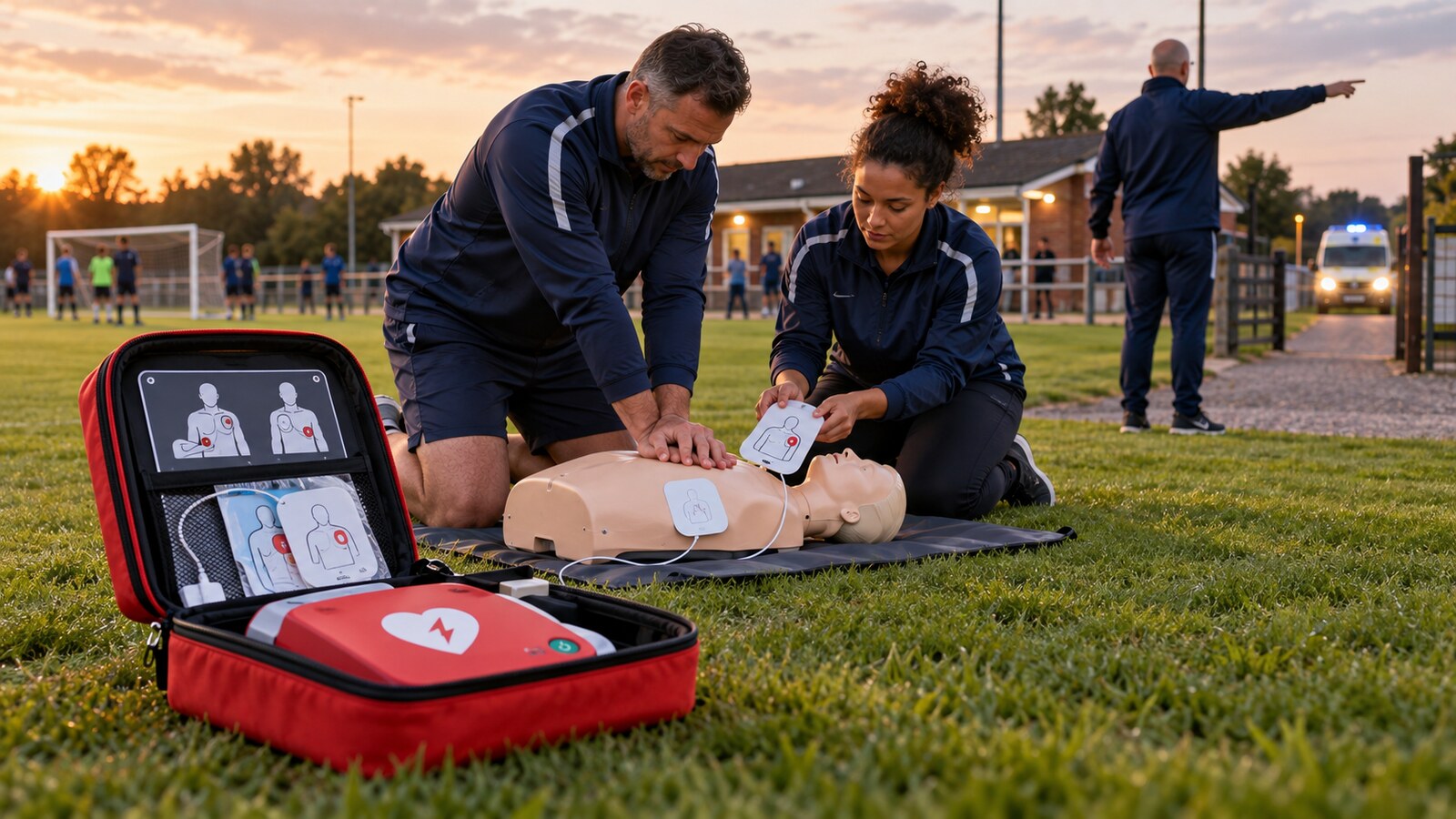
Image note: The featured image is an original conceptual AI-generated illustration of a training drill. It is not evidence of a real cardiac-arrest event or a particular club’s procedures.
Discover more from Marychuks.com AI, Psychology, Business & CreativeVerse
Subscribe to get the latest posts sent to your email.