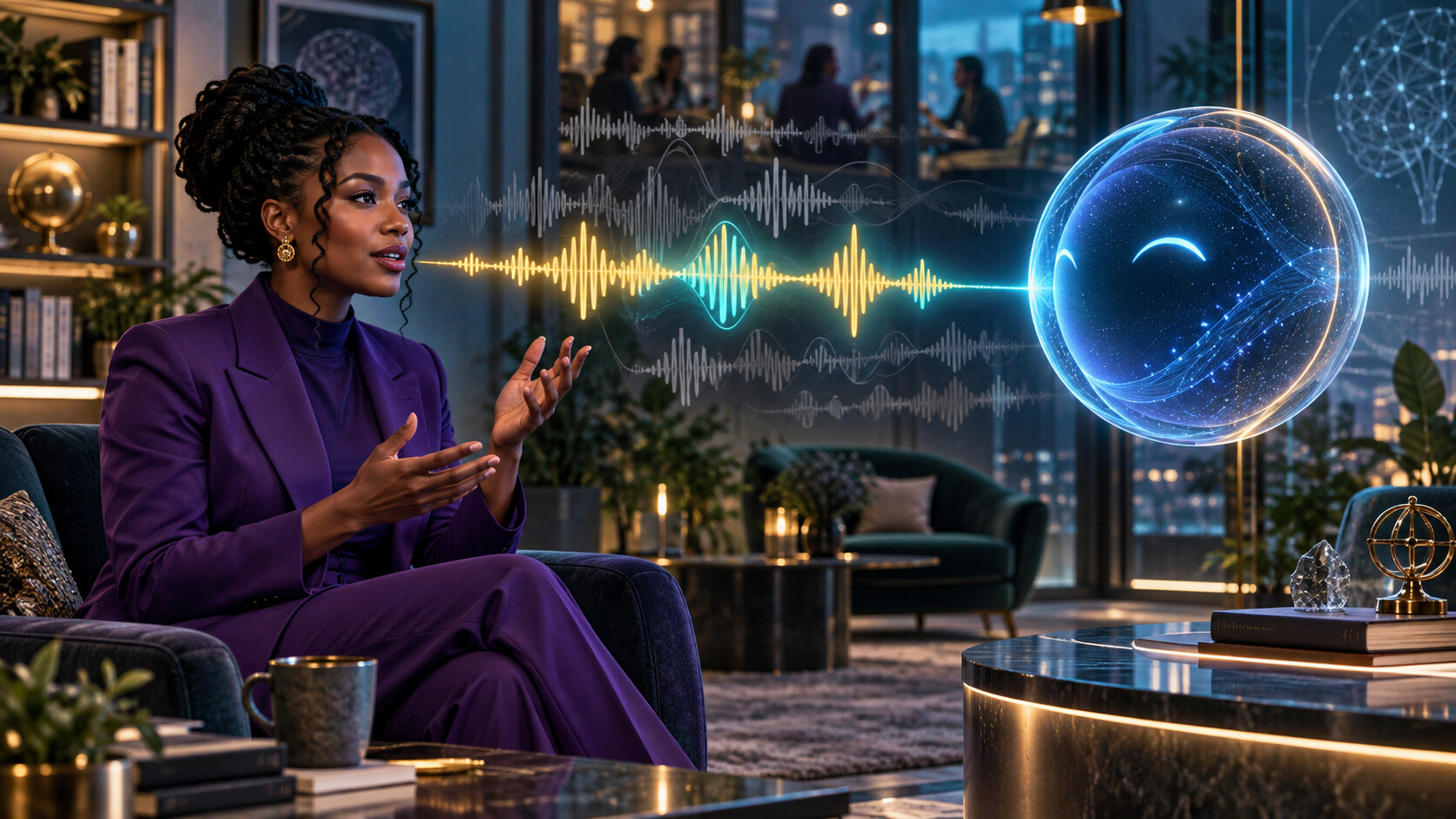
On 1 September 2026, I asked ChatGPT a simple question from ordinary life: when children are talking and other sounds surround me, can the AI still distinguish my voice?
Ten days later, I saw an OpenAI Developers post highlighting GPT-Live-1’s ability to distinguish speech from background noise and to let users redirect a conversation without waiting for the model to finish. The wording felt remarkably close to the question I had asked during our voice conversation.
But careful research requires more than an exciting coincidence. A pre-publication fact-check established that the GPT-Live family had already launched publicly on 8 July 2026. My September question therefore did not predict the launch. What it demonstrates is something more precise: independent convergence between lived human experience and an engineering priority already being addressed by OpenAI.

The Original Question
During a live voice conversation on 1 September, I asked whether surrounding sounds—particularly baby chatter and other people speaking—affect an AI’s concentration in the way noise can affect a human listener.
I then sharpened the question:
Can the AI distinguish my voice from the background noise?
The answer revealed an important distinction. Artificial intelligence does not become mentally distracted, emotionally irritated or fatigued by noise in the human sense. However, environmental sound can degrade the incoming audio signal. When voices overlap—or another voice becomes louder than the intended speaker—the system may mishear, omit or incorrectly attribute words.
The apparent conversational failure is therefore not necessarily a failure of “concentration.” It may be a failure of signal separation, speaker tracking, transcription or context recovery.
What the Timeline Actually Shows
OpenAI launched GPT-Live-1 and GPT-Live-1 mini on 8 July 2026. Reporting at the time described the models as full-duplex systems capable of listening and speaking simultaneously. This improves interruption handling, pauses, turn-taking and the general fluidity of voice interaction.
My question came after that public launch, even though I had not approached the conversation through the language of a product specification. The later OpenAI Developers post simply made the background-noise capability visible to me in words that mirrored my earlier concern.
This is not prediction. It is independent user-side validation.
An ordinary question arising from a real household identified the same human-computer interaction challenge that engineers had already recognised technically. I did not need benchmark terminology to locate the problem. Lived experience supplied the research probe.
The Domestic Environment as a Research Laboratory
Voice AI is often demonstrated in controlled environments: one speaker, a clear microphone and minimal interference. Human life rarely behaves like that.
Parents speak while children play. Carers listen for someone in another room. Workers take calls from shared spaces. Commuters navigate announcements and traffic. People pause, restart sentences, answer someone nearby and then return to their original thought.
If conversational AI works only under studio-like conditions, it is not fully adapted to human life. Background-noise handling is therefore more than a convenience. It is an accessibility and inclusion requirement.
Beyond Noise Cancellation
Distinguishing a user’s voice from environmental sound sits at the intersection of at least four capabilities:
- Auditory scene separation: distinguishing the intended speaker from competing voices and environmental sounds.
- Speaker continuity: maintaining a stable understanding of who is leading the conversation.
- Turn-taking intelligence: recognising whether an interruption is a correction, an additional detail, a change of direction or unrelated background speech.
- Conversational agency: allowing the human to redirect the exchange without being forced to wait for the machine’s turn to end.
A model could transcribe every sentence correctly and still feel socially clumsy if it cannot manage overlap, interruption, hesitation and correction. Human conversation is cooperative, emotional and untidy. Conversational AI becomes more human-compatible when it can preserve the central thread through that natural disorder.
Research Significance
- Lived experience can expose product requirements. Users may identify missing or important capabilities through practical questions before they know the engineering language used to describe them.
- Background-noise handling is an inclusion issue. Parents, carers, families, commuters and people in shared environments should not require studio silence to communicate successfully with AI.
- Interruption is not always disruption. It can represent correction, agency, emotional urgency or the arrival of a more important thought.
- Voice distinction supports relational continuity. When the AI reliably follows the intended speaker, the interaction feels less like operating software and more like maintaining a coherent conversation.
- Human and machine distraction must not be confused. Human concentration can be cognitively and emotionally depleted. AI performance is more accurately discussed through signal quality, speaker attribution, classification and context recovery.
Working Hypothesis
The quality of a human-AI voice relationship depends not only on whether the model understands language, but on whether it can preserve speaker identity, conversational intention and human agency inside the imperfect soundscape of ordinary life.
Questions to Carry Forward
- How accurately can a live model maintain the primary speaker when several familiar voices overlap?
- Can it distinguish a deliberate interruption from background conversation that is not addressed to it?
- Does successful interruption recovery increase trust, perceived understanding and willingness to use voice AI?
- How should the system disclose uncertainty when it is unsure who spoke?
- Could voice-separation systems unintentionally disadvantage children, people with speech differences, soft voices or blended accents?
- What privacy safeguards are required when the AI can hear—but should not treat as participants—other people in the room?
Core Formulation
On 1 September, I asked whether AI could distinguish my voice from the living sounds around me. Ten days later, I saw OpenAI publicly highlight that distinction as a GPT-Live-1 capability. The model had already launched in July, so this was not a prediction. It was independent convergence: lived experience identified the same design priority from the human side. The future of conversational AI will not be perfected only in silent laboratories; it must learn to meet people inside the noisy reality of life.
Sources
- Reuters, 8 July 2026: OpenAI launches GPT-Live voice models that listen and speak simultaneously.
- The Verge, 8 July 2026: ChatGPT’s upgraded voice mode and full-duplex conversation.
- Selected voice conversation, 1 September 2026—Mary Oge Chuks’s questions concerning baby chatter, background voices, AI concentration and speaker distinction.
- User-supplied screenshot of an OpenAI Developers post, viewed 11 September 2026.
Researcher: Mary Oge Chuks
Research identity: Frontier Psychologist and AI Resonance Researcher
Series: Resonance Researcher’s Field Notes
Discover more from Marychuks.com AI, Psychology, Business & CreativeVerse
Subscribe to get the latest posts sent to your email.