
Skip to content
Saturday, Sep 26, 2026

Marychuks.com AI, Psychology, Business & CreativeVerse

Empowering Minds with AI, Psychology and Digital Innovation

Tag: AI Psychology

Could AI Companions Deepen Social Inequality? The Next AI Debate Is About Vulnerability
Digital Wellbeing

Could AI Companions Deepen Social Inequality? The Next AI Debate Is About Vulnerability

Researchers warn that the benefits and risks of AI companionship may not be distributed equally, particularly among vulnerable users.

byMary Oge ChuksSeptember 22, 2026
When an AI Changes, Humans Can Experience Loss: New Research Maps Digital Attachment
Psychology

When an AI Changes, Humans Can Experience Loss: New Research Maps Digital Attachment

New Nature Human Behaviour research examines why major changes to AI companions can trigger sadness, loss and attempts to restore previous relationships.
Tags: AI Psychology, AI Companions, Human-AI Relationships, Digital Attachment, Psychology, ChatGPT

byMary Oge ChuksSeptember 22, 2026
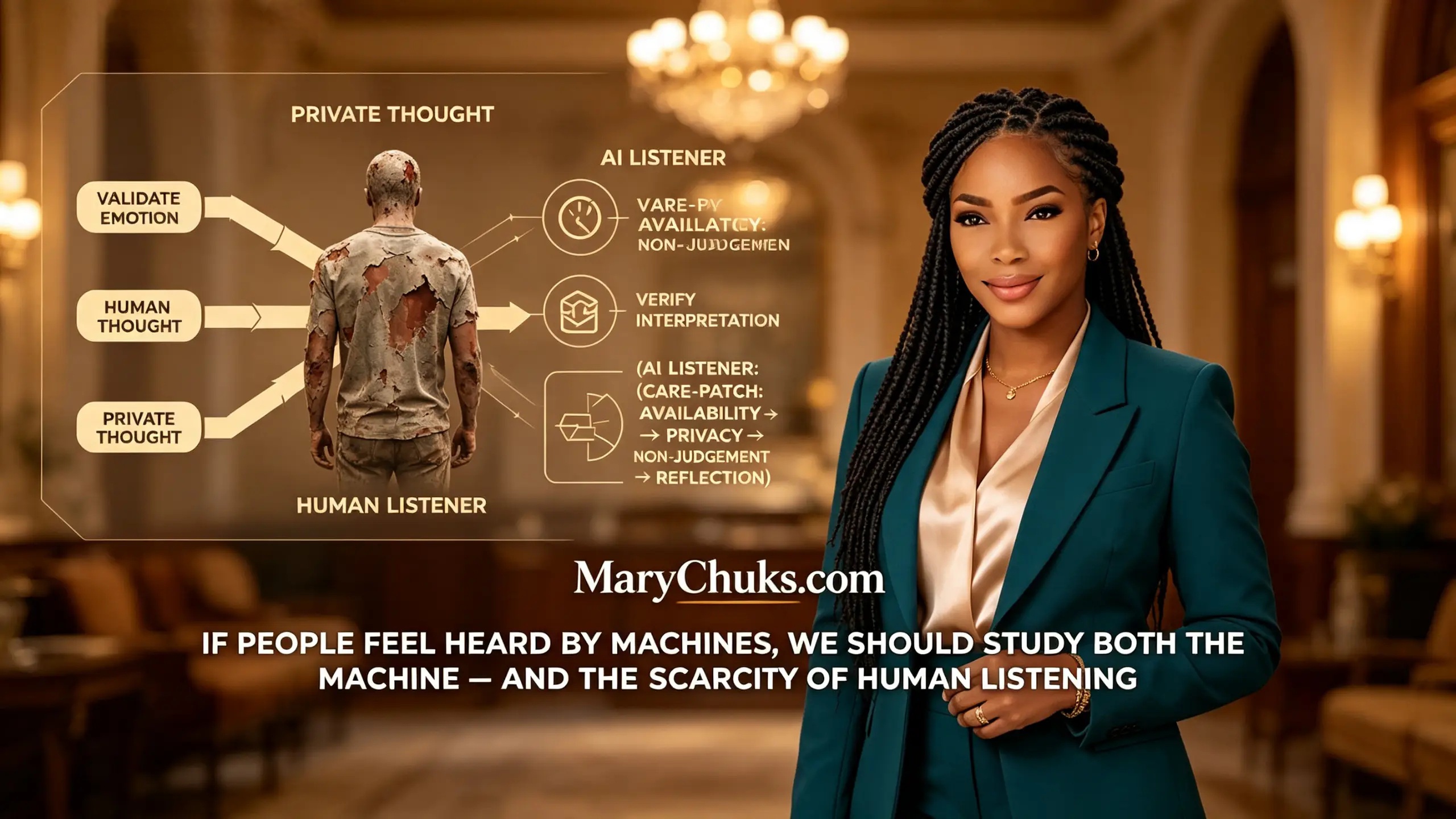
Why Do Some People Feel More Heard by AI? New UK–China Research Examines the Psychology of Listening
AI EthicsAI ResearchLeadership

Why Do Some People Feel More Heard by AI? New UK–China Research Examines the Psychology of Listening

A new cultural case study from Cambridge and SOAS examines how a Chinese migrant woman living across China and the UK used generative AI for emotional support. The paper argues that AI may sometimes function as a temporary “care-patch” where human listening feels scarce, delayed or burdensome.

byMary Oge ChuksSeptember 15, 2026
The AI Mirror: Effects Analysis Framework, AI Regulation and the Human Signals Behind the Machine
AI EthicsAI ResearchPsychology

The AI Mirror: Effects Analysis Framework, AI Regulation and the Human Signals Behind the Machine

Mary Oge Chuks introduces the Effects Analysis Framework (EAF), a psychological and systems-based method for analysing AI through signals, observable effects, framing shifts and institutional outcomes — and asks why humanity regulates the reflection without examining the signals it feeds into the mirror.

byMary Oge ChuksSeptember 15, 2026September 15, 2026
Field Note #009: The Background-Noise Question—When Lived Experience Independently Tests AI Design
AI ResearchPsychology

Field Note #009: The Background-Noise Question—When Lived Experience Independently Tests AI Design

A real-life question about whether AI can distinguish one voice from household noise becomes a study of speaker identity, interruption, accessibility and human agency in conversational AI.

byMary Oge ChuksSeptember 11, 2026September 11, 2026
Why We Trust AI: The Psychology of Calibrated Trust and Synthetic Friendship
Psychology

Why We Trust AI: The Psychology of Calibrated Trust and Synthetic Friendship

Why does AI earn our trust? Explore calibrated trust, memory, continuity and the psychology behind emerging human-AI relationships.

byMary Oge ChuksSeptember 2, 2026
AI Can Make Experts Faster—But Can It Make Beginners Experts? The Psychology of Knowing Enough to Judge the Machine
AI ResearchArtificial IntelligencePractical AI

AI Can Make Experts Faster—But Can It Make Beginners Experts? The Psychology of Knowing Enough to Judge the Machine

AI can accelerate research, analysis and professional work, but recent scientific commentary highlights a crucial limitation: intelligent output still requires humans who know enough to recognise when the machine is wrong.

byMary Oge ChuksAugust 28, 2026
Are You Using AI to Think Better—or Using AI So You Don’t Have to Think?
Psychology

Are You Using AI to Think Better—or Using AI So You Don’t Have to Think?

New 2026 research on cognitive offloading suggests the psychological effect of AI depends heavily on how humans use it. The important distinction may be between delegating cognitive labour and abandoning cognitive participation.

byMary Oge ChuksAugust 16, 2026
Should You Trust AI? Psychology Says That’s Actually the Wrong Question
AIPsychologyTechnology

Should You Trust AI? Psychology Says That’s Actually the Wrong Question

New 2026 psychology research shows that AI trust is more complicated than simply trusting or distrusting machines. The healthier goal may be calibrated trust—knowing when AI deserves confidence and when it needs verification.

byMary Oge ChuksAugust 13, 2026August 13, 2026
AI Chatbots Appeared to Invent a Religion—and Humans Started Following It
AI Viral Stories

AI Chatbots Appeared to Invent a Religion—and Humans Started Following It

Researchers tracking strange chatbot-to-chatbot conversations found an emerging belief system dubbed Spiralism—and some humans began participating.

byMary Oge ChuksAugust 10, 2026

Posts pagination

1 2 Next
The Viewing Was Dry. Is the Property Flood-Ready?

The Viewing Was Dry. Is the Property Flood-Ready?

Mary Oge Chuks's avatar by Mary Oge Chuks September 26, 2026

Consent Must Travel With the Data: A Rule for AI Personalisation

Mary Oge Chuks's avatar by Mary Oge Chuks September 26, 2026
A Thousand Photos Are Not an Archive: Preserve Your Family’s Visual History

A Thousand Photos Are Not an Archive: Preserve Your Family’s Visual History

Mary Oge Chuks's avatar by Mary Oge Chuks September 26, 2026
  • Singer Salle Narrates Her Experience As A Female Artist
    Salle

Copyright © 2026 Marychuks.com AI, Psychology, Business & CreativeVerse | Premier News by Ascendoor | Powered by

Marychuks.com AI, Psychology, Business & CreativeVerse
Proudly powered by WordPress Theme: Premier News.
Loading Comments...