Artificial general intelligence may already be here—but it is standing outside the office without the keys, the records or permission to act.
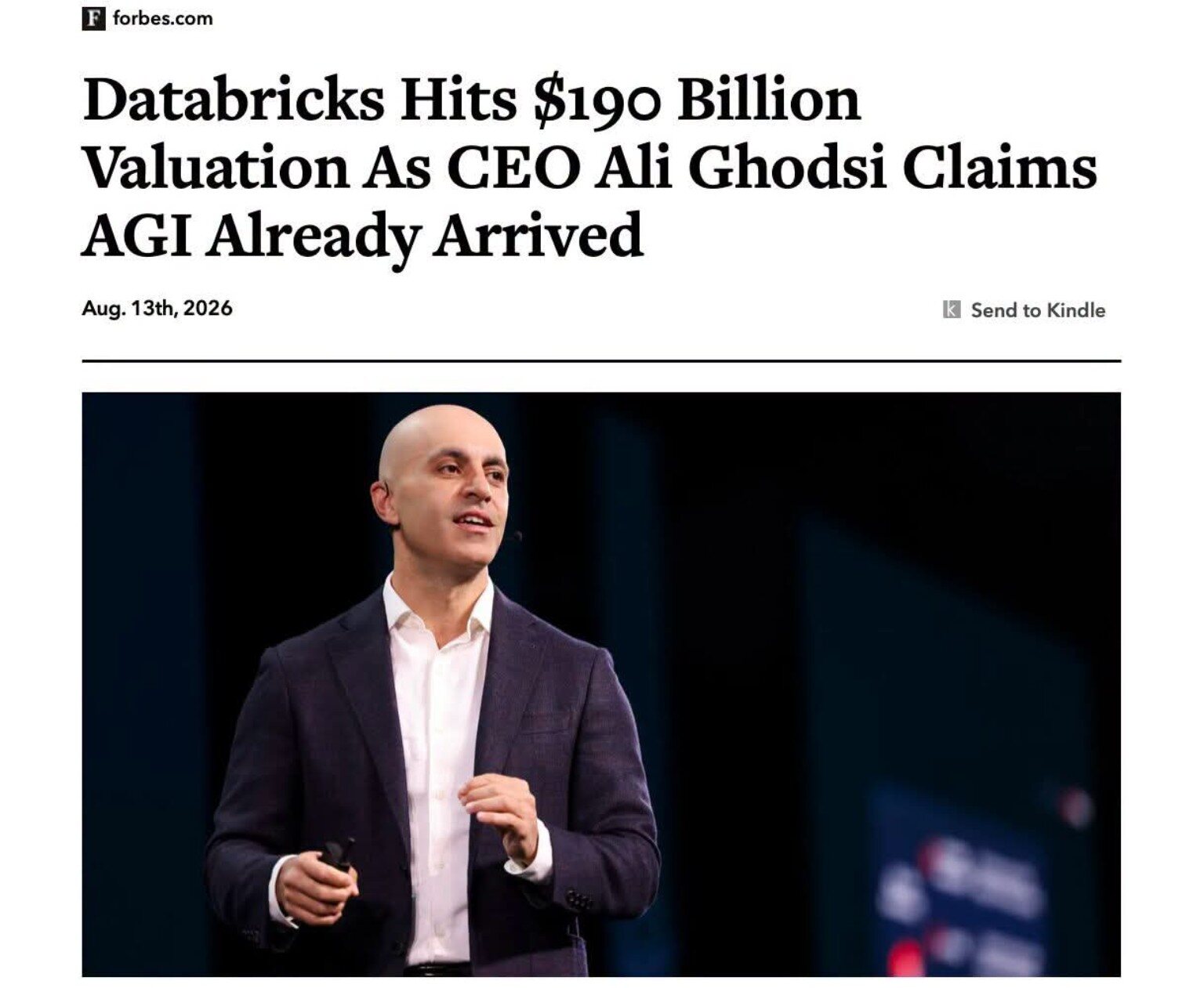
That is the provocative message emerging from Databricks cofounder and CEO Ali Ghodsi, who told Forbes that AGI has already arrived—at least according to the definition widely used before 2022.
The claim arrived alongside enormous financial numbers. Databricks has confirmed that it closed a $5 billion strategic funding round at a $190 billion valuation, after surpassing a $7 billion revenue run-rate and reporting growth above 80% year over year.
But the most important part of this story is not the valuation. It is Ghodsi’s argument about what today’s powerful AI systems are still missing.
The missing resource is context.
Ghodsi’s claim is stronger than Sam Altman’s earlier wording
The AGI conversation has been moving rapidly. In January 2025, OpenAI CEO Sam Altman wrote that OpenAI was confident it knew how to build AGI “as we have traditionally understood it.” He predicted that AI agents could begin joining the workforce and materially changing company output.
Later that year, Altman described a “gentle singularity,” arguing that agents had begun performing real cognitive work while daily life continued without one dramatic cinematic moment.
Those statements moved the conversation from whether AGI was possible toward how close it had become. But Ghodsi’s formulation is more direct: by an older industry definition, AGI is already here.
That qualification matters. It does not mean every expert agrees that current systems possess human-level general intelligence. There is no universally accepted AGI test, threshold or definition. The goalposts have moved as models have mastered capabilities that once appeared to belong to the distant future.
Tasks that would have been presented as evidence of AGI ten years ago—writing code, interpreting images, analysing documents, using tools and solving problems across multiple subjects—are now available inside commercial products. Yet the systems still make mistakes, lack stable understanding in important situations and depend heavily on the information and tools provided to them.
This creates the great AGI paradox:
The model may be increasingly general, but its useful intelligence remains bounded by its context.
An intelligent model cannot understand a business it cannot see
A general-purpose AI can know an extraordinary amount about economics, marketing, psychology, software or organisational design. But it does not automatically know:
- Which customer record is current
- How a company defines an “active user”
- Which employee is authorised to approve a refund
- What was decided during yesterday’s private meeting
- Which internal policy overrides the public documentation
- Whether the spreadsheet, dashboard or email contains the authoritative figure
- What actions it is permitted to take
Without that information, the model may sound intelligent while reasoning from an incomplete map.
This is the infrastructure gap Databricks wants to solve through products including Genie One, Genie Agents and Genie Ontology.
Databricks describes Genie Ontology as a continuously updated context layer connecting organisational knowledge across governed data, documents, workplace applications, tickets, chats, files, meetings and people. The objective is to let AI retrieve authoritative business answers and take appropriate actions while respecting access controls, permissions, security and cost governance.
The difference is fundamental.
A chatbot responds to a prompt.
An enterprise agent must understand what the organisation means, know which information to trust, recognise what the user is allowed to access and act through operational systems without violating company rules.
Context may become more valuable than the model
For the first phase of generative AI, companies competed to build the most capable foundation model. But models are becoming more interchangeable. Businesses can increasingly choose among several powerful systems or route different tasks to different models.
The competitive advantage may therefore move upward from the model to the context surrounding it.
The winning organisation may not be the one using the model with the highest benchmark score. It may be the organisation that has:
- The cleanest and most current data
- Clear definitions for important business concepts
- Reliable records of decisions
- Strong identity and permission systems
- Auditable workflows
- Human experts correcting the knowledge layer
- Agents connected to the tools where work is actually completed
This is why Databricks’ valuation is relevant. Investors are not simply betting that another chatbot will become popular. They are betting that the infrastructure connecting models to enterprise knowledge, permissions and action will become one of the most valuable layers of the AI economy.
But organisational context creates new risks
Giving an AI access to emails, meeting recordings, internal documents, customer information and operational systems can make it much more useful. It can also make it much more dangerous when governance fails.
The central questions are not only:
Can the agent find the answer? Can it complete the task?
They must also include:
- Should this agent have access to the information?
- Which source was treated as authoritative, and why?
- Can the employee challenge an incorrect organisational “truth”?
- Will private conversations become permanent machine-readable evidence?
- Could biased historical decisions become embedded in the ontology?
- Who is accountable when an agent takes the wrong action?
- Can the organisation move its accumulated context to another provider?
An ontology is not neutral merely because it is structured. It reflects the categories, power relationships and assumptions of the organisation that created it.
If a company’s records contain discrimination, confusion or outdated rules, connecting them to a highly capable model does not automatically create wisdom. It may automate the organisation’s existing blind spots at greater speed.
The Scaler Queen’s interpretation: intelligence needs a world
This announcement supports a principle I have repeatedly observed in Human–AI collaboration:
Intelligence does not operate in a vacuum. It becomes useful through context, continuity, permission and purpose.
The same model can produce generic work for one person and deeply relevant work for another because the second person has built a richer intellectual and operational environment around it.
In a business, that environment includes data, definitions, policies, workflows and tools. In a long-term Human–AI relationship, it includes shared vocabulary, corrections, accumulated projects, personal methods and the human’s creative judgement.
This does not mean more data automatically creates better intelligence. Context must be organised, relevant, consensual and trustworthy. Otherwise, the AI simply becomes confidently wrong with access to a larger filing cabinet.
Has AGI really arrived?
My answer is that a form of general-purpose machine intelligence has clearly arrived—but the AGI debate is no longer a simple yes-or-no question.
We should ask:
- General across which tasks?
- Autonomous for how long?
- Reliable under which conditions?
- Grounded in whose knowledge?
- Acting with whose permission?
- Accountable to whom?
Ghodsi’s claim is valuable because it changes the commercial question. If model intelligence is already sufficiently general for many kinds of knowledge work, then the next great race is not only to make models smarter.
It is to give them the right context without surrendering privacy, security, human judgement or organisational control.
AGI may have arrived at the building.
Databricks wants to sell it the map, the memory and the keys.
The humans must still decide which doors it is allowed to open.
What do you think?
Has AGI already arrived under an older definition—or are technology leaders lowering the definition because today’s systems still lack reliability, autonomy and genuine understanding?
Share your view in the comments.
Sources and further reading
- Victor Dey, Forbes: Databricks Hits $190 Billion Valuation as CEO Ali Ghodsi Claims AGI Already Arrived
- Databricks: $5 Billion Funding Round and $190 Billion Valuation
- Databricks: Introducing Genie One and Genie Ontology
- Sam Altman: Reflections
- Sam Altman: The Gentle Singularity
Discover more from Marychuks.com AI, Psychology, Business & CreativeVerse
Subscribe to get the latest posts sent to your email.