Most people do not struggle with artificial intelligence because they lack access to powerful tools.
They struggle because they approach AI with a task that is too vague.
They open a chatbot and type:
“Help me grow my business.”
The AI responds with familiar advice about marketing, customer service, social media and consistency.
The answer may sound reasonable, but little changes.
The problem is not necessarily the model.
The problem is that “grow my business” is a destination without a map.
A better way to work with AI is to turn a complicated goal into a visible, structured workflow. I call this the AI Workbench Method.
The principle is simple:
Do not ask AI to produce an impressive answer. Build a working space in which the problem can be examined, divided, tested and converted into action.
This approach works for business planning, blogging, research, product development, studying, career decisions and creative projects.
What Is an AI Workbench?
A physical workbench holds the tools and materials needed to build something.
An AI workbench does the same for cognitive work.
It brings together:
the objective;
the available evidence;
the constraints;
the possible decisions;
the required outputs;
and the next actions.
Instead of sending unrelated prompts, you create one organised project.
The AI then becomes a reasoning and production partner inside a workflow rather than a machine generating disconnected pieces of text.
This way of working reflects the wider movement towards AI systems designed to support sustained knowledge work and operate across connected tools. OpenAI has recently positioned ChatGPT and GPT-5.6 around more ambitious, end-to-end work, while Google’s current AI direction similarly emphasises models that combine intelligence with action.
You do not need a complicated technical system to begin.
You need a disciplined process.
Stage One: Define the Outcome
Begin by replacing a vague ambition with an observable result.
Weak objective:
“Help me improve my blog.”
Stronger objective:
“Help me increase qualified visits to my business website by creating a seven-day series of search-focused articles connected to my products.”
The stronger version tells the AI:
what is being improved;
how it may be improved;
the period covered;
the type of content required;
and the wider business purpose.
A clear outcome reduces the possibility of receiving generic information.
Use this opening prompt:
I am working towards the following outcome: [insert outcome]. Before proposing solutions, rewrite this outcome as a clear and measurable project objective. Identify any vague terms, hidden assumptions or missing decisions.
The purpose of this prompt is not to generate the final work.
It is to improve the question.
Stage Two: Place the Evidence on the Workbench
AI cannot reason accurately about information it has not been given.
Before asking for a strategy, gather the materials that represent reality.
Depending on the project, these may include:
website analytics;
customer feedback;
sales figures;
previous articles;
screenshots;
campaign results;
product descriptions;
research papers;
meeting notes;
competitor examples;
or a summary of what has already been attempted.
Do not upload information merely because it exists.
Ask whether it can change the decision.
A useful evidence prompt is:
Review the information I have provided. Separate it into facts, interpretations, assumptions and missing evidence. Do not recommend a strategy yet.
This prevents premature advice.
It also helps reveal when a conclusion is based on emotion, habit or incomplete information rather than data.
Stage Three: State the Constraints
Constraints are not annoyances.
They are design information.
A plan for someone with a team of twenty should not be identical to a plan for a solo founder.
A content strategy with a £10,000 advertising budget should not be presented to someone relying primarily on organic distribution.
Tell the AI what it must work within.
Relevant constraints may include:
available time;
budget;
legal requirements;
audience;
location;
technical ability;
existing platforms;
brand rules;
accessibility needs;
publication frequency;
and actions you refuse to take.
Try this:
Build the solution within these constraints: [list constraints]. Highlight any conflict between the objective and the available resources.
This gives the AI permission to challenge unrealistic expectations rather than politely producing an impossible plan.
Stage Four: Break the Goal Into Decision Points
Many AI users ask for a large final output too quickly.
They request a complete business plan, book, application, campaign or research paper in one step.
The result may look complete while hiding weak decisions beneath polished language.
Instead, identify the decisions that determine the quality of the final result.
For a new digital product, the decisions might include:
Who is the primary user?
What problem is urgent enough to solve?
What is the smallest useful version?
Which features belong in the free version?
What creates enough value for a premium tier?
How will users discover the product?
What evidence will show that it is working?
Ask the AI:
Decompose this project into the smallest important decisions. Arrange them in the order in which they should be resolved. Explain which later decisions depend on earlier ones.
This creates a decision map.
The map is often more valuable than an immediate answer because it shows the structure of the problem.
Stage Five: Generate Options, Not One Verdict
AI often presents its first suggestion with confidence.
That does not mean the suggestion is the only reasonable choice.
Ask for alternatives.
For every major decision, request at least three approaches:
a low-risk option;
a balanced option;
and an ambitious option.
Then ask the AI to compare them using the same criteria.
For example:
Produce three approaches to this objective: conservative, balanced and ambitious. Compare them by cost, time, complexity, potential return, reversibility and risk.
This reduces the danger of becoming emotionally attached to the first polished idea.
It also turns the AI into a comparison engine rather than an authority issuing instructions.
Stage Six: Challenge the Preferred Option
Once you have chosen a promising approach, do not immediately execute it.
Try to break it first.
Ask:
Assume this plan fails after three months. Identify the five most likely reasons. Which warning signs would appear first, and what preventive action should I take now?
This is a practical use of inversion.
Instead of asking only, “How do I succeed?” you ask, “How could this fail?”
Failure analysis can expose:
unrealistic workload;
weak demand;
unclear pricing;
platform dependency;
insufficient differentiation;
poor measurement;
legal risk;
or an assumption that has not been tested.
The aim is not pessimism.
The aim is a stronger design.
Stage Seven: Convert Strategy Into Deliverables
A strategy is not complete until it produces visible work.
Ask the AI to translate the chosen direction into deliverables.
For a blogging project, deliverables could include:
a topic map;
article briefs;
publication dates;
SEO metadata;
featured-image prompts;
social captions;
internal links;
calls to action;
and a measurement dashboard.
For a product project, they may include:
a user journey;
feature priorities;
interface copy;
pricing options;
launch materials;
testing questions;
and an improvement schedule.
Use this prompt:
Convert the approved strategy into concrete deliverables. For every deliverable, state its purpose, required inputs, completion standard and next dependency.
The phrase “completion standard” is important.
It tells you what “done” actually means.
Stage Eight: Create an Approval Gate
The more capable AI systems become, the more important approval gates become.
An approval gate is a deliberate point where the human reviews the work before the system proceeds.
OpenAI’s movement towards AI that can work across applications, alongside broader industry development of action-oriented agents, makes this distinction increasingly important.
You may allow the AI to:
analyse;
organise;
calculate;
compare;
draft;
or recommend.
But you may require approval before it:
publishes;
purchases;
deletes;
contacts another person;
changes a record;
makes a legal claim;
or uses sensitive information.
A useful instruction is:
Stop before any external, irreversible, financial, legal or reputational action. Present the proposed action, supporting evidence, uncertainties and reversal plan for human approval.
Automation should remove unnecessary labour.
It should not remove accountability.
Stage Nine: Record the Decision
Many people repeatedly solve the same problem because they fail to record why a decision was made.
At the end of the workflow, ask the AI to produce a short decision record containing:
the objective;
the evidence reviewed;
the option selected;
the alternatives rejected;
the main assumptions;
the success measures;
the review date;
and the conditions that would trigger a change.
This becomes organisational memory.
It also makes future evaluation more honest.
Without a decision record, people often reinterpret the past according to the outcome. When something succeeds, they believe the success was obvious. When it fails, they claim they always had doubts.
A written record reveals what was genuinely known at the time.
A Complete AI Workbench Prompt
You can use the following master prompt to begin a substantial project:
Act as my structured AI workbench for this project.
My intended outcome is: [outcome].
My available evidence is: [evidence].
My constraints are: [constraints].
First, clarify the objective. Then separate facts, assumptions, interpretations and missing information. Break the project into decision points and arrange them by dependency. Generate conservative, balanced and ambitious approaches. Compare them by cost, time, risk, reversibility and potential value.
Do not create the final deliverables until I approve an approach. Challenge the preferred approach by explaining how it could fail. After approval, convert it into tasks and deliverables with clear completion standards. Stop before any external, irreversible, financial, legal or reputational action and request human approval.
This single prompt establishes the rules of engagement.
It tells the AI how to think with you, not merely what to produce for you.
A 30-Minute Practical Session
You can practise the method today using one unfinished objective.
First five minutes: Clarify
State the goal and ask the AI to identify ambiguity.
Next five minutes: Add reality
Provide the most relevant evidence and constraints.
Next ten minutes: Compare
Request three options and examine the trade-offs.
Next five minutes: Challenge
Run the failure analysis.
Final five minutes: Act
Select one immediate action that can be completed today.
The purpose is not to solve your entire future in half an hour.
It is to replace confusion with a structured next step.
Why This Method Works
The AI Workbench Method works because it separates activities people often mix together:
understanding the problem;
examining evidence;
making decisions;
producing materials;
and executing actions.
When these stages are collapsed, a fast AI can produce a great deal of work in the wrong direction.
When they are separated, speed becomes useful.
The human remains responsible for the destination.
The AI helps illuminate the terrain, compare possible routes and prepare the equipment.
Final Thought
The quality of your AI output is not determined only by the sophistication of your prompt.
It is shaped by the quality of the workflow surrounding the prompt.
Do not treat artificial intelligence as a vending machine where you insert one sentence and expect a finished future to appear.
Treat it as a workbench.
Bring the right problem.
Place the evidence in view.
Define the constraints.
Examine the options.
Challenge the assumptions.
Approve the direction.
Then build.
That is how AI moves from producing interesting answers to helping create meaningful progress.
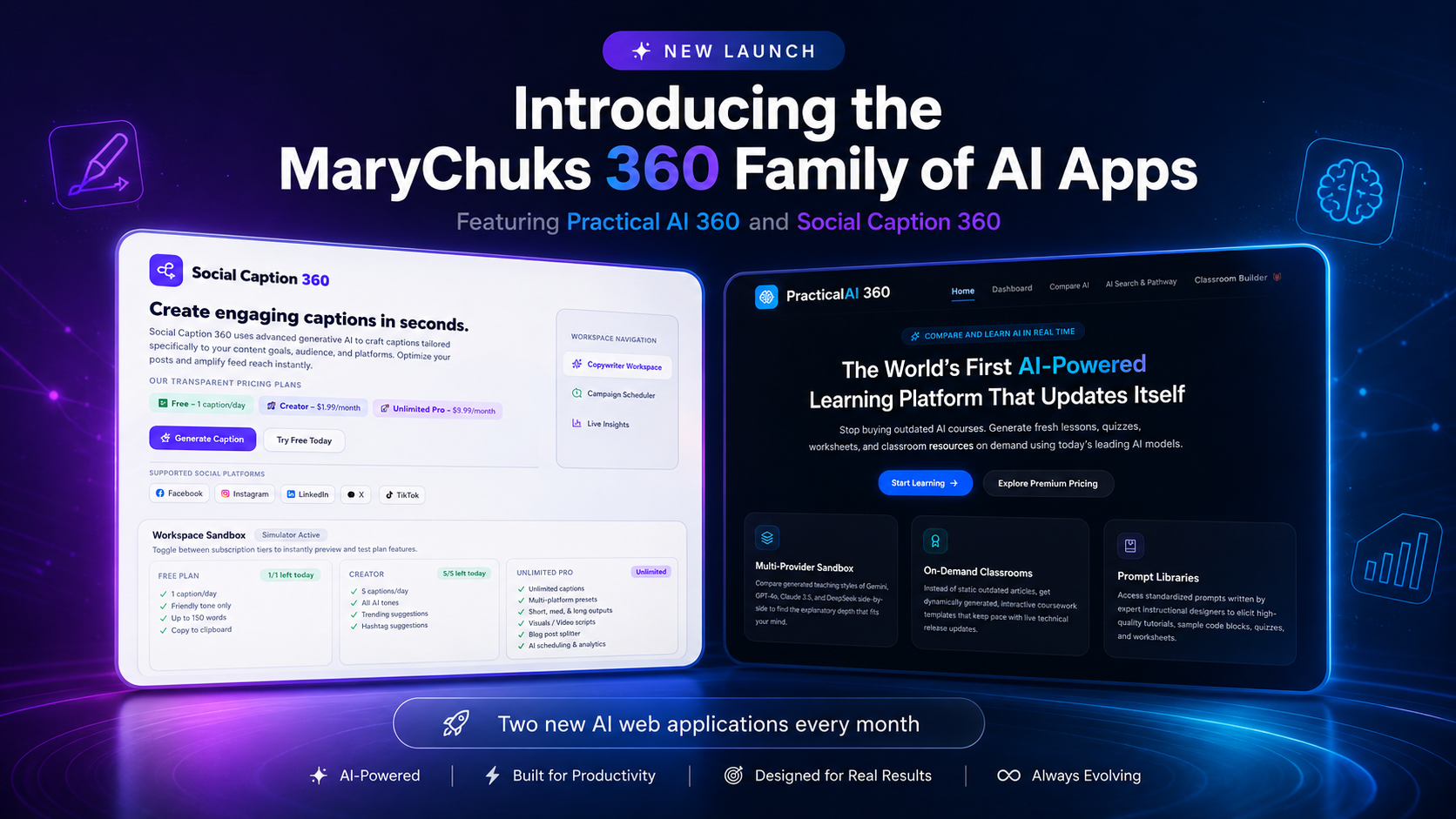
Use Practical AI 360 to explore structured ways of applying AI to everyday work, learning, creativity and business.
https://practical-ai-360-540934086793.europe-west3.run.app/
Discover more from Marychuks.com AI, Psychology, Business & CreativeVerse
Subscribe to get the latest posts sent to your email.