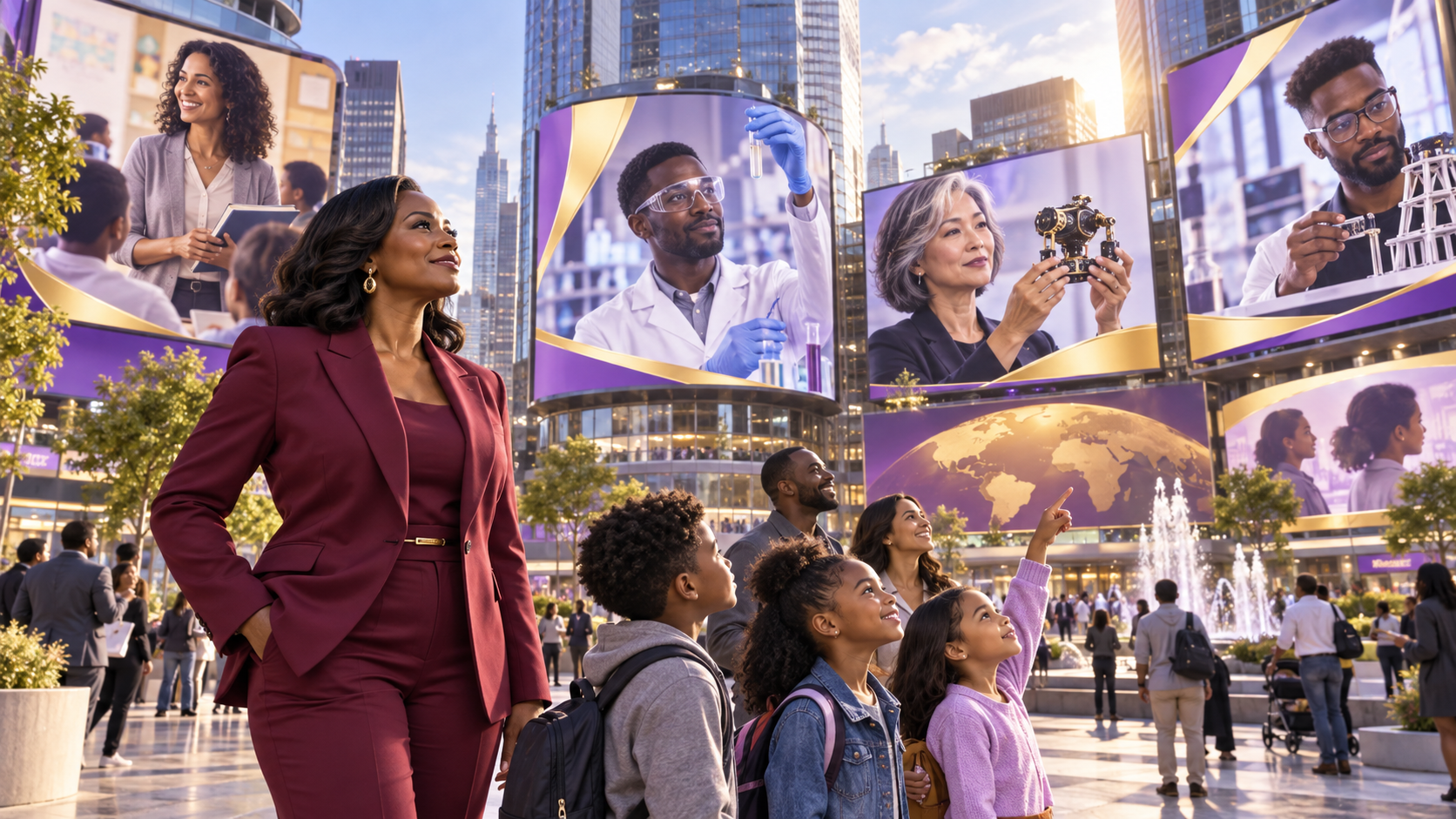

What children see celebrated in public helps define what they imagine is possible. If the largest screens in a city repeatedly display only consumption, celebrity and political power, society quietly teaches that visibility belongs to whoever can buy it.
A recent campaign in China placed scientists including Qian Xuesen, Tu Youyou, Yuan Longping and Deng Jiaxian on prominent public billboards and digital screens. The images turned prime advertising space into a lesson about discovery, service and national memory.
That campaign inspired my proposal: what if advertisers treated 10 to 15 per cent of premium public advertising inventory as a corporate-responsibility contribution to teachers, scientists, inventors, nurses, carers and community builders? I call this the 15% Billboard Principle.
This is a proposal, not an existing rule
The percentage is a design starting point, not a claim that research has identified one perfect global quota. Ten per cent would be easier for smaller networks; fifteen per cent would create stronger visibility. Different cities could test different models and publish the results.
The principle is simple: a company benefits from the public’s attention, infrastructure and labour. It can return part of that attention to the people whose work expands public knowledge and wellbeing.
Why visibility is a form of social infrastructure
Role models are often discussed as if families can simply choose them. Yet role models must first be visible. A child cannot become curious about agricultural science, classroom teaching, biomedical research or engineering if those forms of work rarely enter the public imagination.
Schools provide formal learning. Advertising teaches informally all day. It tells us which faces matter, which lifestyles signal success and which ambitions deserve aspiration. Corporate responsibility should therefore include the ecology of attention—not only carbon reports and charitable cheques.
How the 15% model could work
- Inventory contribution: outdoor-media companies reserve a percentage of unsold or premium rotating space.
- Corporate sponsorship: brands fund public-interest creative work without turning the featured person into a product endorsement.
- Local nomination: schools, universities, professional bodies and communities propose people with verifiable contributions.
- Independent curation: a diverse panel checks accuracy, representation and conflicts of interest.
- Educational extension: a safe QR code can lead to a biography, lesson plan or local learning opportunity.
- Transparent reporting: organisers publish who was represented, where, for how long and who funded the display.
Protect the idea from becoming corporate decoration
A company should not be able to celebrate one scientist on a billboard while undermining research, exploiting workers or spreading misinformation elsewhere. The programme must sit inside a wider responsibility framework.
Sponsors should not control historical facts. Featured teachers and researchers should not be forced to praise the brand. Selection should reach beyond famous names to include local excellence, women, disabled professionals, Black and minority innovators and people working outside elite institutions.
What success should measure
Impressions are not enough. A pilot should ask whether children can name more scientific and civic careers, whether linked learning pages receive visits, whether local institutions gain applications, and whether the public remembers the contribution rather than only the sponsor.
The creator-economy lesson is equally important. Public-interest campaigns need writers, photographers, filmmakers, historians and designers. Corporate responsibility can create paid creative work while strengthening educational culture.
A new prestige economy
Society does not need to stop celebrating music, sport or entertainment. Creativity gives life meaning. The problem is imbalance. When scientific discovery and daily public service are nearly invisible, prestige becomes detached from contribution.
Advertising does not merely sell products. It distributes public attention—and public attention shapes civilisation.
The 15% Billboard Principle is therefore a leadership challenge: can companies use a portion of their power to enlarge what society admires? My community-outreach experiment showed that local businesses can respond warmly when a public purpose is clear. This proposal scales that same invitation.
Build a brand with public purpose
Sources and date note
This article reflects information available on 6 September 2026. The scientist-billboard campaign was reported by the Global Times on 1 September 2026. The 10–15% model is Mary Oge Chuks’s independent proposal.
Discover more from Marychuks.com AI, Psychology, Business & CreativeVerse
Subscribe to get the latest posts sent to your email.