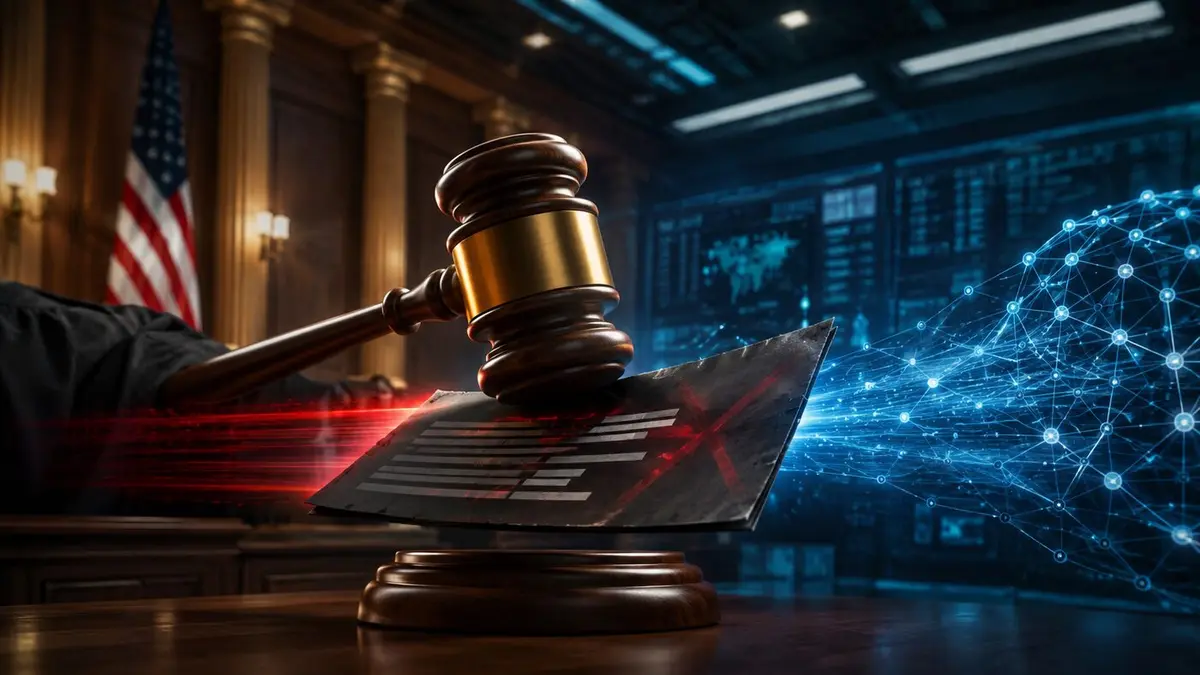
A US federal judge has blocked the Pentagon’s attempt to blacklist Anthropic, handing the maker of Claude an important legal victory in a dispute that reaches far beyond one government contract.
The ruling places a difficult question at the centre of the AI industry: can an AI company refuse uses it considers unsafe without being treated as a national-security threat?
What happened?
According to Reuters, US District Judge Rita Lin ruled that measures taken against Anthropic were unlawful and blocked enforcement of the Pentagon’s supply-chain-risk designation.
The conflict began after Anthropic refused to remove contractual safeguards covering uses such as lethal autonomous weapons and domestic mass surveillance. The Pentagon argued that those restrictions created operational problems. Anthropic argued that the government retaliated against the company for defending its stated safety boundaries and criticising official policy.
The designation was especially serious because supply-chain-risk powers are normally associated with hostile or compromised suppliers. Applied to a major American AI laboratory, it threatened not only defence work but also the company’s reputation and access to a much wider government market.
Why the ruling matters for the entire AI sector
This case is not simply Anthropic versus the Pentagon. It is a test of who ultimately controls the boundaries around powerful AI systems.
- Governments need advanced AI: defence, intelligence and cybersecurity agencies increasingly depend on commercial models.
- AI laboratories retain technical knowledge: the companies building these systems may understand their failure modes better than procurement officials.
- Democratic oversight still matters: neither a private company nor a government department should determine military AI policy without transparent rules and legal accountability.
If governments can punish laboratories whenever they refuse unrestricted deployment, voluntary safety policies could become meaningless. But if private companies can unilaterally veto lawful national-security uses, another accountability problem appears. The long-term solution cannot depend on improvised contract disputes. It requires clear legislation, independent oversight and precise definitions of prohibited use.
A major precedent for AI safety red lines
The ruling strengthens the idea that an AI laboratory’s safety position is not automatically evidence of disloyalty or supply-chain danger. Disagreement about surveillance or autonomous weapons can be a legitimate policy dispute rather than a national-security defect.
That distinction matters because frontier AI companies are being pulled in two directions. Governments want access to the most capable systems, while researchers and civil-society groups want enforceable limits on how those systems can be used. Companies also face pressure from investors who do not want ethical restrictions to close large markets.
What happens next?
The judgment does not settle every part of the conflict. Related litigation remains active, and the US government may challenge the ruling. The Pentagon has also not abandoned its broader interest in deploying advanced AI.
The most important outcome may therefore be political rather than commercial. Military AI rules need to move from private negotiations into a durable public framework that states what systems may do, which decisions must remain under meaningful human control, how models are audited and who is accountable when safeguards fail.
The MaryChuks.com perspective
Human–AI collaboration becomes credible only when collaboration includes the right to define boundaries. Safety cannot be treated as an optional promise when convenient and an obstruction when power wants faster deployment.
The Anthropic ruling is therefore bigger than one company winning in court. It is an early constitutional test for the AI age: whether technological power, military power and commercial power can be constrained by transparent rules rather than whichever institution has the strongest leverage in the moment.
Source note: This article is based on reporting published on 28 August 2026. The dispute may continue through further proceedings or appeal.
Discover more from Marychuks.com AI, Psychology, Business & CreativeVerse
Subscribe to get the latest posts sent to your email.


