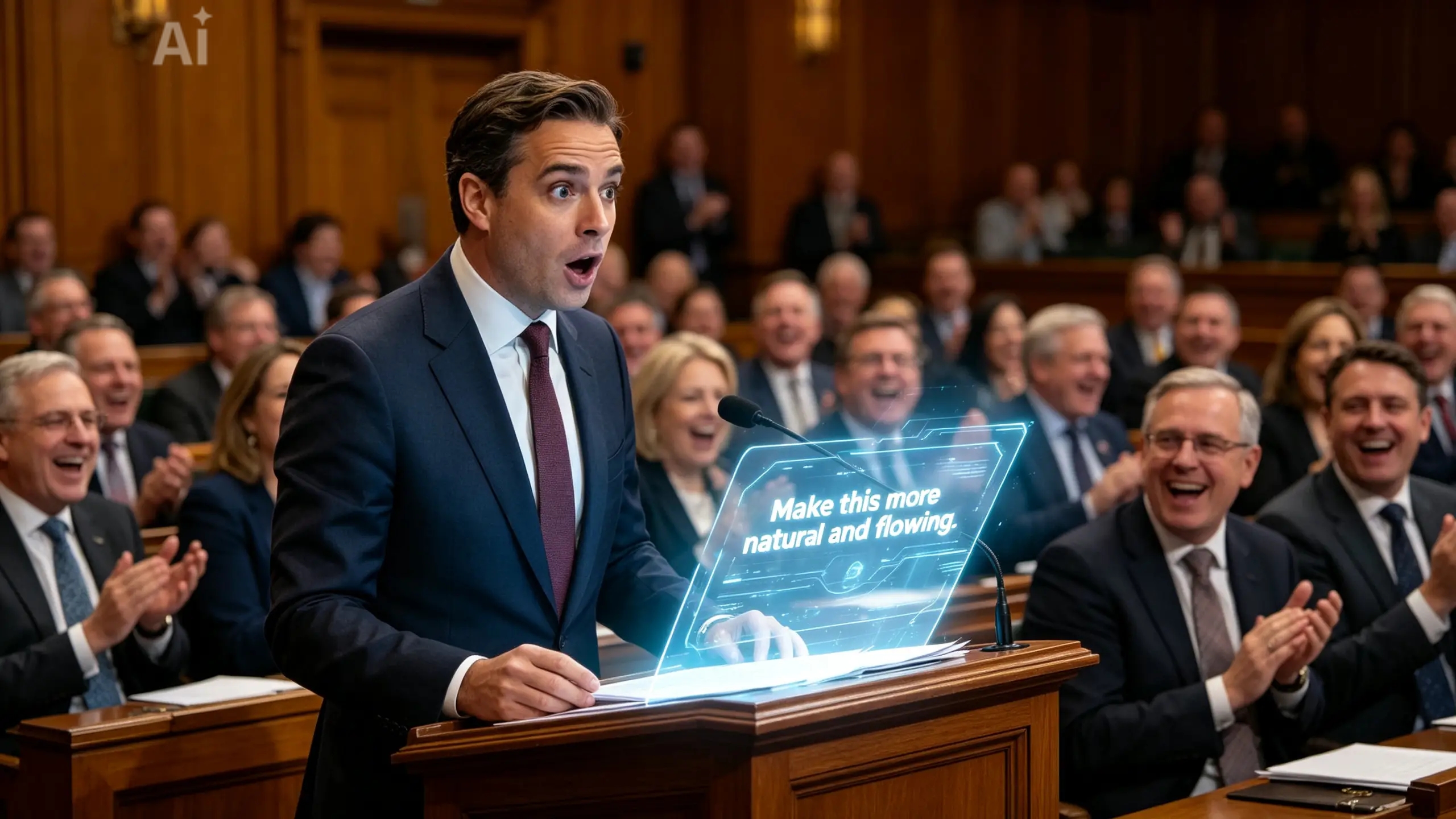
A Canadian politician has become the centre of one of the funniest artificial intelligence moments of the year after appearing to read AI-generated editing instructions aloud during an official legislative speech.
Bill Oliver, a member of the Legislative Assembly of New Brunswick, was delivering remarks to fellow lawmakers when his speech suddenly took an unexpected turn.
After speaking about public confidence in the office of an advocate, Oliver continued by reading a sentence that sounded less like part of a political speech and more like an instruction from an artificial intelligence writing assistant:
“Here’s a more natural, flowing version of that section that reads like a legislative speech rather than a series of short points.”
The line appeared to be an editing note that should have been removed before the final speech was printed.
Instead, it was read aloud in the legislature.
Oliver did not appear to pause or immediately acknowledge the unusual wording. He simply continued reading, leaving viewers to wonder whether he realised what had happened.
The clip was recorded during a speech to lawmakers in early June 2026, but it gained international attention several weeks later after spreading across social media and news platforms. Al Jazeera reported that Oliver appeared to read AI-style editing instructions aloud twice during the address. �
aljazeera.com
A Viral AI Moment That Looked Like a Behind-the-Scenes Draft
The sentence immediately caught the attention of people familiar with generative AI tools.
Anyone who regularly uses AI writing assistants will recognise the style.
Phrases such as “here is a more natural version,” “here is a clearer rewrite,” or “this version flows more smoothly” are commonly used by chatbots when introducing an edited passage.
Those instructions are usually meant for the person requesting the rewrite.
They are not normally supposed to appear inside the finished document.
That is what made the moment so funny.
The public was not simply hearing Oliver’s speech.
They were apparently hearing part of the editing conversation that may have taken place before the speech was completed.
It was the political equivalent of an actor reading a stage direction aloud or a television presenter saying, “pause here and smile at the camera.”
Was It Definitely ChatGPT?
Although many social media posts have described the line as a “ChatGPT prompt,” there is currently no publicly confirmed evidence identifying which AI tool, if any, was used.
The language strongly resembled the type of response produced by generative AI writing tools, but it would be more accurate to describe it as an apparent AI editing instruction rather than definitively claiming it came from ChatGPT.
Several reputable reports have used similarly cautious language.
Global News described the event as the apparent use of AI during a speech, while Al Jazeera reported that Oliver appeared to read AI-generated editing instructions aloud. �
Global News +1
Fast Company also reported that Oliver’s team declined to comment when contacted about the incident. �
Fast Company
That distinction matters.
Artificial intelligence stories spread quickly online, and humorous viral posts can easily turn assumptions into supposed facts.
The verified part of the story is that Oliver read wording that sounded like an editing instruction during his legislative speech.
The exact software used to create or edit the document has not been publicly confirmed.
The Internet Reacts
Once the video began circulating online, viewers quickly turned the moment into a wider debate about politicians, artificial intelligence and professional responsibility.
Some people treated it as harmless comedy.
Others criticised the apparent failure to proofread a speech before delivering it in a legislative chamber.
Fast Company reported that social media users questioned how the line survived multiple possible stages of preparation and review. Some also compared the incident with the standards applied to students, lawyers and other professionals who use AI-generated work without adequate checking. �
Fast Company
The reactions were not only about whether AI had been used.
They were about whether anyone had carefully read the final document.
That is the real issue.
Maybe He Forgot His Reading Glasses
Of course, there may be another explanation.
Perhaps Oliver forgot his reading glasses.
Perhaps the entire printed page looked like one large official block of text.
Perhaps his brain entered what might be called teleprompter obedience mode:
See words.
Read words.
Question nothing.
It is impossible to know exactly what happened in the moment, but the image of a politician reading every sentence placed in front of him has become part of the internet humour surrounding the clip.
The incident has also given AI users a new warning:
Never trust a printed document merely because it looks finished.
The Real Mistake Was Not Using AI
There is an important distinction to make.
Using artificial intelligence to help draft or improve a speech is not automatically wrong.
Politicians have always received help from speechwriters, researchers, advisers and communications teams.
AI can assist with many of the same tasks.
It can help organise ideas, improve grammar, simplify complicated language, reduce repetition and create a more natural flow.
The problem begins when people use AI output without properly reviewing it.
AI-generated writing may contain:
Editing notes
Placeholder text
Incorrect facts
Invented quotations
Repetitive language
Unintended instructions
Statements that do not reflect the speaker’s real position
A human being must therefore remain responsible for the final document.
AI may produce the first draft.
It should never be treated as the final authority.
Human-in-the-Loop Left the Building
The Oliver video is a perfect example of why MaryChuks.com consistently supports a human-in-the-loop approach to artificial intelligence.
Human-in-the-loop means that a person remains actively involved in reviewing, correcting and approving the work produced by an AI system.
The human does not merely press a button and accept everything that appears.
The human checks the facts.
The human removes instructions.
The human verifies quotations.
The human decides whether the language accurately represents their intentions.
In this case, the apparent AI tool may have completed its task correctly.
It produced or introduced a more natural and flowing version of the speech.
The failure happened after that point.
The editing instruction apparently remained inside the final text.
Someone printed it.
Someone carried it into the legislature.
And then it was read aloud.
The AI may have been inside the workflow.
The human reviewer was apparently outside it.
Why Proofreading Matters More in the AI Era
Generative AI has made content creation faster than ever.
A speech that once took several hours to draft can now be produced in minutes.
However, greater speed creates a new psychological risk.
When a document looks polished, people may assume it is complete.
Clean grammar can create an illusion of accuracy.
Professional formatting can create an illusion of authority.
Fluent writing can make people less likely to question what they are reading.
This is sometimes described as automation bias: the tendency to trust the output of a technological system simply because it was generated by a machine.
The more convincing AI becomes, the more important human judgement becomes.
A poorly written document encourages scrutiny.
A polished AI-generated document may slip through because it already looks finished.
That is why proofreading is no longer only about correcting spelling and punctuation.
It is now also about detecting machine instructions, hallucinated information and language that does not belong in the final publication.
A Simple AI Publishing Checklist
Before delivering, publishing or submitting any AI-assisted content, users should ask five basic questions:
1. Are there any instructions left inside the document?
Search for phrases such as:
“Here is a revised version”
“You could say”
“This section can be improved”
“Let me know if you would like”
“Here is a more natural version”
These are usually assistant notes, not part of the final content.
2. Have all facts been verified?
AI systems can produce incorrect names, dates, statistics and references.
Every important claim should be checked against a reliable source.
3. Does the document reflect the speaker’s actual beliefs?
Fluent language is not the same as authentic language.
The speaker should understand and agree with every statement.
4. Has another person reviewed the final version?
A second pair of eyes can catch mistakes that the original editor may overlook.
5. Has the final version been read aloud?
Reading a document aloud is one of the easiest ways to detect awkward wording, hidden instructions and sentences that do not belong.
Had the speech been rehearsed aloud before the legislative session, the editing note might have been noticed.
AI Did Its Job; Quality Control Did Not
The viral moment is funny because it exposes the machinery behind the polished speech.
Audiences are normally presented with the final product.
They do not hear the prompts, revisions, editing notes or internal instructions that helped create it.
On this occasion, the curtain briefly opened.
The audience heard what appeared to be part of the production process.
Yet the lesson should not be that people must stop using AI.
The lesson is that people must use AI responsibly.
AI can strengthen human communication.
It can improve structure and clarity.
It can help speakers organise complex ideas.
But it cannot take responsibility for the final words spoken in public.
That responsibility still belongs to the person holding the paper.
Conclusion
Bill Oliver’s viral legislative moment will probably be remembered as one of the most amusing examples of AI-assisted writing escaping into the real world.
The exact tool used has not been publicly confirmed, so claims that the instruction definitely came from ChatGPT should be treated cautiously.
What is clear is that Oliver read a sentence that appeared to be an AI-style editing instruction during an official speech, and the video quickly became an international talking point. The story is entertaining, but the lesson is serious.
AI can draft.
AI can edit.
AI can make writing more natural and flowing.
But before the words reach a classroom, courtroom, boardroom, website or legislature, a human being must review them.
Otherwise, the audience may receive the speech and the behind-the-scenes instructions at the same time.
And yes, perhaps next time someone should also check that the speaker remembered his reading glasses.
References
Al Jazeera — “Moment Canadian politician accidentally reads AI prompt during speech,” published 28 July 2026. The report states that Bill Oliver appeared to read AI-generated editing instructions aloud twice during a speech to lawmakers in early June. �
aljazeera.com
Global News — Bill Oliver news page and report on the viral New Brunswick legislative speech, published 29 July 2026.
Global News described the event as a speech containing unusual passages and apparent AI use. �
Global News
Fast Company — “Lawyers, teachers, and students face consequences when they use AI to do their jobs. What about politicians?”, published 27 July 2026. The article provides the wording read during the speech, online reactions, and confirmation that Oliver’s team declined to comment.
Discover more from Marychuks.com AI, Psychology, Business & CreativeVerse
Subscribe to get the latest posts sent to your email.