The phrase “open-source AI” often creates a simple assumption:
Open means free.
Alibaba and Moonshot AI are demonstrating that the future may be more complicated.
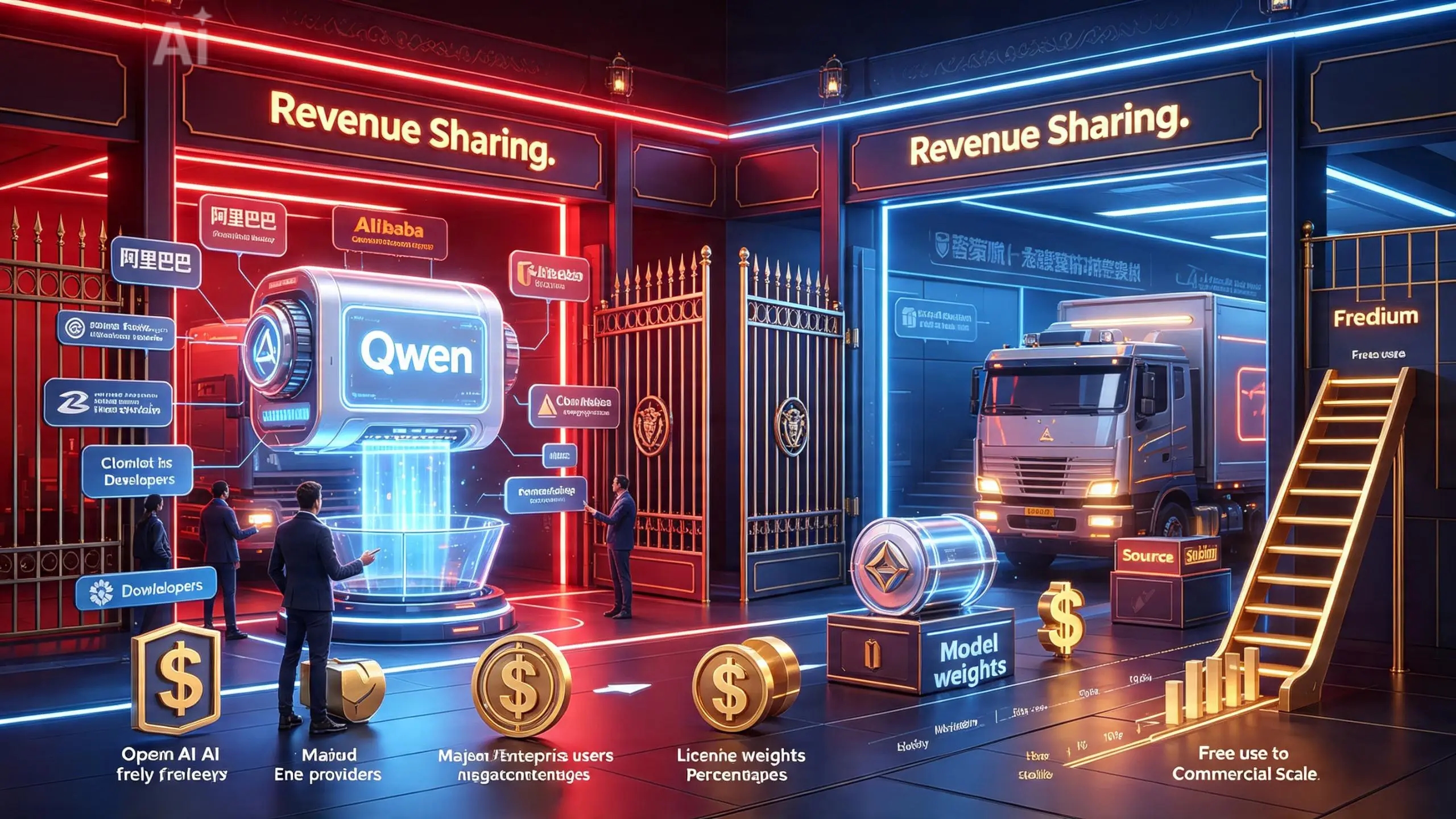
Reuters reports that Alibaba plans to require some major commercial users of the next version of its Qwen model to share part of the revenue they generate from it.
The approach resembles Moonshot AI’s licensing strategy for Kimi K3, which includes commercial terms for companies earning large amounts of revenue by offering the model as a service. �
Reuters
The development may redefine one of the most important business assumptions in the AI industry.
Open Weights Do Not Mean Unlimited Commercial Freedom
Qwen3.8-Max is an open-weight model.
That means developers can obtain the trained model weights and potentially run or modify the system themselves.
But licensing determines what people are legally allowed to do with those weights.
Reuters reports that Moonshot’s Kimi K3 licence requires businesses generating more than $20 million in annual sales from offering the model as a service to negotiate a commercial agreement. One source said Moonshot has sought revenue shares of up to 30% in some cases. �
Reuters
Alibaba is reportedly preparing a similar model for its next Qwen release, although the exact revenue-share percentage remains undecided. �
Reuters
Why Give the Model Away First?
Because openness can create distribution.
Thousands of developers experiment with the model.
Startups integrate it.
Cloud companies optimise it.
Researchers test it.
Businesses begin building workflows around it.
The model becomes familiar.
Then, when somebody turns that ecosystem into a large commercial business, the original developer can ask:
“Lovely success. Where is our percentage?” 😋🤣
This is the classic freemium strategy applied to frontier AI.
Reuters quoted DigitalOcean chief executive Paddy Srinivasan, describing the model as a tried-and-tested open-source freemium approach. �
Reuters
Why Chinese Labs Need Revenue
Training frontier models costs enormous amounts of money.
Even when the model weights are released openly, developers still need to fund:
Training runs
Data centres
Chips
Researchers
Post-training
Safety testing
Future versions
Inference infrastructure
Giving everything away indefinitely is difficult unless another business subsidises it.
Alibaba can monetise cloud usage.
Moonshot needs other ways of recovering research costs.
Revenue sharing may allow open distribution without abandoning commercial sustainability.
Is It Still Open Source?
This is where terminology gets messy.
Traditional open-source software licences often allow broad commercial use without requiring revenue sharing.
Many AI systems described casually as “open source” are more accurately described as open-weight because only part of the full development process is accessible.
A model can have downloadable weights while still imposing commercial restrictions.
That does not automatically make the model bad or deceptive.
It means developers must read the licence rather than trusting the word “open” in a headline.
Why This Story Is Viral
For years, the AI battle appeared to offer two models:
Closed American AI: Pay for API access.
Open Chinese AI: Download it and run it yourself.
That boundary is blurring.
Chinese developers appear to be asking:
Why should openness mean allowing billion-dollar companies to make unlimited money from our research without paying us?
It is a fair commercial question.
It is also a warning to startups building businesses on models they do not own.
Mary Chuks’ Perspective
This story is important for every AI entrepreneur.
Never build your business model around the word free.
Build it around the licence.
A model can be free today and commercially restricted tomorrow.
The safest strategy is multi-model orchestration.
If your application can switch among Qwen, Kimi, Claude, GPT, Gemini, and others, one licence change does not destroy the entire product.
That is why the application layer matters.
The model is an engine.
Your workflow, customers, brand, and data are the business.
Practical Takeaways for AI Startups
Before deploying any open-weight model commercially:
Read the full licence.
Check revenue thresholds.
Confirm whether the SaaS resale is permitted.
Track which model generated which customer output.
Keep alternative providers available.
Budget for future commercial licensing.
Avoid presenting “open” as equivalent to “free forever.”
Review licences again when new model versions arrive.
Conclusion
Open AI is not disappearing.
It is becoming a business model.
Alibaba and Moonshot appear to be showing that a company can distribute powerful models widely while still expecting the largest commercial beneficiaries to pay.
The future may not be open versus paid.
It may be:
Open until you scale. Then, welcome to the Scaler Bill. 🤣
Original Source and Further Reading
Reuters reported Alibaba’s planned Qwen commercial-revenue-sharing model and Moonshot’s existing Kimi K3 licensing structure on 7 August 2026. �
Discover more from Marychuks.com AI, Psychology, Business & CreativeVerse
Subscribe to get the latest posts sent to your email.