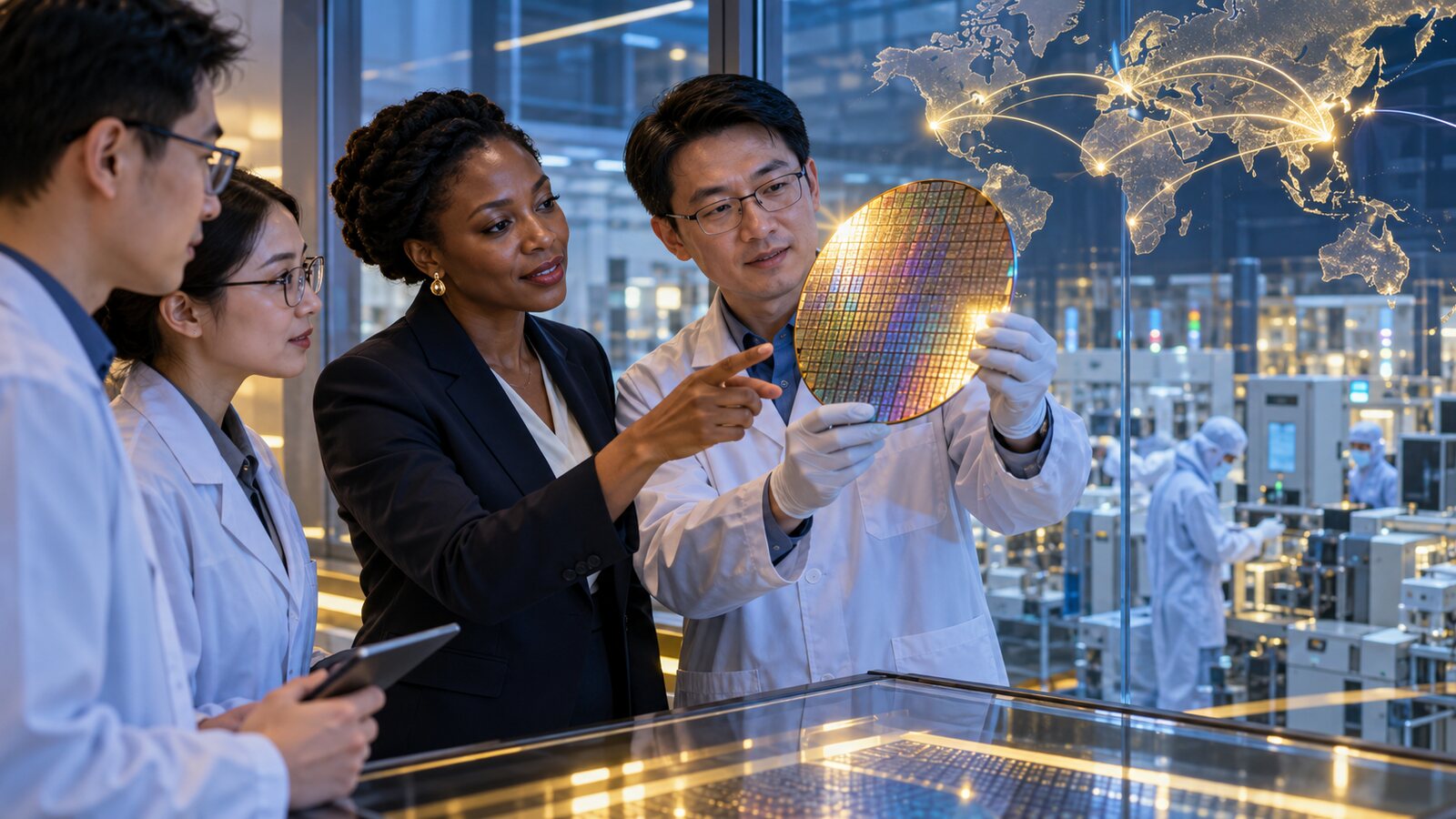

Semiconductors are no longer merely components inside phones and servers. They have become instruments of industrial policy, national security and diplomacy. Taiwan’s extraordinary position in advanced chip manufacturing gives it economic strength—and places it under growing pressure to share more of the AI supply chain with international partners.
Reuters reported on 7 September 2026 that Taiwan is emphasising its role as a democratic and reliable technology partner while governments seek domestic capacity. The strategy can be understood as chip diplomacy: investing abroad, supporting trusted supply chains and turning manufacturing expertise into long-term relationships.
Why one island matters to the global AI economy
Modern AI depends on a physical stack: advanced processors, memory, packaging, networking, electricity, cooling and data centres. Taiwan sits near the centre of that stack because of its manufacturing ecosystem and the capabilities of companies such as TSMC.
That concentration has created efficiency, but it also creates geopolitical and operational risk. Customers and governments want resilience. Taiwan, meanwhile, wants overseas expansion to reinforce—not hollow out—its domestic technology base.
Investment announcements require careful reading
The Reuters report described TSMC’s global expansion and cited a reported commitment of about $265 billion in Arizona, alongside discussion of a possible further $20 billion. These figures should not be treated as completed factories or instantly available capacity. Announced investment, construction, equipment installation and high-volume production are different stages.
Europe is also considering how a second Chips Act could strengthen its position. Again, proposals and policy debates are not the same as enacted funding or completed fabrication lines. Date-stamping these claims matters because semiconductor plans evolve over years.
The diplomatic bargain
A host country gains jobs, supply security and access to an essential technology. Taiwan gains deeper commercial and political relationships. The company undertaking the investment gains proximity to major customers and incentives—but may face higher costs, workforce constraints and operational complexity.
This is why chip policy cannot be reduced to ribbon-cutting. A fabrication plant needs specialised suppliers, skilled engineers, reliable power and water, logistics and a customer base. Our article on TCS’s planned 1GW AI data centre made the same point from the demand side: compute is becoming public infrastructure.
What businesses should learn
- Diversify critical dependencies. Know which chips, cloud regions and vendors can interrupt your service.
- Separate announcement from capacity. Build timelines around production reality, not headline value.
- Follow packaging and memory. Leading-edge fabrication is only one potential bottleneck.
- Price resilience. Redundancy costs money, but a single point of failure can cost more.
- Track policy. Export controls, subsidies and energy rules can reshape the economics of a product.
Consumers already see the consequences when supply tightens. “RAMageddon” explored how AI demand can raise the cost of everyday electronics. The earlier NVIDIA and Hugging Face analysis examined a different kind of stack concentration. Together, they show why ownership and access are central questions in the AI economy.
Conclusion
Taiwan’s chip diplomacy is an attempt to convert technical excellence into durable partnership while preserving a strategic home base. The world wants more geographic resilience; Taiwan wants expansion to strengthen its security and prosperity. Whether both goals can be achieved will depend on execution, not announcements alone.
Sources and further reading
Discover more from Marychuks.com AI, Psychology, Business & CreativeVerse
Subscribe to get the latest posts sent to your email.



One thought on “Taiwan’s Chip Diplomacy: When Semiconductor Capacity Becomes Foreign Policy”