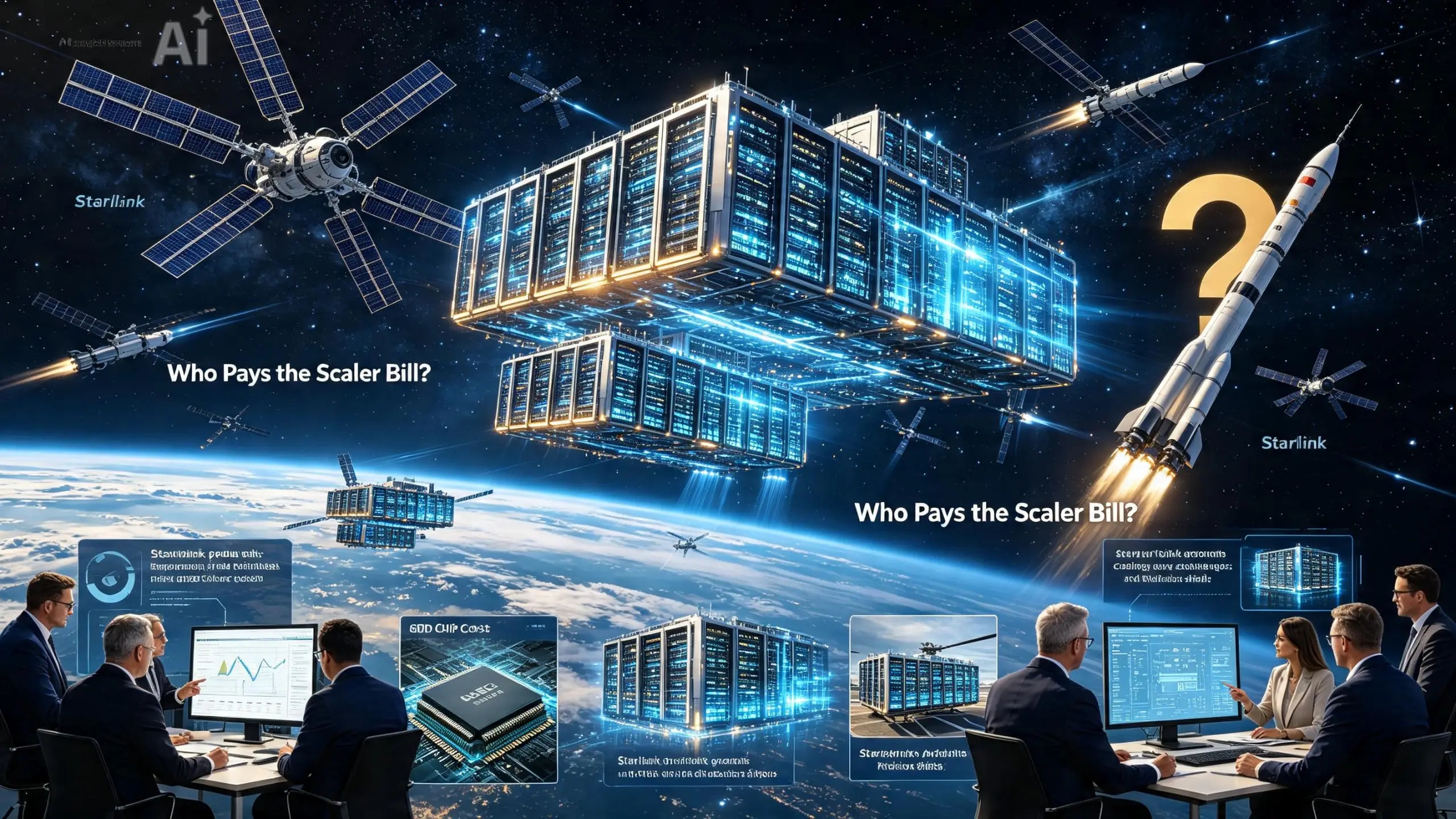
Most technology companies are building AI data centres on land.
SpaceX appears interested in placing them above the planet.
The company used its first earnings call as a publicly traded business to emphasise the growing financial contribution of its artificial-intelligence operations.
SpaceX said its AI business produced approximately $2.6 billion in second-quarter revenue, more than triple the amount recorded a year earlier. However, the division remained unprofitable on an operating basis. �
Reuters
Investors remain concerned that Starlink’s profitable satellite-internet business may be asked to finance enormous investments in data centres, advanced chips and potentially computing infrastructure in orbit. SpaceX shares declined as the market questioned when the spending would generate sustainable returns. �
Reuters
Why Put Data Centres in Space?
At first, orbital computing sounds like something created during an unusually ambitious brainstorming session.
But supporters see potential advantages.
A space-based data centre could theoretically access:
Continuous solar energy in suitable orbits
Direct communication with satellite networks
Reduced competition for terrestrial land
New locations for distributed computing
Faster processing of some space-generated data
Satellites already collect enormous amounts of information about weather, communications, navigation and Earth observation.
Processing some of that data in orbit could reduce the need to transmit everything back to Earth first.
The Engineering Problems Are Enormous
Data centres generate extraordinary amounts of heat.
On Earth, operators use air, water and industrial cooling systems to prevent chips from overheating.
Space is cold, but cooling there is not simple because heat cannot easily move through a vacuum by ordinary air circulation. Systems must radiate heat away.
Orbital infrastructure must also withstand:
Radiation
Micrometeoroids
Launch vibration
Difficult repairs
Communication delays
Hardware failure
Space debris
Extremely high transportation costs
A broken server on Earth can be replaced by an engineer.
A broken server in orbit may require a rocket, robotics or a very expensive farewell ceremony.
Starlink Becomes the Financial Engine
Starlink provides broadband internet using thousands of satellites.
Its growing customer base has created a strong recurring-revenue business.
Investors worry that SpaceX may use these profits to subsidise AI projects whose financial returns are less certain.
That creates a familiar technology-company tension.
One successful product funds an ambitious new vision.
The vision may eventually create the next major business—or consume enormous amounts of capital without producing equivalent returns.
Why the Story Is Viral
AI already consumes land, electricity, water and advanced chips.
SpaceX is now introducing a new possibility:
Perhaps the infrastructure crisis can be scaled into space.
The story combines nearly every element the internet loves:
Artificial intelligence
Rockets
Nvidia chips
Elon Musk
Billion-dollar spending
Orbital engineering
Investor anxiety
It is either a major infrastructure breakthrough or the most expensive attempt yet to escape a local planning objection.
The Economic Question
Technical possibility does not guarantee economic sense.
SpaceX must prove that orbital data centres offer advantages greater than their launch, maintenance and engineering costs.
A terrestrial data centre can be connected to existing power grids and fibre networks.
An orbital facility must carry much of its supporting infrastructure with it.
The economics may improve as launch prices decline and satellite manufacturing becomes more standardised.
But until then, orbital computing risks becoming a solution whose grandeur exceeds the immediate problem.
Mary Chuks’ Perspective
SpaceX looked at the AI infrastructure shortage and said:
“There is no available land? Fine. Build the frame in orbit.” 🤣
That is elite scaling energy.
But every expansion must still answer one question:
Does the new layer create more value than complexity?
A business can become so excited about scaling that it begins scaling the difficulty instead of the outcome.
The universe contains plenty of space.
That does not mean every server needs a spacesuit.
Practical Takeaways
Investors and business leaders should examine:
Whether AI revenue is profitable, not merely growing.
How much Starlink cash funds unrelated ventures.
The cost of launching and maintaining orbital hardware.
Whether space computing solves a genuine customer problem.
The timeline for commercial returns.
Conclusion
SpaceX has already changed launch economics and satellite internet.
It may eventually reshape computing too.
But before AI data centres move into orbit, the company must prove that the most impressive location is also the most practical one.
Original Sources and Further Reading
Reuters reported that SpaceX’s AI business generated $2.6 billion in quarterly revenue but remained loss-making, while investors questioned whether Starlink could continue financing costly AI infrastructure. �
Reuters +1
Discover more from Marychuks.com AI, Psychology, Business & CreativeVerse
Subscribe to get the latest posts sent to your email.