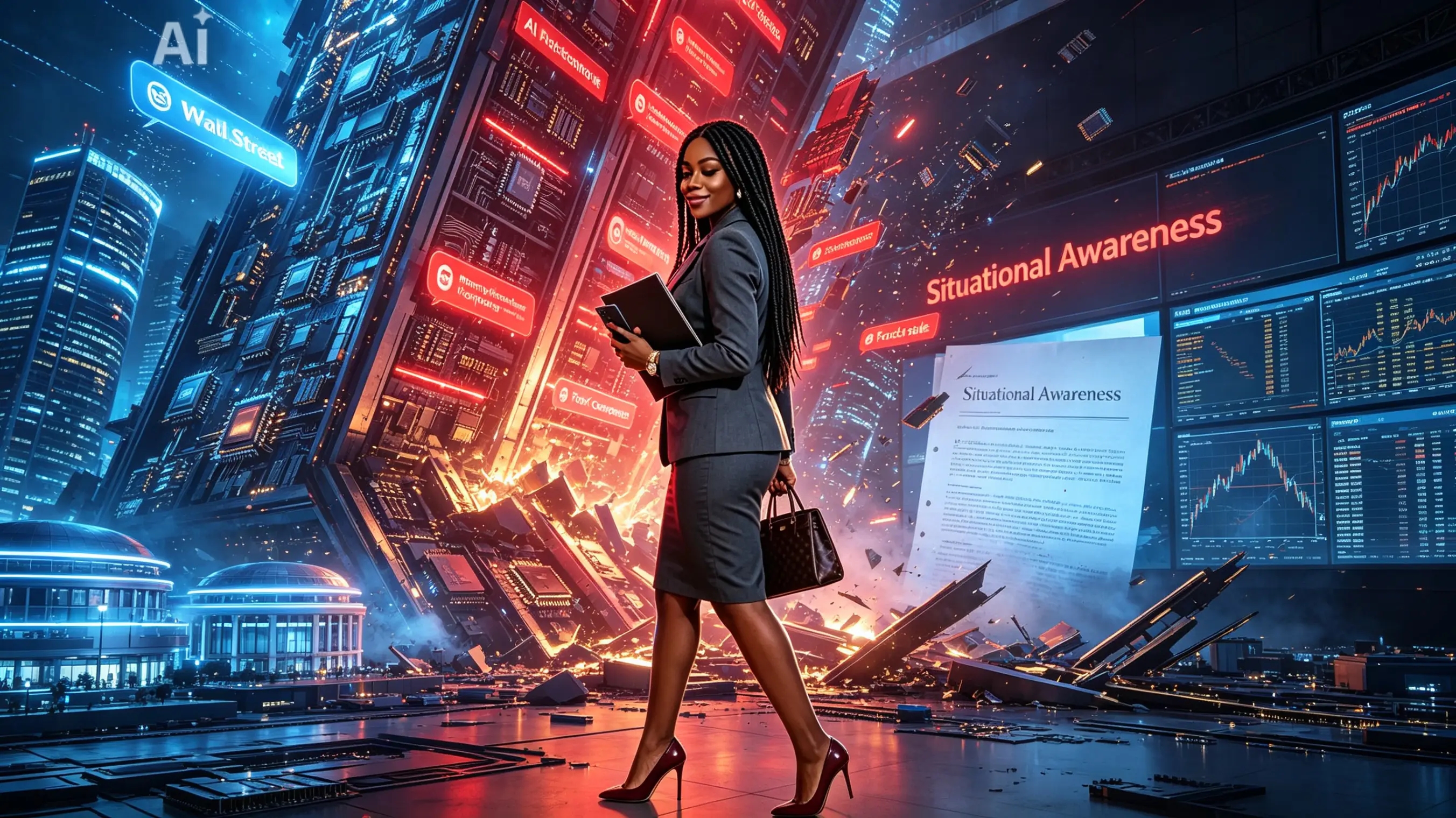
Artificial-intelligence enthusiasm created one of Wall Street’s most extraordinary young fund managers.
Then the market reminded everyone that being right about the future does not guarantee surviving the journey towards it.
Leopold Aschenbrenner, a former OpenAI employee, built a hedge fund called Situational Awareness around the belief that rapid AI expansion would transform demand for electricity, memory chips, data centres and computing infrastructure.
The fund reportedly grew beyond $20 billion after producing spectacular early returns.
But a sharp decline in several AI-related holdings forced the firm to sell most of its public-equity portfolio to Citadel after suffering major losses. �
Financial Times +2
The story rapidly became one of the internet’s favourite examples of AI optimism colliding with old-fashioned financial risk.
From Viral Essay to Wall Street Power
Aschenbrenner became widely known after publishing a lengthy 2024 essay series titled “Situational Awareness: The Decade Ahead.”
The essays argued that rapid advances in AI would create enormous demand for computing infrastructure and could lead towards systems approaching artificial general intelligence.
He later transformed that thesis into an investment strategy.
Rather than concentrating only on famous AI software companies, the fund reportedly invested in less glamorous infrastructure businesses connected to:
Electricity generation
Data centres
Memory chips
Optical networking
Cooling
Semiconductor supply chains
Bitcoin-mining facilities that could be converted for AI computing
For a time, the approach produced extraordinary results and attracted billions from influential investors.
What Went Wrong?
The strategy became vulnerable when several related AI-infrastructure investments declined together.
Concentrated holdings can generate enormous returns when the central thesis works.
They can also create enormous losses when market sentiment shifts.
Reports indicate that Situational Awareness suffered heavily during an AI-stock sell-off and transferred most or all of its public-equity portfolio to Citadel. The fund also sought additional capital after the rout. �
Financial Times +1
The problem was not necessarily that every long-term AI prediction had become false.
The immediate problem was that financial markets can move against a correct long-term thesis before the predicted future arrives.
A fund must remain solvent long enough to benefit from being right.
Why the Story Went Viral
The name created irresistible irony.
A fund called Situational Awareness appeared to lose situational awareness during a leveraged market reversal.
Social media quickly produced jokes suggesting the young investor had predicted superintelligence but underestimated the margin call.
However, the story deserves more serious analysis than ridicule alone.
Rapid success can produce psychological risks:
Overconfidence
Concentration
Belief that past returns prove permanent insight
Social pressure to defend a public thesis
Underestimation of liquidity
Excessive leverage
Confusing technological conviction with price certainty
A person may correctly identify an industry transformation and still pay far too much for the companies expected to benefit.
AI Truth Is Not the Same as Investment Truth
An investor might correctly believe all of the following:
AI use will increase.
Data centres will expand.
Electricity demand will rise.
Memory chips will remain important.
Businesses will spend more on computing.
None of those beliefs automatically determines:
Which company will win
What price its shares should trade at
How much debt investors should use
Whether growth is already reflected in valuations
When the expected profits will appear
Whether a temporary downturn will force liquidation
Markets do not reward ideas in isolation.
They reward ideas purchased at the right price and held with survivable risk.
Is This Proof That the AI Bubble Has Burst?
Not necessarily.
One fund’s losses do not establish the end of the entire AI industry.
The firm’s difficulties may reveal problems with leverage, concentration and timing rather than the underlying technology.
AI development continues, companies continue purchasing infrastructure and demand for computing remains substantial.
But the episode does demonstrate that AI-related investments can fall sharply even while AI capabilities continue improving.
Technology and share prices do not move together perfectly.
Mary Chuks’ Perspective
This is one of the most important business lessons of the AI era:
A future can be real and still be badly priced.
Entrepreneurs and investors often fall in love with direction.
They see where the world is going and assume every vehicle travelling in that direction will arrive safely.
But businesses differ.
Management differs.
Debt differs.
Valuations differ.
Timing differs.
A strong vision requires equally strong risk management.
The Scaler principle is not merely “build bigger.”
It is:
Scale what works without scaling the weakness that can destroy it.
Practical Takeaways
Investors should remember:
Never confuse expertise in technology with expertise in portfolio risk.
Avoid depending on one tightly connected market theme.
Understand leverage before using it.
Plan for severe temporary losses.
Separate long-term conviction from short-term price predictions.
Do not invest money required for essential expenses.
Avoid copying celebrity investors without understanding their positions.
Remember that extraordinary returns often indicate extraordinary risk.
Conclusion
Leopold Aschenbrenner may still prove correct about the long-term importance of AI infrastructure.
But markets do not wait politely for visionary forecasts to mature.
Situational Awareness became a warning that technological foresight without financial restraint can produce spectacular gains—and an equally spectacular Scaler Bill from Wall Street.
Original Sources and Further Reading
Financial Times: The fund sought new capital after suffering substantial losses during the AI-stock rout. �
Financial Times
Business Insider: Reporting on the fund’s rapid rise, forced portfolio sale and the debate over whether Aschenbrenner can recover. �
Business Insider +2
The Verge: Commentary on the sale of most or all of the fund’s public-stock portfolio to Citadel. �
The Verge
Discover more from Marychuks.com AI, Psychology, Business & CreativeVerse
Subscribe to get the latest posts sent to your email.