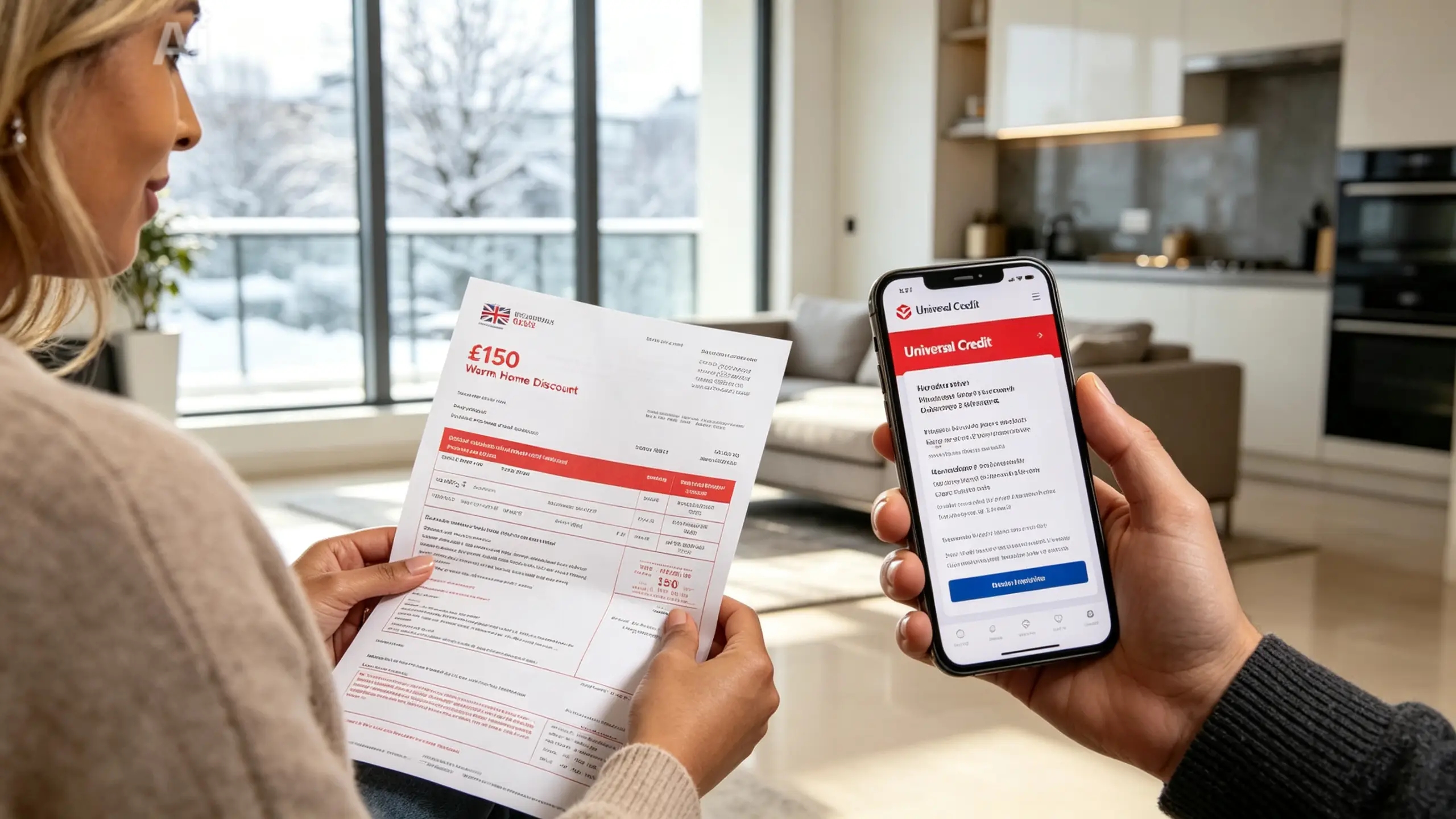
Millions of households across Britain could receive a £150 reduction on their energy bills through the Warm Home Discount Scheme during winter 2026–2027.
The support is particularly relevant to people receiving four means-tested benefits:
Universal Credit
Housing Benefit
Pension Credit
Income-related Employment and Support Allowance
However, one important detail could determine whether an eligible household receives the discount automatically: the name registered on the electricity account on 23 August 2026.
The support has attracted renewed attention as Prime Minister Andy Burnham’s government places the cost of living at the centre of its early policy agenda.
But households should understand exactly what the £150 support is—and what it is not.
The £150 Is an Energy-Bill Discount, Not a Cash Payment
Despite some headlines describing the support as a cost-of-living “payment,” the Warm Home Discount is not normally deposited into a person’s bank account.
Instead, an eligible household’s energy supplier applies a one-off £150 credit directly to the electricity bill.
The official government guidance states that the scheme will reopen in October 2026 and that qualifying households will usually receive the discount automatically. �
GOV.UK
That distinction matters.
People should not expect a £150 DWP bank transfer. They should instead look for the reduction or credit appearing on their electricity account during the winter payment period.
Some households with combined gas and electricity accounts may be able to request that the discount be applied to their gas bill instead, depending on their supplier.
Which Benefits Qualify in England and Wales?
For the 2026–2027 scheme, households in England and Wales may qualify when the person named on the electricity account—or their partner—receives one of the following:
Universal Credit
Universal Credit supports people who are unemployed, unable to work or earning a low income.
Housing Benefit
Housing Benefit helps eligible households with rental costs, although many working-age claimants now receive housing support through Universal Credit.
Income-Related Employment and Support Allowance
Income-related ESA provides support to people whose illness or disability affects their ability to work.
Pension Credit
Both eligible pensioners receiving Pension Credit and their partners may qualify, provided the relevant energy-account conditions are satisfied.
The government’s current England and Wales guidance identifies these four means-tested benefits as the qualifying routes for the scheme. �
GOV.UK
Why 23 August 2026 Matters
The qualifying date for households in England and Wales is 23 August 2026.
On that date, all of the following should apply:
The household’s energy supplier participates in the scheme.
The claimant or their partner receives a qualifying means-tested benefit.
The claimant’s name—or their partner’s name—is registered on the electricity bill.
This means a person could receive Universal Credit or another qualifying benefit but still face complications if the energy account is registered under somebody else’s name.
For example, problems may arise where:
A former partner remains named on the account.
The bill is registered only in a landlord’s name.
An adult child pays the energy supplier for the household.
A recently bereaved person has not updated the account.
A couple has separated but the account details remain unchanged.
A household has recently moved and the supplier records are incomplete.
Anyone in one of these situations should contact their energy supplier as soon as possible and make sure the account information accurately reflects the household.
Will People Need to Apply?
Most eligible households in England and Wales should receive the discount automatically.
Government departments use benefit information and energy-supplier records to identify qualifying households. This data-matching process is intended to reduce the number of people who miss out because they did not submit an application.
However, automatic does not mean households should ignore their accounts.
People should still check that:
Their supplier has the correct name.
Their address is accurate.
Their benefit records contain their current address.
Their electricity account is active.
Their supplier participates in the scheme.
Scotland operates under different eligibility and application arrangements. Some Scottish households may need to apply directly through their supplier, while other groups receive the discount automatically. �
Ofgem +1
The Warm Home Discount Scheme does not operate in Northern Ireland, where different energy-support arrangements are available.
Can Prepayment-Meter Customers Qualify?
Yes.
People using prepayment or pay-as-you-go electricity meters may still qualify for the Warm Home Discount.
The supplier may provide the support through a voucher, account credit or another top-up method rather than applying it to a conventional monthly bill.
Prepayment customers should ensure their supplier has up-to-date contact details so that letters, emails or vouchers do not go missing.
Will the Discount Affect Other Winter Support?
Receiving the Warm Home Discount should not reduce a household’s entitlement to the Cold Weather Payment or Winter Fuel Payment.
These are separate forms of support with different eligibility rules.
The Warm Home Discount specifically provides a £150 reduction against an eligible household’s energy costs. �
GOV.UK
The Wider Cost-of-Living Programme
The renewed focus on the £150 scheme comes as the Burnham government announces broader measures intended to reduce household expenses.
The government has also announced plans to remove VAT from domestic electricity bills from 1 October 2026, with an estimated average saving of about £45 per year.
A national £2 cap on many single bus journeys in England is also planned from January 2027. �
United Response
These policies are being presented as the beginning of a longer effort to give households greater financial “breathing space.”
However, the real effect will vary.
A £150 discount can make a meaningful difference to a low-income household, particularly during winter. But it does not remove the deeper pressures created by rent, food costs, childcare, transport expenses and persistent energy-price uncertainty.
Why Accurate Headlines Matter
There is an important difference between saying:
“People on benefits will receive a £150 payment”
and saying:
“Eligible households may receive a £150 discount on their energy bill.”
The second description is more accurate.
Not every individual receiving one of the named benefits will automatically qualify in every circumstance. The energy supplier, account holder, qualifying date and place of residence all matter.
Good public-interest journalism should help readers understand the conditions rather than simply presenting a large number in the headline.
What Households Should Do Now
Before 23 August, potential beneficiaries should:
Check whose name appears on the electricity bill.
Update any incorrect address or personal details.
Confirm that the energy supplier participates in the scheme.
Ensure benefit records show the current home address.
Keep copies of recent energy statements.
Watch for official letters or emails during the autumn.
Contact the supplier if the discount does not appear when expected.
Households should use official government guidance or contact their energy company directly rather than relying on unsolicited messages.
Cost-of-living schemes frequently attract scammers who impersonate government departments or energy suppliers.
People should be cautious of messages requesting bank details, passwords or upfront “processing fees” for the Warm Home Discount. Since the support is normally applied directly to the energy account, a demand for payment should immediately raise suspicion.
MaryChuks Analysis
The £150 discount may appear modest when considered against a full year of household expenses. But for a family already balancing rent, food, transport and winter heating, it could create valuable breathing room.
The greatest immediate risk is not necessarily ineligibility.
It is administrative exclusion—an eligible person missing support because the energy bill is held under the wrong name or because records have not been updated.
Public policy does not succeed merely because support has been announced. It succeeds when the people entitled to that support can actually access it.
That is why households should not wait until winter to inspect their accounts.
A five-minute check today could protect a £150 reduction tomorrow.
Discover more from Marychuks.com AI, Psychology, Business & CreativeVerse
Subscribe to get the latest posts sent to your email.