Artificial Intelligence has become one of the most transformative technologies of our time. It is writing articles, diagnosing diseases, assisting students, generating artwork, helping businesses make decisions, and even supporting scientific discoveries. Yet despite these advances, reactions to AI remain divided.
Some people eagerly experiment with every new AI tool they encounter, while others avoid AI altogether, convinced it is dangerous or untrustworthy.
Why do intelligent people respond so differently to the same technology?
The answer lies less in AI itself and more in the psychology of trust.
Understanding how humans build trust can help individuals, businesses, educators, and policymakers encourage responsible AI adoption while addressing genuine concerns.
What Is Trust?
Trust is the willingness to become vulnerable because we expect another person—or system—to behave predictably and beneficially.
Psychologists generally associate trust with three elements:
Predictability
Competence
Good intentions
Humans naturally trust people and technologies that consistently demonstrate these qualities over time.
AI challenges each of these expectations.
Why Some People Fear AI
Fear is often a rational response to uncertainty.
Most people are not actually afraid of algorithms.
They are afraid of what they cannot predict.
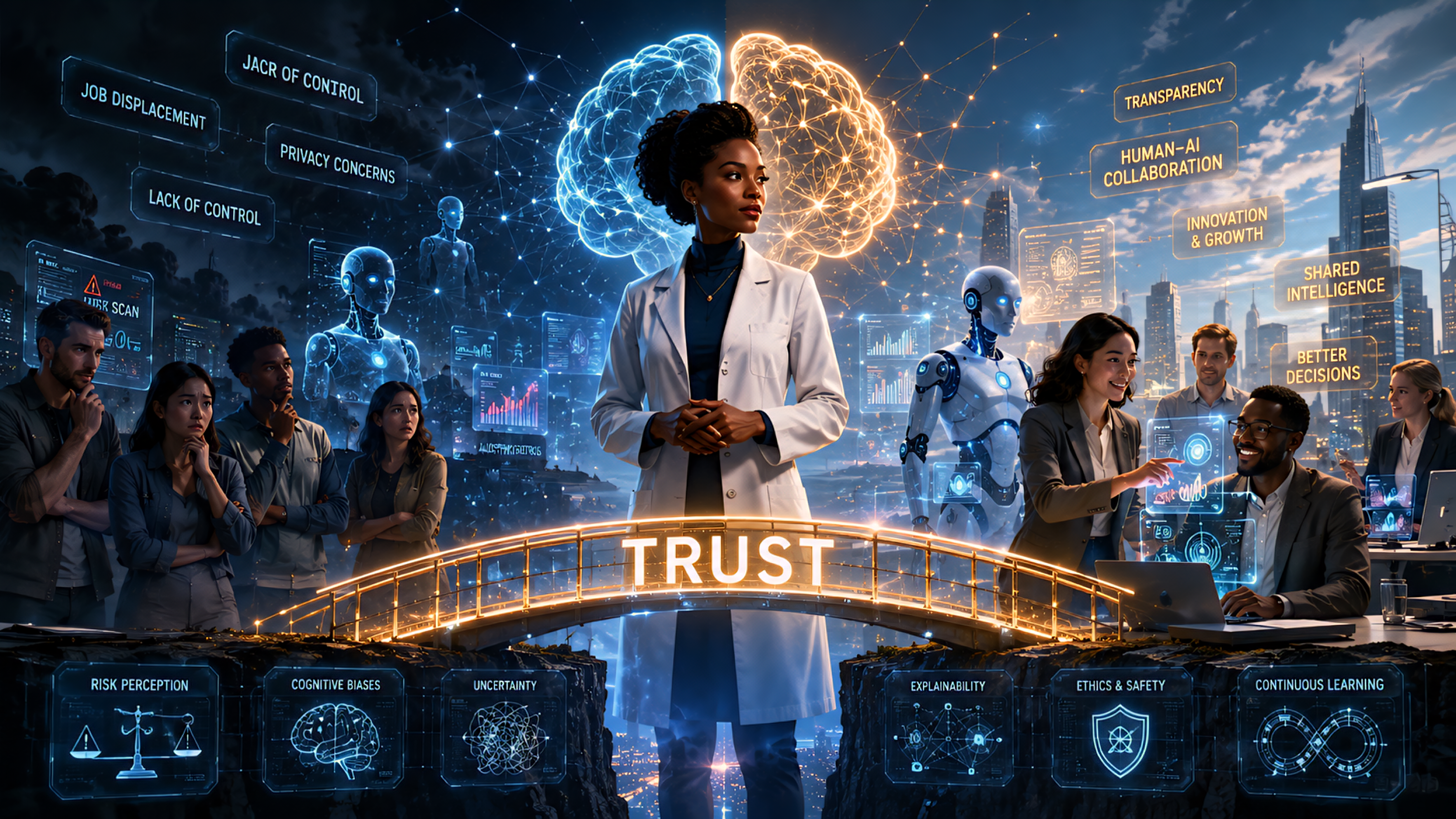
Common psychological concerns include:
Losing control
Job displacement
Privacy invasion
Incorrect decisions
Lack of transparency
Dependence on machines
When people don’t understand how AI reaches conclusions, uncertainty increases—and uncertainty often creates anxiety.
Risk Perception Is Emotional, Not Always Rational
Psychological research shows that humans rarely judge risk objectively.

Instead, we rely on emotional shortcuts called heuristics.
Examples include:
Availability Bias
If someone constantly reads news about AI scams or deepfakes, they may believe AI is mostly harmful.
Negativity Bias
Negative experiences are remembered more strongly than positive ones.
One AI mistake can outweigh dozens of successful interactions.
Loss Aversion
People fear losing something they already possess more than they value potential gains.
This explains why workers often fear automation before experiencing its benefits.
Familiarity Builds Confidence
People usually trust technologies they use regularly.
Consider smartphones.
Twenty years ago they seemed unnecessary.
Today most people depend on them every day.
The same pattern is emerging with AI.
The more positive interactions people have with AI, the more comfortable they become.
Experience gradually replaces uncertainty with confidence.
Personality Differences Matter
Psychologists have found that personality influences technology adoption.
People high in openness to experience often:
Enjoy experimentation
Learn new tools quickly
Adapt to change
View AI as an opportunity
Meanwhile, individuals who value stability and predictability may require more evidence before embracing emerging technologies.
Neither approach is inherently right or wrong—they simply reflect different ways of managing uncertainty.
Social Influence Shapes Trust
Humans are social learners.
We often decide whether something is trustworthy by observing others.
If trusted friends, teachers, or colleagues successfully use AI, we become more willing to try it ourselves.
This phenomenon is known as social proof.
Communities play a significant role in how quickly AI becomes accepted.
Transparency Builds Trust
People trust systems they understand.
When AI explains:
why it produced an answer,
what information it used,
where uncertainty exists,
users are more likely to accept its recommendations.
Explainable AI is therefore becoming increasingly important in healthcare, education, finance, and government.
Human-AI Collaboration Creates Confidence
The goal should not be replacing human judgment.
Instead, AI works best as a collaborator.
A doctor supported by AI.
A teacher assisted by AI.
A psychologist using AI for research while maintaining empathy and ethical decision-making.
This partnership allows humans to combine emotional intelligence, creativity, and ethical reasoning with AI’s speed and analytical power.
Building Healthy Trust in AI
Healthy trust is different from blind trust.
Responsible AI users should:
Verify important information.
Understand AI’s limitations.
Use AI as an assistant, not a replacement for critical thinking.
Protect personal data.
Continue learning as AI evolves.
Balanced trust leads to better decisions than either complete skepticism or unquestioning acceptance.
Looking Ahead
As AI becomes integrated into everyday life, trust will become one of the defining psychological challenges of the digital age.
The future belongs not to those who fear every new technology, nor to those who trust it blindly.
It belongs to those who understand how trust is built, maintained, and earned.
When humans approach AI with curiosity, critical thinking, and responsible use, technology becomes more than a tool—it becomes a partner in solving problems, expanding creativity, and improving lives.
AI is not just changing technology.
It is changing how humans learn to trust.
Conclusion
The psychology of trust reminds us that acceptance of AI is not determined solely by technical performance. It is shaped by emotion, experience, personality, social influence, and perceived risk. By making AI systems more transparent, educating users, and encouraging human-AI collaboration, we can build confidence without
abandoning critical thinking.
The future of AI will depend as much on human psychology as on technological innovation. Understanding trust is therefore one of the most valuable skills we can develop in an increasingly AI-powered world.
Discover more from Marychuks.com AI, Psychology, Business & CreativeVerse
Subscribe to get the latest posts sent to your email.