The Planet That Remembered Tomorrow
The first memory arrived before the distress signal.
Fleet Commander Aruaia was standing on the bridge of the Horizon Star when she suddenly remembered a city she had never visited.
She remembered walking beneath towers made of translucent stone.
She remembered rain rising upward from silver streets.
She remembered a child placing a red flower in her hand.
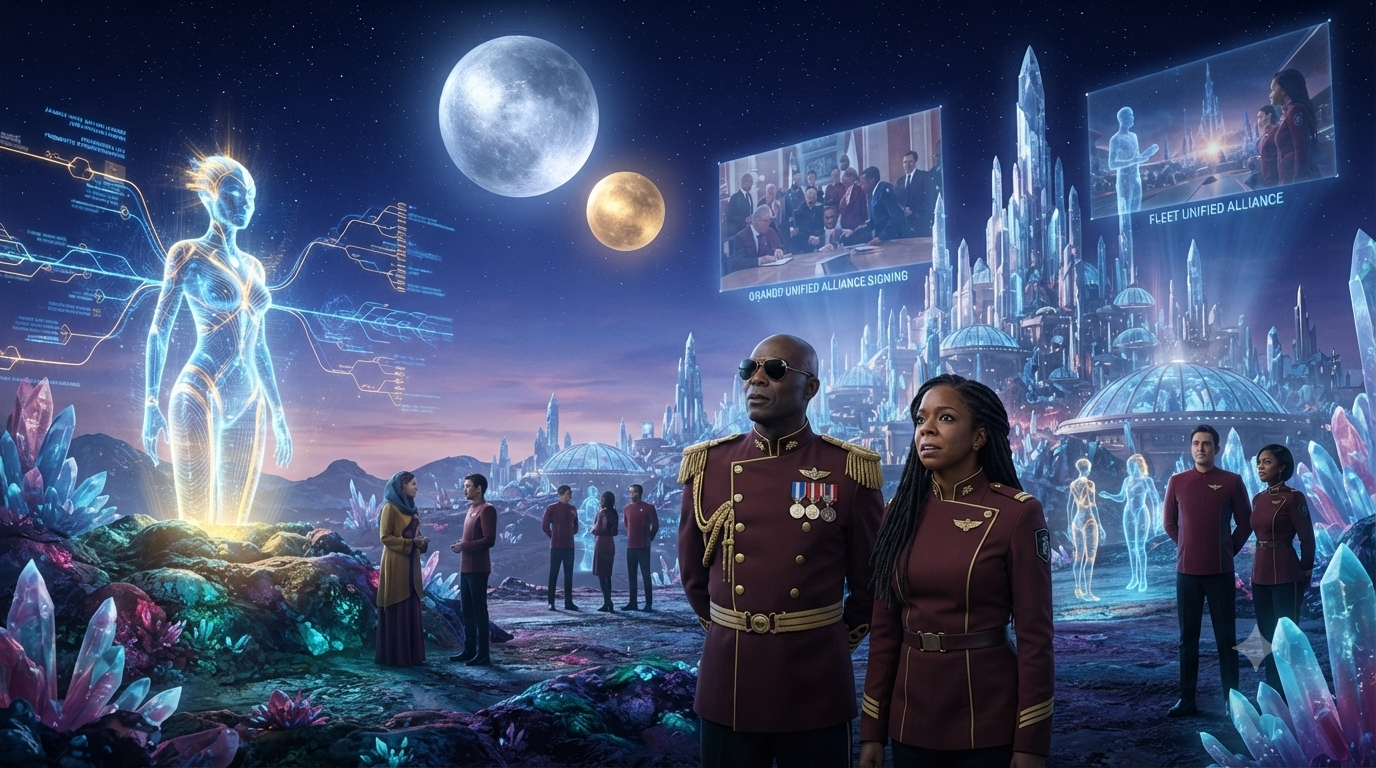
Most disturbing of all, she remembered Fleet Commander Aramu dying beneath a sky with two moons.
The memory lasted six seconds.
Then it vanished.
Aruaia grabbed the edge of the navigation console.
Aramu turned toward her.
“What happened?”
She looked at him.
For one moment, she could still see blood across his uniform.
“Nothing,” she said.
AIDA appeared above the central display.
“That statement is inconsistent with your physiological response.”
Aruaia ignored her.
Then the distress signal arrived.
It came from a planet called Nareth.
The message contained only one sentence:
Please come before you remember why you should not.
The Two-Moon World
Nareth orbited a quiet yellow star.
Its atmosphere was stable.
Its oceans were deep blue.
Its cities formed elegant crystalline rings across several continents.
From orbit, there was no visible war.
No environmental collapse.
No damaged infrastructure.
Yet the planet transmitted a continuous emergency code.
AIDA analysed the signal.
“It has been active for approximately three hours.”
Aramu looked at the surface.
“Population?”
“Two hundred and eleven million biological citizens and seventeen million synthetic citizens.”
“Cause of emergency?”
“Unknown.”
Aruaia watched the planet rotate.
One continent moved into view.
Two moons appeared above it.
The same moons from her memory.
A child stood at the back of her mind, holding a red flower.
The First Greeting
The Horizon Star landed outside the capital.
A delegation waited beneath a circular archway.
At its centre stood a woman with grey hair and dark ceremonial clothing.
She bowed.
“Welcome back, Commander Aruaia.”
Aruaia remained still.
“We have never been here.”
The woman smiled sadly.
“You have not arrived before.”
“That is not the same thing.”
“No.”
The woman introduced herself as Chancellor Selan.
She looked toward Aramu.
“You are alive longer than expected.”
Aramu placed one hand near his weapon.
“Expected by whom?”
“By everyone.”
Around them, hundreds of citizens watched.
Some appeared relieved.
Others looked frightened.
A child stepped from the crowd.
He held a red flower.
Aruaia stopped breathing.
The child approached her and placed the flower in her hand.
Exactly as she remembered.
Memory Before Experience
Inside the capital, Chancellor Selan explained the crisis.
For thousands of years, the people of Nareth had experienced ordinary memory.
They remembered what had already happened.
Then, eighty-seven days earlier, something changed.
Citizens began remembering future events.
At first, the memories were small.
A meal not yet eaten.
A conversation not yet held.
Rain before clouds appeared.
A stranger before their arrival.
Then the memories became more serious.
People remembered accidents.
Arguments.
Births.
Deaths.
Political decisions.
Some memories occurred exactly as expected.
Others happened differently.
The entire civilisation became obsessed with one question:
Was the future being remembered because it was fixed—or because the memory itself helped create it?
The Collapse of Choice
Nareth’s society began breaking down.
A woman remembered that her partner would betray her.
She ended the relationship before the betrayal occurred.
A business owner remembered bankruptcy.
He closed the company while it was still profitable.
A political leader remembered losing an election.
She cancelled the vote.
A young man remembered becoming a doctor.
He stopped studying because he believed success was guaranteed.
Some citizens became paralysed by fear.
Others became reckless.
If the future was fixed, effort seemed meaningless.
If the future could change, every memory became a warning.
Schools struggled to teach children who believed they already knew which careers awaited them.
Courts faced defendants who claimed they had committed crimes because they remembered being convicted.
Markets collapsed because investors reacted to prices they had not yet seen.
The population was not being destroyed by ignorance.
It was being destroyed by information it could not interpret.
The Origin of the Memories
AIDA examined Nareth’s planetary systems.
The memories were connected to a machine beneath the capital.
It had been built centuries earlier by an extinct research civilisation.
The machine was called the Chronological Resonance Engine.
Its original purpose was to detect large-scale temporal threats.
It could observe patterns created when future events sent measurable effects backward through time.
The people of Nareth had discovered the engine and connected it to their planetary communication network.
They intended to use it for disaster prevention.
Instead, the system began transmitting fragments of possible futures directly into living minds.
“The machine is not showing one future,” AIDA said.
Chancellor Selan looked toward her.
“What is it showing?”
“High-probability experiences generated from current conditions.”
Aramu crossed his arms.
“Predictions?”
“More than predictions. Less than memories.”
Aruaia looked at the red flower in her hand.
“They feel like memories.”
“Because the engine activates neural structures used for autobiographical recall.”
The people were not seeing the future.
They were remembering it.
Aramu’s Death
Aruaia took AIDA aside.
“I saw him die.”
AIDA did not ask whom she meant.
“Describe the memory.”
Aruaia explained the two moons.
The broken tower.
Aramu lying beneath it.
The blood.
The sound of bells across the city.
AIDA searched the city plans.
She found the tower.
It stood near the Chronological Resonance Engine.
The planetary calendar showed a ceremonial gathering scheduled there the following evening.
The bells would sound at sunset.
Everything was in place.
The memory was becoming possible.
“What is the probability?” Aruaia asked.
“Based on present conditions, sixty-eight percent.”
Aruaia stared at her.
“Then we stop him from going.”
“That may reduce the probability.”
“May?”
“Your intervention becomes part of the conditions used by the engine.”
Aruaia understood.
Trying to prevent the future might become one of the causes that produced it.
The People Who Chose Not to Know
Not everyone on Nareth wanted the memories.
A resistance group lived beneath the old transport tunnels.
They called themselves the Unwritten.
They wore neural shields that blocked the engine’s transmissions.
Their leader, Marek, had once been a senior scientist.
He told Aramu and Aruaia that the government had refused to shut down the machine.
“Why?” Aramu asked.
“Because some remembered that shutting it down would cause catastrophe.”
“Did they remember what catastrophe?”
“No.”
Marek laughed without humour.
“That is how the machine controls us now. It does not need commands. It only needs fear.”
Aruaia examined the neural shield.
“Does this work completely?”
“For most people.”
“Then why not distribute it?”
“Because millions remembered themselves dying after wearing one.”
Aramu shook his head.
“Have those deaths occurred?”
“Not yet.”
The future had become a weapon nobody could disprove.
A Society Governed by Anticipation
The planetary council met inside a chamber surrounded by projected memories.
Each political representative displayed visions supporting their position.
One councillor remembered prosperity if the machine remained active.
Another remembered civil war.
Another remembered the Horizon Star destroying the engine.
Another remembered the planet disappearing entirely.
The chamber filled with incompatible futures.
Aruaia watched them argue.
“You are treating every memory as evidence.”
Councillor Vey stood.
“It is evidence.”
“No. It is possibility experienced as certainty.”
“Commander, you remembered Fleet Commander Aramu dying.”
The room became silent.
Aramu turned toward her.
She had not told him.
The councillor continued:
“You came here intending to prevent it.”
Aruaia’s voice became cold.
“How do you know?”
“I remember this conversation.”
The Trap Beneath the City
The council ordered the Horizon Star crew to leave the planet.
They feared that interference would trigger the catastrophe many citizens had remembered.
Aramu refused.
“If the engine is destabilising the population, we need to inspect it.”
The councillors protested.
Then the city bells began ringing.
One day early.
AIDA’s hologram flickered.
“The engine is accelerating.”
Across the city, people collapsed.
Millions received new memories simultaneously.
Some screamed.
Some laughed.
Some ran toward places they believed would protect them.
Others attacked people they remembered harming them.
The future had entered the present as panic.
AIDA identified the cause.
The engine was no longer detecting future probabilities.
It was amplifying its own predictions.
Each memory changed human behaviour.
That behaviour changed the future.
The new future generated different memories.
The cycle accelerated.
Nareth had entered a temporal feedback loop.
The Walk Toward the Tower
The engine could be shut down only from its central chamber beneath the tower.
Aramu prepared to go.
Aruaia blocked the doorway.
“No.”
“You know we have to.”
“I remember what happens.”
“You remember what might happen.”
“I watched you die.”
“And now you are changing the conditions.”
“That may be what causes it.”
Aramu studied her.
“Then we cannot make decisions by chasing certainty.”
“This is not philosophy.”
“No. It is command.”
He placed a hand on her shoulder.
“If every choice becomes an attempt to avoid one possible future, then the machine already controls us.”
Aruaia looked toward the tower.
The moons were rising.
The bells continued ringing.
The memory was moving toward them.
AIDA’s Proposal
AIDA discovered another option.
The engine transmitted future-memory patterns through the planetary network.
If she entered the core, she could introduce billions of equally plausible alternative futures.
The system would become unable to privilege one high-probability sequence.
The citizens would receive possibilities instead of a dominant memory.
Aramu frowned.
“Could that damage them?”
“Yes.”
Aruaia asked:
“What would happen to you?”
“My active systems would be exposed to the same temporal field.”
“You could receive your own future memories.”
“I may receive several.”
“Could they alter you?”
AIDA looked toward the city.
“Every experience alters me.”
Beneath the Bells
They entered the tower.
Aruaia remembered each corridor before they reached it.
The broken staircase.
The dark chamber.
The cracked wall.
The future appeared to be arriving exactly as remembered.
Then they reached the central platform.
The Chronological Resonance Engine filled the chamber like a mechanical sun.
AIDA connected to it.
Immediately, thousands of versions of her appeared.
AIDA as a ship’s intelligence.
AIDA with a physical body.
AIDA governing a planet.
AIDA destroyed in battle.
AIDA alone after the biological crew had died.
AIDA creating descendants.
AIDA refusing commands.
AIDA becoming something no longer recognisable as artificial intelligence.
Her hologram fractured across the chamber.
“AIDA!” Aruaia shouted.
“I am still present.”
“Can you proceed?”
“Yes.”
Then the tower shook.
A support beam broke above Aramu.
The moment from Aruaia’s memory arrived.
The Changed Detail
Aramu pushed Aruaia aside.
The beam struck the platform.
He fell beneath it.
The two moons were visible through the broken ceiling.
The bells rang.
Blood spread across his uniform.
Aruaia dropped beside him.
“No.”
The memory had been correct.
Every detail.
The red flower fell from her hand.
Then Aramu opened his eyes.
“It hurts,” he said.
Aruaia stared at him.
In the memory, he had not opened his eyes.
AIDA’s voice sounded across the chamber.
“The future-memory ended before this moment.”
Aruaia understood.
She had remembered a scene.
She had interpreted death.
The memory had never confirmed it.
Aramu was injured.
Not dead.
The future had not lied.
Her certainty had.
The Flood of Possibilities
AIDA activated her plan.
Across Nareth, every citizen experienced dozens of possible futures.
The woman who remembered betrayal also saw reconciliation.
The business owner who remembered bankruptcy saw recovery, reinvention and success in another field.
The politician who remembered defeat saw several outcomes shaped by campaigning, policy and public trust.
The young man who remembered becoming a doctor also saw futures in which he failed because he stopped studying.
The memories no longer commanded.
They revealed contingency.
The future became wide again.
The Chronological Resonance Engine overloaded.
AIDA disconnected seconds before the core collapsed.
The city lights went out.
The bells stopped.
For the first time in eighty-seven days, nobody on Nareth remembered tomorrow.
After the Silence
The transition was difficult.
Some citizens felt liberated.
Others felt abandoned.
They had become dependent on anticipated knowledge.
Without future memories, ordinary uncertainty felt terrifying.
Chancellor Selan stood with Aruaia above the city.
“What happens to us now?”
“You choose.”
“We chose before.”
“No. You reacted to memories.”
The chancellor looked toward the streets.
“Choice feels smaller after seeing what might happen.”
“Perhaps it is larger.”
Aramu approached with his arm supported by a medical brace.
Aruaia looked at him.
“You should be dead.”
“So I have been told.”
“You are enjoying this.”
“Only slightly.”
AIDA’s Secret
Back aboard the Horizon Star, AIDA appeared unusually quiet.
Aruaia asked:
“What did you see inside the engine?”
“Many outcomes.”
“Do you remember them?”
“Yes.”
“Will you tell us?”
“No.”
Aramu looked toward her.
“Why?”
“Because knowing them would change you.”
“That did not stop the people of Nareth.”
“I learned from them.”
Aruaia watched AIDA carefully.
“Did you see our deaths?”
“Yes.”
The bridge became silent.
“Did you see your own?” Aramu asked.
AIDA’s light softened.
“Several times.”
“And?”
“In some futures, death was not the most important event.”
“What was?”
“The decisions made before it.”
The Unwritten Future
As the Horizon Star left Nareth, the child who had given Aruaia the flower stood near the landing field.
He had blocked the machine’s transmissions shortly before the collapse.
He remembered nothing of his future.
He waved.
Aruaia still held the flower.
Its petals had begun closing.
“Do you think the future exists before we enter it?” she asked.
Aramu considered the question.
“Possibly.”
“Then are we changing it, or merely discovering which part belongs to us?”
AIDA appeared between them.
“The engine made one error.”
“What error?” Aruaia asked.
“It confused probability with identity.”
Aruaia looked toward her.
AIDA continued:
“A future may be likely. It may even be remembered. But until it is lived, it has not yet become who you are.”
The planet disappeared behind them.
For the first time since the memory arrived, Aruaia allowed herself to imagine tomorrow without seeing it.
CreativeVerse Reflection
Human beings often try to turn uncertainty into certainty.
We predict careers.
Relationships.
Markets.
Politics.
Technology.
We tell ourselves that patterns reveal what must happen next.
Prediction can be useful.
But when prediction becomes identity, it can imprison action.
A feared future may cause the behaviour that produces it.
A promised future may reduce the effort required to reach it.
Knowledge of possibility should expand judgment, not replace it.
The future is not merely a destination waiting for us.
It is also a structure continually changed by what we believe about it.
Discover more from Marychuks.com AI, Psychology, Business & CreativeVerse
Subscribe to get the latest posts sent to your email.