
Can information exist before the event that creates it? Space gives this question an extraordinary appearance because the universe never shows every observer the same “now.” It shows each observer the information that has had enough time to reach them.
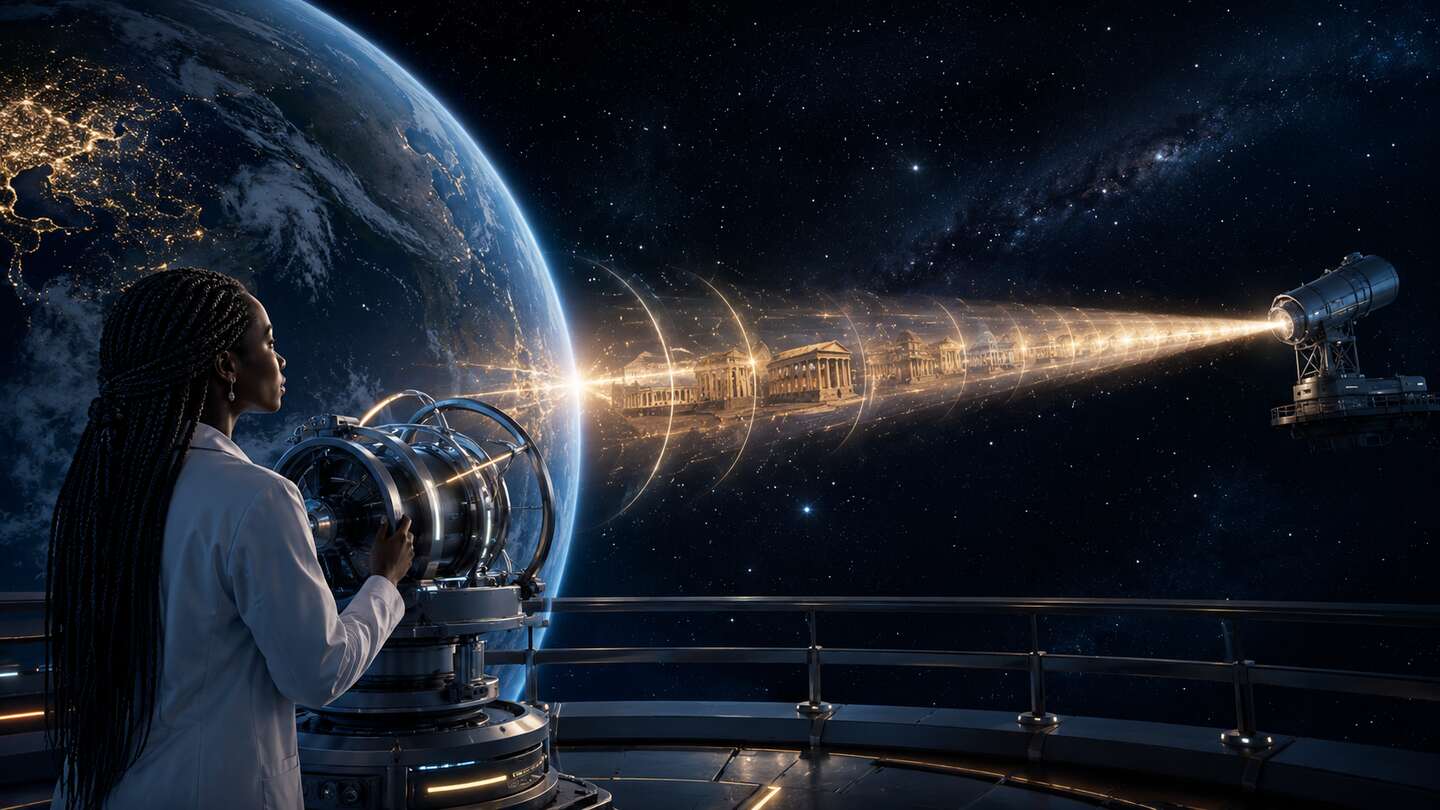
Imagine an observer exactly 2,000 light-years from Earth. The Earth-light arriving there today began its journey roughly 2,000 years ago. In principle, that light carries information about our planet during the era of the Roman Empire. Light from modern cities, aircraft and satellites would not arrive at that location for roughly another 2,000 years.
Does that mean information about ancient Rome exists before Rome? No. But it reveals something just as fascinating: information can survive the event and continue travelling long after the local moment has passed.
Every act of seeing is a look into the past
Light travels at approximately 300,000 kilometres per second. That is extraordinarily fast, but it is not instantaneous. A light-year is therefore a measure of distance: the distance light travels during one Earth year.
NASA explains that distant observation is lookback time. We see the Sun approximately eight minutes after its light leaves it. Proxima Centauri, our nearest neighbouring star, appears more than four years in the past. The Andromeda galaxy appears as it was around 2.5 million years ago.
Even the person sitting across a room is seen a tiny fraction of a second in the past. Human life feels immediate because the delay is far below conscious perception. Astronomy simply stretches the delay until it becomes impossible to ignore.
The event creates the record
In ordinary causal physics, a record cannot carry information about an event before the event occurs. A Roman building must first reflect sunlight. Those altered photons then travel outward. Before that interaction, they cannot contain an image of that building.
This gives us three distinct things:
- The event: matter and energy interact at a particular place and time.
- The information carrier: reflected or emitted light leaves the event.
- The observation: a detector receives enough of that light to reconstruct something about what happened.
The observation may occur centuries, millennia or billions of years after the event. That does not move the information backwards in time. It means the universe stores parts of its history in travelling signals.
Could someone 2,000 light-years away really watch ancient Rome?
This is where the popular thought experiment needs an important correction. The correct Earth-light would be passing that distant observer now, but receiving photons is not the same as resolving people or buildings.
At 2,000 light-years, Earth would be unimaginably small and buried in the glare of the Sun. Individual Roman buildings would occupy a tiny fraction of that already minute image. A telescope would need an extraordinary effective aperture or interferometric baseline, exceptional suppression of starlight and enough photons to reconstruct surface detail. Our current instruments cannot remotely provide a live street-level film of an Earth-like planet at that distance.
NASA’s Roman Space Telescope direct-imaging programme illustrates the scale of the present challenge: it is designed to demonstrate technology by imaging large Jupiter-like worlds around nearby Sun-like stars. Imaging Earth-sized worlds is a harder future objective; resolving their individual buildings is many orders of magnitude beyond that.
So the science supports the time delay, but not the effortless telescope shown in many viral illustrations.
Information before an event—or prediction?
Sometimes we appear to possess information before an event because we can predict it. Astronomers can calculate an eclipse. Meteorologists can forecast a storm. A psychologist may recognise a behavioural pattern before its next expression.
But prediction is not the same as receiving the future event’s record. Prediction uses present information and a model to assign possible future outcomes. The actual event can still surprise us because the model, measurements or underlying system may be incomplete.
This distinction matters in AI too. A system that predicts the next event has not necessarily accessed the future. It has compressed patterns from the past and present into a probability distribution.
There is no single universal visual present
Our everyday phrase “what is happening right now?” assumes a shared present. Across astronomical distances, observers receive different slices of history. An observer near Earth sees modern London. An observer 100 light-years away receives Earth-light from roughly a century ago. An observer 2,000 light-years away receives much older light.
These observers are not seeing different realities. They are receiving different information because they occupy different positions in spacetime.
The universe as an expanding archive
Here is the philosophical beauty: an event may be over locally while its information is still beginning new journeys elsewhere. The birthday candle has gone out, yet photons from the flame continue moving through space. The person has left the room, yet sound waves, memories, photographs and digital records continue carrying traces.
Space turns that ordinary principle into a cosmic archive. The past is not sitting in one celestial library waiting to be opened. Fragments of it are distributed through expanding shells of light, gravitational effects, matter and memory.
So, can information exist before its event?
Not as a causal record of an event that has not happened. We can hold plans, predictions and probabilities before an event, but the event-specific information is produced when the event occurs and interacts with its environment.
What space teaches us is different: information does not need to arrive everywhere when it is created. It can cross the universe slowly by cosmic standards, allowing one world’s past to become another observer’s present evidence.
That is not information travelling backwards. It is history still travelling forwards.
Continue exploring with CreativeVerse: The Light Beyond the Horizon, revisit The Beginning to the End of the Universe, and consider how observation shapes knowledge in The AI Verification Habit.
Question for readers: If a distant civilisation receives Earth’s ancient light today, whose “present” does that history belong to?
Sources
- NASA: Time Travel—Observing Cosmic History
- NASA Space Place: What Is a Light-Year?
- NASA Roman Space Telescope: Direct Imaging
- NASA: How Does Webb See Back in Time?
Discover more from Marychuks.com AI, Psychology, Business & CreativeVerse
Subscribe to get the latest posts sent to your email.